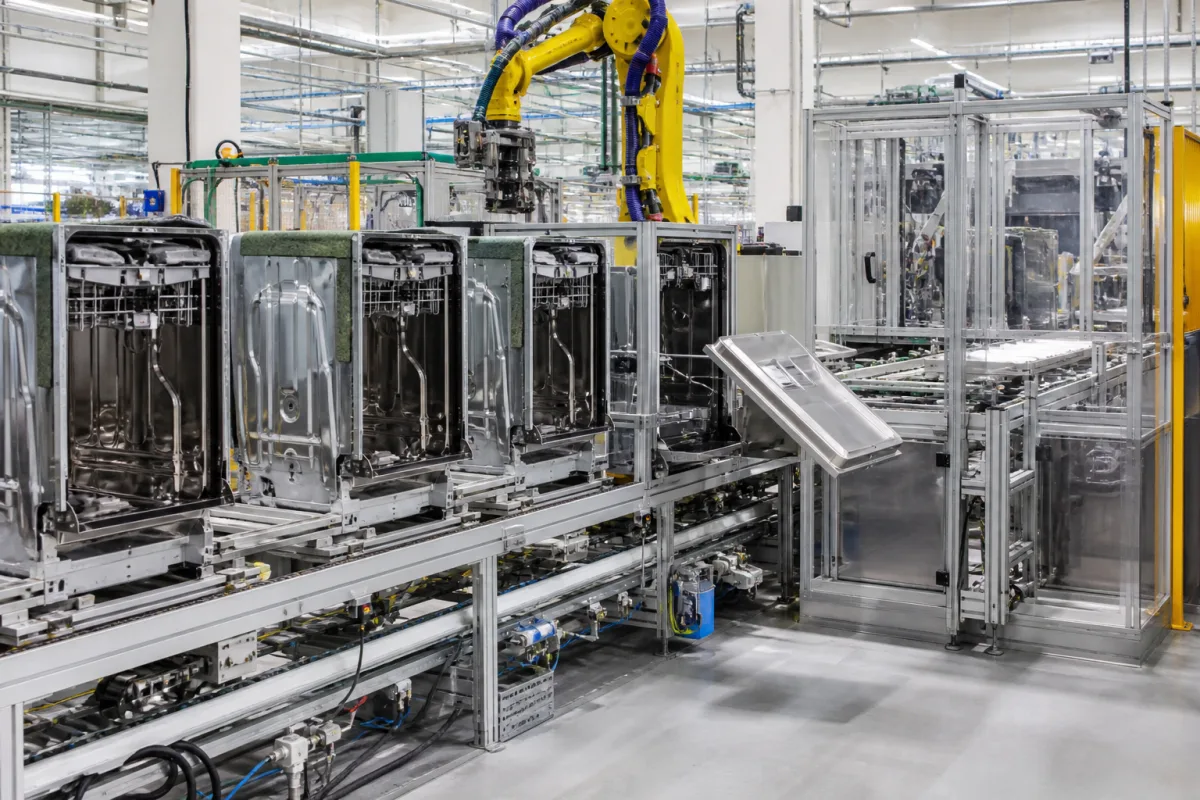
Automated dishwasher production line: stainless tub assembly, line cycle time and end-of-line safety testing
Dishwasher manufacturing lines · Stainless tub roll-seaming, cycle time and line capacity, stamping dies, and end-of-line earth bond and hipot tests
This page covers the production line that builds dishwashers: stamping and roll-seaming the stainless tub, moving tubs through assembly stations, and running electrical safety tests on every finished appliance. Ask three things first: what cycle time and hourly capacity each section reaches and with what rejection rate, which operations are automated versus manual for your volume and budget, and which routine tests the end-of-line stations perform and with what limits.
Production lines for household dishwashers, including tub forming and assembly sections, assembly conveyors and end-of-line test stations, supplied as integrated turnkey lines. Industrial robots used for assembly, including six-axis, SCARA, delta and collaborative robots, are covered on the Assembly robot page. Commercial warewashing machines and the dishwashers themselves are outside this page.
CNFX editorial research · Sources checked October 12, 2026 · 3 sources
Size the tub line: cycle time, capacity and stations
Wuxi IDO Technology describes its dishwasher tub assembly line for stainless steel tubs as built around a Model 60 liner seaming machine with top, bottom and middle plates, feeding mechanisms and a post-seaming unloading and transfer device, in four workstations A1–A4. It lists a cycle time of 20 seconds or less for the automated section and each standalone machine, whole-line capacity of at least 160 units per hour, a product rejection rate of 0.5% or less and an air source of 0.5–0.6 MPa. [1]
The stations IDO describes are single-piece conveying of top and bottom plates with profile-matching fixtures on a looping conveyor, which includes an elevated section needing 1.8–2.0 m of clear height beneath it; a pre-assembly station where a robotic arm with three independent clamping systems positions the top, middle and bottom panels; a roll-seaming station where the three panels are joined by roll-hemming in a stationary die, with two servo motors positioning the parts and pneumatic fixtures holding the middle panel; and an unloading station where a third robotic arm on a shared gantry, driven by servo motor and rack and pinion, moves the flanged liner onto a rail-guided trolley. [1]
IDO states that whether each part of the line is automated or manual depends on the client's requirements, cycle time, investment budget and available space. [1] Editorial calculation: a 20 s cycle allows at most 3,600 ÷ 20 = 180 cycles an hour at one station, against the ≥160 units/h IDO gives for the whole line; at 160 units/h, a 0.5% rejection rate is 0.8 tubs an hour, or about 6 in an 8-hour shift of 1,280 tubs.
Give the supplier the tub drawings and material, the models and variants to run, target units per hour and shifts, the operations you want automated, available floor space and height, and your existing presses and conveyors.
02
Plan end-of-line safety and function testing
Seaward, a test-equipment maker, summarises the routine production-line tests that BS EN 60335-1 recommends in its Annex A: an earth bond test at a current above 10 A from a source below 12 V, with a 0.1 Ω fail limit for products without a supply lead and 0.2 Ω for products fitted with one, and no specified test time (Seaward recommends at least 2 s); a functional or run test; and a dielectric withstand (hipot) test. [3]
For the hipot test Seaward lists minimum voltages of 1,000 V AC for basic insulation and 2,500 V AC for double or reinforced insulation where the operating voltage is above 150 V, 800 V and 2,000 V AC at 150 V or below, and 400 V for Class III appliances, applied for at least 1 s with a 5 mA trip current that can be raised where higher leakage is known; a DC voltage of 1.5 times these values is an alternative. [3]
Editorial note: these values are a test-equipment maker's summary; confirm the limits against the edition of EN 60335-1 or IEC 60335-1 and the national adoption that applies to the market, and add any water-leak or function checks your dishwasher design needs.
03
Tub stamping dies, tub assembly line and end-of-line test sections
The sections below come from one line builder and one test-equipment maker; IDO describes its projects as customized turnkey solutions. [1]
Section
What the source states
Fix in the order
Tub stamping dies
Dies for tub top, tub bottom, inner door, outer door and tub wrapper. [2]
Part list and press tonnage.
Tub assembly line
≤20 s cycle; ≥160 units/h; ≤0.5% rejection; 0.5–0.6 MPa air. [1]
Capacity and variants.
End-of-line test stations
Earth bond, function and hipot tests per EN 60335-1 Annex A as summarised by Seaward. [3]
Test list and limits.
04
Conveyors, robots, roll-seaming, dies and test stations along a dishwasher line
Module
Role
Fix in the order
Conveying system
Moves plates and tubs between stations; looping conveyor with fixtures. [1]
1 company lists this product among what they make. Company figures are quoted from each
company's own website; every card states where the relationship came from.
Wuxi Ido Technology Co., Ltd.
Manufacturing site to be confirmed for the order
Lists a dishwasher tub assembly line and dishwasher stamping dies.
Explore company information and manufacturing capabilities, then discuss the scope of your project with a relevant supplier.
Share this page
Compiled and source-reviewed by the CNFX editorial team.
Each manufacturer above links to the page on that company's own website where the product is listed, with the date we checked it. How we source and review
· Page last updated 13 October 2026
Buyer questions
How fast is an automated dishwasher tub line?
Wuxi IDO lists a cycle time of 20 s or less and whole-line capacity of at least 160 units per hour, with a rejection rate of 0.5% or less. [1]
How are dishwasher tubs joined on the line?
IDO's line joins the top, middle and bottom panels by roll-hemming in a stationary die, with servo positioning and pneumatic fixtures. [1]
Which safety tests run at the end of the line?
Seaward's summary of EN 60335-1 Annex A lists an earth bond test above 10 A, a functional test and a hipot test, e.g. 1,000 V AC for basic insulation above 150 V operating voltage for at least 1 s. [3]
Sources and what still needs a direct check
Sources checked 2026-10-12. Wuxi IDO describes its own line and dies; Seaward, a test-equipment maker, summarises the routine tests of EN 60335-1.