DC isolators for PV · Current rating by voltage and pole wiring, DC-PV2 and DC-21B categories, short-time withstand, impulse voltage, enclosure IP and UV, terminals and losses
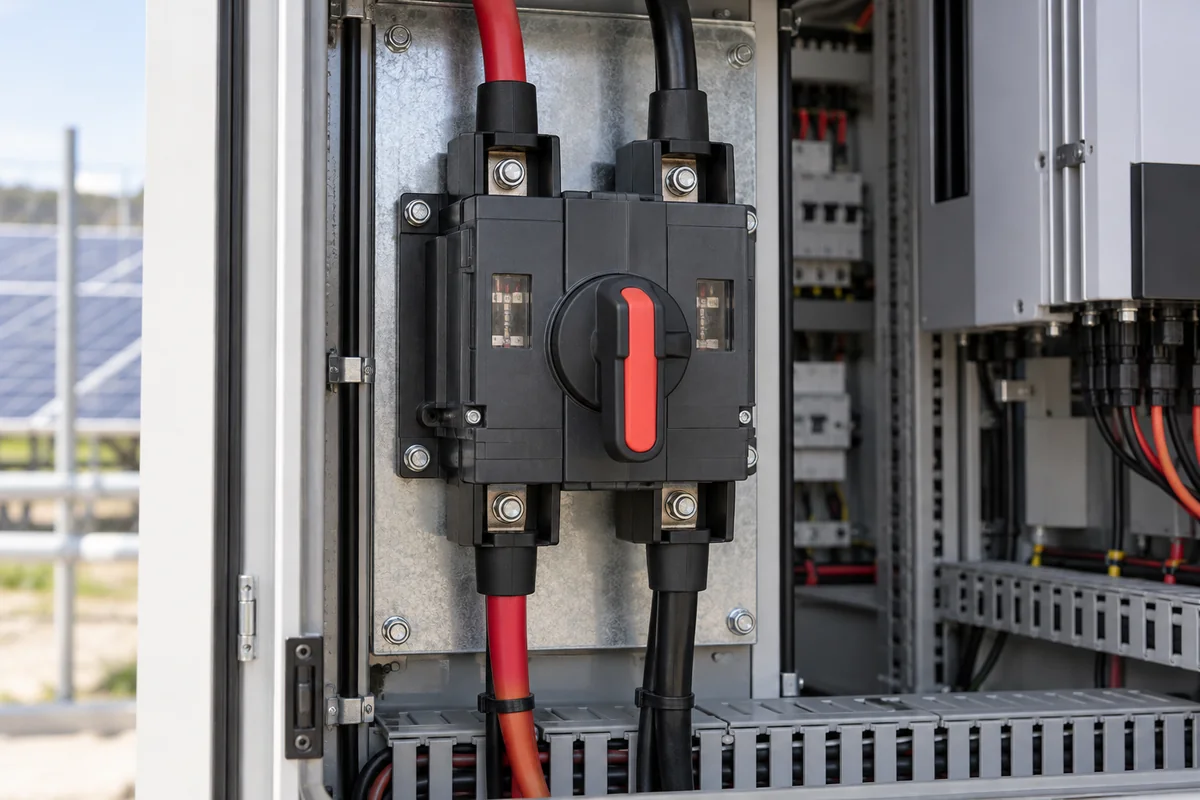
A DC switch or isolator is a manually operated rotary switch-disconnector, with silver-plated knife-edge contacts in a series of switching chambers inside a UV-resistant enclosure, that makes, breaks and visibly isolates DC circuits such as solar PV strings between the array and the inverter. Ask three things first: what current it is rated for at your maximum string voltage with your chosen pole wiring, which utilization category and standard it is tested to, and what enclosure, terminal and environmental ratings the installation needs.
Manually operated DC switch-disconnectors and isolators for PV strings, batteries and DC distribution, enclosed or panel-mounted. DC circuit breakers, fuses and combiner boxes sold without isolators, and AC isolators are outside this page.
CNFX editorial research · Sources checked October 12, 2026 · 4 sources
Eris's ERS01324DC data sheet describes a 4-pole, 32 A DC switch-disconnector for photovoltaics with a maximum rated voltage Ui of 1,500 V, tested to IEC 60947-3 categories DC-PV2 and DC-21B. Its rating depends on how the poles are wired: at 600 V DC every arrangement carries 32 A; at 1,200 V DC the two arrangements without series poles (A2+2 and A4) carry 13 A, while 2 or 3 poles in series (A4O, A4B) carry 32 A; at 1,500 V DC the figures are 6 and 5 A versus 23 A. Some arrangements use bridging links supplied with the switch. [1]
Its sister model ERSP324DC, rated 1,000 V and 32 A, lists 32 A at 500 V but 13 A at 600 V and 9 A at 800 and 1,000 V with no poles in series, and 32 A up to 1,000 V when poles are wired in series. [2]
Editorial calculation: a single string whose cold open-circuit voltage reaches about 1,100 V needs a configuration rated at least at the 1,200 V level: with 2 or 3 poles in series the ERS01324DC carries 32 A, enough for a string current of, say, 15 A, but without series poles it would be limited to 13 A. Size the isolator from the string's maximum voltage and current, and wire it exactly as the rating table shows. [1]
ABB's catalogue Switches for PV applications (1SCC301009K0201) shows the same series-pole logic in another range: OTDC16, 25 and 32 switch-disconnectors carry 16, 25 and 32 A in DC-21B at 660 V DC with two poles in series, 1,000 V with three, and 1,000 V or 2 × 660 V with four. The enclosed OTDCP versions list Ui of 1,250 V at pollution degree 2 and 1,000 V at pollution degree 3, 6 kV dielectric strength for 1 minute, 8 kV impulse withstand, and IP65 UV-resistant enclosures with cover interlock and padlockable handle. Its UL-listed OTDC100 and OTDC200 for NEC Article 690 PV systems are rated 1,000 V DC at 100 and 200 A, −20 to +50 °C, with a 5 kA short-circuit rating at 1,000 V DC and a mechanical endurance of 4,000 operations, which ABB says to divide by two for operating cycles. [3]
Editorial calculation: 4,000 operations is 2,000 on-off cycles; at one isolation per week for maintenance that is about 38 years (2,000 ÷ 52), so for routine PV isolation the electrical rating and enclosure ageing matter more than mechanical endurance. [3]
Give the supplier the maximum string open-circuit voltage at the coldest temperature, the maximum current, the number of strings per isolator, the required utilization category (DC-PV2, DC-21B) and standard, pole wiring, enclosure IP and UV rating, cable size and glands, mounting, ambient temperature range, approvals and quantities.
02
Count the contacts in series and the enclosure temperature
Kraus & Naimer's photovoltaic catalogue shows how one 2-pole switch family reaches higher DC voltages by putting more contacts in series per circuit, using pre-assembled bridges. Its KG switch-disconnectors are to EN 60947-3 in utilization category DC-PV2, which the catalogue defines as connecting and disconnecting a PV circuit where severe overcurrent may occur and current can flow in both directions; the ratings are valid only if the pre-assembled bridges have not been modified. [4]
The enclosed versions are rated in IP66/67 fully insulated plastic housings for 50 °C over 24 hours with peaks up to 55 °C, with a second column for 60 °C with peaks up to 65 °C. Some ratings fall in the hotter column: the KG32B with 8 contacts per circuit at 800 V DC drops from 25 A to 20 A in DC-PV2, and the KG41B from 40 A to 35 A in DC-21B. Kraus & Naimer gives the insulation voltage Ui of 1,000 V for ungrounded or midpoint-grounded PV systems in overvoltage category III and pollution degree III. [4]
Editorial calculation: at 800 V DC the KG41B carries 20 A with 6 contacts per circuit and 32 A with 8, a 60% increase from two more contacts; at the 60 °C rating the KG32B keeps 80% of its 50 °C current (20 / 25 A). Its 1,000 V DC open-circuit limit is below the 1,500 V Ui of the Eris ERS01324DC, so the voltage class must be chosen from the string's cold open-circuit voltage before comparing currents. [4][1]
Ask each supplier for the rating table for the exact contacts-per-circuit arrangement, the enclosure temperature the current applies to, and the maximum PV open-circuit voltage, not only the switch's headline current. [4]
Check withstand, impulse voltage, losses and enclosure
The ERSP324DC lists a rated impulse withstand voltage (Uimp) of 8 kV, short-circuit making and short-time withstand currents of 1,700 A for 1 s, an insulation rating of 1,000 V, contact switching time under 5 ms with an operator-independent rotary mechanism, and an energy loss of 0.016 kW at maximum current. [2]
Both switches are in IP66 polycarbonate enclosures rated UL 94 V-0 with padlockable handles, rising-clamp terminals for 4–16 mm² cable, M4 terminal screws, pollution degree 3 and silver-plated, self-cleaning knife-edge contacts; the operating temperature is −40 to +120 °C for the ERSP324DC and −25 to +85 °C for the ERS01324DC. [2][1]
Editorial calculation: 16 W of loss at 32 A corresponds to a total contact-path resistance of about 16 ÷ 32² ≈ 16 mΩ; at a 15 A string current the loss would be about 3.5 W (scaling with the square of current). [2]
04
Compare what suppliers offer
Suppliers linked to this page list DC isolators or DC disconnect switches; each card links to the page reviewed.
Listings include DC isolator switches, waterproof isolating switches, DC disconnect switches up to 1,000 and 1,500 V, and DC isolator boxes.
05
Trace the isolator components
This is a functional reference built from the sources cited; it is not one maker's design.
Fill the specification fields with values for your array
A DC isolator quotation needs values for your array. The table explains each field, gives published values where a reviewed source states them, and says what to obtain from the supplier.
Explore company information and manufacturing capabilities, then discuss the scope of your project with a relevant supplier.
Share this page
Compiled and source-reviewed by the CNFX editorial team.
Published product pages show what a company offers, not tested performance. Confirm the legal seller, factory, test certificates and scope for your order. How we source and review
· Page last updated 13 October 2026
Buyer questions
Why does a DC isolator's current rating fall at higher voltage?
Breaking DC is harder at higher voltage; Eris's ERS01324DC carries 32 A at 600 V but 5–6 A at 1,500 V unless poles are wired in series. [1]
What is DC-PV2?
It is an IEC 60947-3 utilization category for DC switching in PV; the ERS01324DC is tested to DC-PV2 and DC-21B. [1]
How much power does a DC isolator dissipate?
Eris lists 0.016 kW at maximum current for its ERSP324DC. [2]
How many poles in series does a 1,000 V DC isolator need?
In ABB's OTDC16–32 range, two poles in series give 660 V DC and three give 1,000 V at the same 16–32 A DC-21B rating; four allow 1,000 V or 2 × 660 V. [3]
Sources and what still needs a direct check
Sources checked 2026-10-12. Eris publishes data sheets for its own DC isolators; ratings for your isolator must come from the supplier's data sheet and test certificates. ABB's PV switch catalogue gives a second maker's ratings, and Kraus & Naimer's photovoltaic disconnector catalogue adds ratings by contacts in series and enclosure temperature.