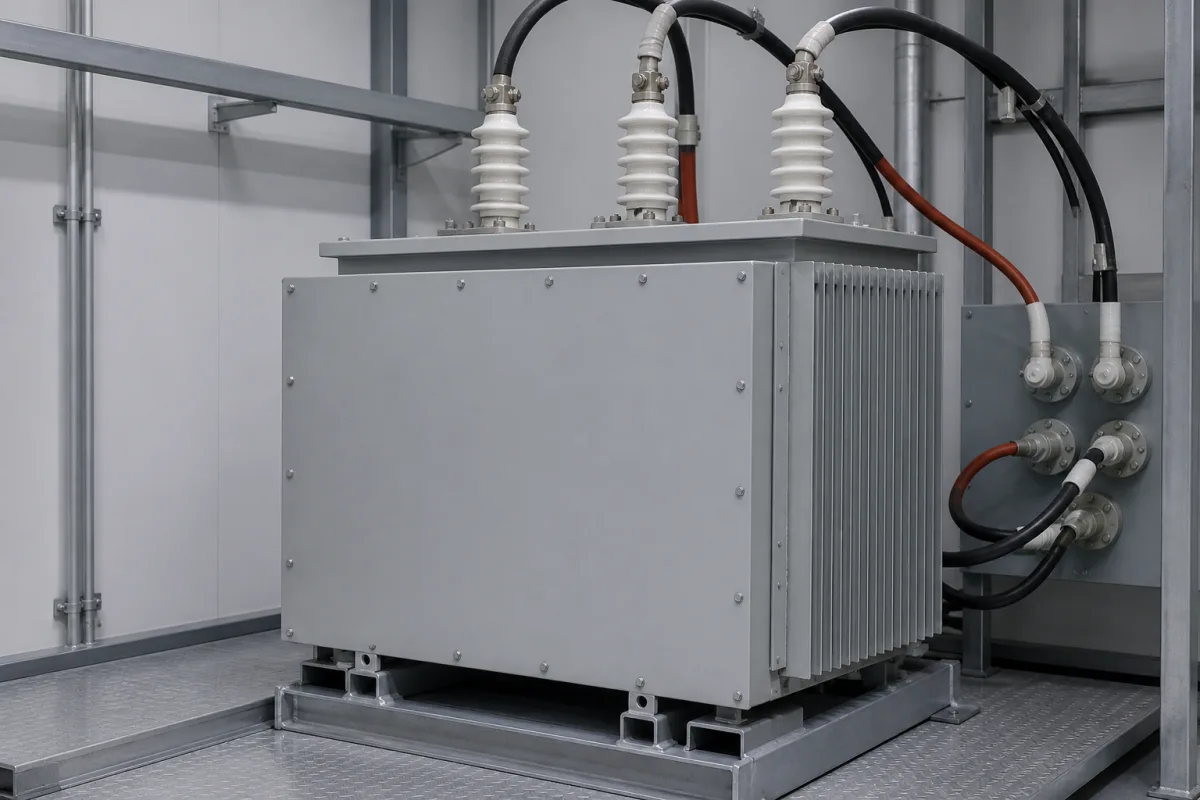
High-voltage generator for DC withstand and leakage-current testing (portable DC hipot set with voltage-multiplier column and control box)
Portable DC hipot sets · kV and mA rating per voltage-multiplier stack, ripple and regulation, microamp leakage metering, arrester and cable test modes
A DC high-voltage generator, sold as a DC hipot or DC dielectric test set, is a field instrument in two parts: a control box that sets and meters the test, and a high-voltage unit that rectifies and multiplies a medium-frequency AC supply into tens or hundreds of kilovolts DC. The test object is charged, held at a fixed voltage, and its leakage current is read. The buying questions are the kilovolt and milliamp rating you need, how smooth and stable the output is, how finely leakage current is measured, and whether the objects you test, especially aged extruded cable, should be tested with DC at all.
Portable DC high-voltage generators and DC dielectric test sets used for withstand and leakage-current tests on power cables, surge arresters, switchgear, transformers and rotating machines. AC test transformers and AC dielectric test sets are covered on the High-voltage test transformer page; regulated laboratory and OEM high-voltage supplies on the High-voltage power supply (HVPS) page. VLF test sets, impulse generators, X-ray tube generators, ignition modules and high-voltage generator sets for power generation are separate products.
CNFX editorial research · Sources checked October 12, 2026 · 4 sources
Kilovolt and milliamp ratings by multiplier column, with ripple and regulation
Wrindu's RDZG range shows how one control box is paired with multiplier columns of rising height: the higher the kilovolt rating, the taller and heavier the column, and the lower the current on offer. [1]
Wrindu gives rated current options of 2 to 10 mA for its 60–120 kV models and 2 to 5 mA for 200–350 kV. It lists a ripple coefficient of no more than 0.5%, voltage stability within 0.5% when the mains changes by ±10%, voltage regulation finer than 0.1%, and voltage measurement to ±0.5% ±2 digits with 0.1 kV resolution. Output polarity is negative, with a zero-voltage start. Wrindu notes that the column dimension is the diameter of the grading cap by the diameter of the insulating cylinder by total height. [1]
Weshine describes the same architecture: a medium-frequency voltage-doubling circuit driven by PWM and IGBT switches, run above 30 kHz to keep the instrument small and light. [2] Editorial calculation: if Wrindu's 0.5% ripple coefficient is read as a share of the output, a 120 kV set may carry up to 0.6 kV of ripple at full voltage. The complete 350 kV set weighs 24 + 9 = 33 kg against 6 + 5 = 11 kg for the 60 kV set.
State the highest test voltage your procedures call for, the capacitance of the largest object (long cable runs charge slowly), the mA you need to charge it, the polarity, and whether the column must go through doors or into vehicles.
02
DC withstand on extruded cable: acceptance of new runs versus field-aged XLPE
Megger presents the case for DC: compared with AC, DC test equipment uses far less power, charges highly capacitive samples fast, is easy to carry and costs less, and Megger states that the DC test can detect incipient breakdown without the possibility of damage to good insulation. [3]
Writing in EC&M, Wally Vahlstrom reports that research has questioned this for extruded cable. EPRI studies TR-101245 and EL-6902 concluded that DC hipot testing of field-aged XLPE cable reduces its life and increases water-tree growth, while DC testing of new medium-voltage cable before energising does not reduce cable life. The article quotes IEEE Std 400-2001 that service-aged XLPE tested with DC at the recommended levels may fail after return to service, and that even massive insulation defects in extruded insulation cannot be detected with DC at those levels. [4]
Per the same article, the standards reduced the recommended DC test duration from 15 minutes to 5, no longer endorse DC hipot as a maintenance test for extruded cable in service for more than five years, and still provide for DC as an acceptance test on newly installed extruded cable; DC remained effective on paper-insulated lead-covered cable. [4] Editorial note: the Megger statement and the EPRI findings come from different decades and different cable types; check the current edition of the test standard your owner or utility applies before buying a DC set for aged XLPE circuits.
Tell the supplier which objects you will test (new or aged cable and its insulation type, arresters, switchgear, motors) so it can say whether a DC set, a VLF set or both fit your procedures.
03
Microamp leakage metering and the arrester 0.75 U1mA function
The value of a DC test lies in the leakage current, so the ammeter matters as much as the kilovolts.
For zinc-oxide surge arresters, both Chinese makers build in a dedicated step. Wrindu fits a 75% MOA voltage button; Weshine describes a 0.75 U(DC 1 mA) function with automatic arrester testing, and an anti-impulse ammeter that sends its reading wirelessly to the main unit. Weshine also lists a 10-step test mode, an automatic boost mode for capacitive objects that avoids overcurrent trips, and seven selectable voltage steps from 0.05 to 5.0 kV on its 60–160 kV units. [1][2]
Megger sizes its 5 kV model for equipment rated 2.5 kV and below and its 15 kV model for equipment rated 7.5 kV and below, for step-voltage and proof tests. [3] Editorial calculation: both models therefore top out at twice the rating of the equipment they are specified for, and at full output the 15 kV model delivers 15 kV × 2 mA = 30 W against 5 kV × 5 mA = 25 W for the 5 kV model.
Ask where the ammeter sits (at high-voltage potential or in the return lead), its lowest range, whether guard terminals are provided, and how the arrester reference-voltage step is triggered and recorded.
04
Duty cycle, discharge protection and site conditions for field use
These sets are rated for intermittent work. Wrindu specifies under 30 minutes at rated load, operation at 0 to 40 °C and below 90% humidity, and altitude below 3,000 m. [1]
Wrindu lists overvoltage set-point, overcurrent and short-circuit discharge protection, plus disconnection and non-zero-start interlocks, and states the column can withstand direct discharge of a large capacitive sample to ground. [1] Weshine says its set withstands discharge at rated voltage without damage. [2] Megger fits input and output circuit breakers, an output overload relay and a zero-start interlock, and offers a resistance discharge stick as an accessory; its operating range is listed as 0 to 122 °F (−17.7 to +50 °C). [3]
Editorial note: a charged cable holds energy after the set switches off. Ask the supplier which discharge rod or resistor is supplied and its rating for the capacitance you test.
05
Data to send for a DC high-voltage generator
Paste it into your enquiry below or into an email to a maker, then replace every bracket.
Test objects: [cable type, insulation, new or aged, length; arresters; switchgear; machines]
Voltage and current: [maximum kV DC; mA needed to charge the largest object]
Output quality: [ripple; stability; polarity]
Metering: [lowest µA range; ammeter position; guard terminal]
Functions: [0.75 U1mA arrester step; step-voltage; timer; data export]
Site: [mains supply; temperature; altitude; transport limits]
Safety: [discharge rod; interlocks; earthing kit]
Explore company information and manufacturing capabilities, then discuss the scope of your project with a relevant supplier.
Share this page
Compiled and source-reviewed by the CNFX editorial team.
Each manufacturer above links to the page on that company's own website where the product is listed, with the date we checked it. How we source and review
· Page last updated 13 October 2026
Buyer questions
What ripple does a portable DC hipot set have?
Wrindu lists a ripple coefficient of no more than 0.5% for its 60–350 kV RDZG sets, with stability within 0.5% for a ±10% mains change. [1]
Should field-aged XLPE cable be tested with DC?
EC&M reports EPRI findings that DC hipot shortens the life of field-aged XLPE, and that the standards no longer endorse it as a maintenance test on extruded cable in service over five years; DC is still provided for as an acceptance test on new runs. [4]
What is the 0.75 U1mA function?
It is a dedicated step for zinc-oxide arrester testing, listed by Weshine as a 0.75 U(DC 1 mA) function and by Wrindu as a 75% MOA voltage button. [2][1]
How small a current can the set read?
Megger's 5 and 15 kV sets have a 0–5 µA lowest range; Wrindu gives 0.1 µA resolution on its anti-impact ammeter. [3][1]
Sources and what still needs a direct check
Sources checked 2026-10-12. Wrindu, Weshine and Megger describe their own DC test sets; the EC&M article reports EPRI research and IEEE Std 400-2001 on DC testing of extruded cable.