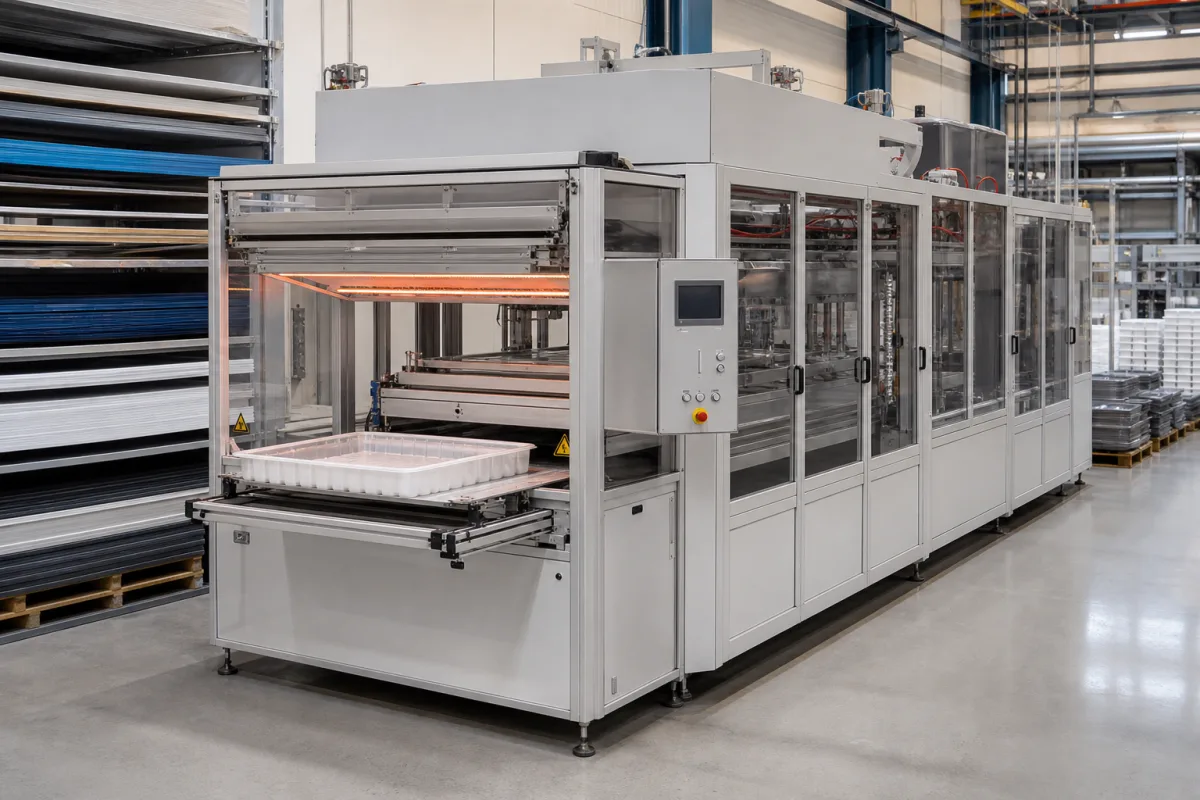
Thermoforming · Forming area and depth, draw ratio and sheet gauge, draft angles, venting and tool mounting
An industrial vacuum forming machine heats a plastic sheet and draws it over or into a tool by vacuum, sometimes assisted by air pressure, to make trays, covers, housings and liners. Ask three things first: the forming area, depth and sheet thickness it handles, the heater and vacuum capacity, and how tools are mounted and parts released.
Sheet-fed vacuum forming machines and roll-fed vacuum or pressure thermoforming machines for plastic parts, trays and cups. Thermoforming form-fill-seal packaging machines, rubber vacuum presses and moulding presses are outside this page.
CNFX editorial research · Sources checked October 12, 2026 · 4 sources
Formlabs' vacuum forming guide defines the draw ratio as the surface area of the part divided by its footprint, states that “a 3:1 draw ratio is generally considered to be the maximum for most vacuum forming operations”, and sets the minimum starting sheet gauge as the draw ratio multiplied by the finished part gauge. Deeper draws need thicker stock, give more variation in wall thickness and are harder to form, so parts should be kept as shallow as possible. [1]
Editorial calculation: an open box 200 × 150 mm and 50 mm deep has a surface area of 200×150 + 2×(200×50) + 2×(150×50) = 65,000 mm² on a 30,000 mm² footprint, a draw ratio of about 2.2:1; for a 1 mm finished wall the sheet should be at least about 2.2 mm. [1] The dimensions here are illustrative; ask the supplier for the maximum depth and sheet thickness of the machine and for wall-thickness trials.
Give the supplier the part drawings, material and finished wall thickness, sheet size and thickness, forming area and depth, cycle time, sheet-fed or roll-fed, plug assist or pressure forming, trimming, tool material and quantity, and power and vacuum supply.
02
Design and mount the tool for vacuum and release
Formlabs recommends 4–5° of draft on male tools and 1.5–3° on female tools, more for deep or textured parts; vent holes through the tool for internal pockets so the sheet is pulled into them rather than draping; and chamfers or radii on sharp edges to reduce stress and the chance of tearing or webbing. [1]
Formech's technical note on mounting tools says tools need airflow under their bases so vacuum can pass through the tool's holes to the table and release air can push back up; it recommends an air gap of about 1 mm between tool and baseboard, reduced for very thin material, or channels milled in the tool's underside linked to the central vacuum hole, with one vacuum hole under the centre of each tool when two or more are mounted. [2]
03
Compare what suppliers offer
Suppliers linked to this page list vacuum forming or thermoforming machines; each card links to the page reviewed.
One maker's data for a roll-fed pressure and vacuum thermoforming line (Foshan Honggang, DM7880) show the figures a quotation should state: three stations for forming, in-mould steel-rule trimming (up to 13 m of knife rule) and automatic stacking; forming area 780 × 800 mm, maximum sheet width 810 mm, sheet thickness 0.15–2.0 mm, maximum forming height 140 mm, and up to 30 cycles per minute depending on material and thickness. It lists 130 kW installed power with 25–50 kW actual consumption, servo drives of 7.5 kW × 2 for forming, 3.0 kW for stretching, 7.5 kW × 2 for cutting, 5.5 kW for sheet feeding and 2.0 kW for stacking, a 15,000 kg machine 11.8 × 2.4 × 2.6 m, and PET, PP, PS, PLA, PVC and ABS sheet. [3]
Editorial calculation: at 30 cycles per minute a cycle lasts 2 seconds, so heating, forming, cutting and stacking each have that time at their stations; ask the supplier for the cycle rate it will guarantee on your sheet and gauge. [3]
BYTCNC lists economic, multi-function and large industrial vacuum forming machines; Honggang lists vacuum and pressure thermoforming machines with multiple stations and cup making machines; Wylong lists automatic plastic thermoforming and cup forming machines with sheet extruders; Yugong lists plastic thermoforming machines among other machinery.
04
Match a 3D-printed tool's material to the sheet's forming temperature
Stratasys' FDM thermoforming design guide reports forming trials on 3D-printed tools. A polycarbonate (PC) tool formed 223 ABS parts at 360 °F (182 °C) with a 2 minute 30 second cycle and stayed within 0.010 in (0.254 mm) total deviation before drifting out of tolerance. An ULTEM 9085 resin tool formed 23 Kydex parts at 400 °F (204 °C), reached 260 °F (127 °C) and stayed within 0.005 in (0.127 mm) of its original scan. [4]
The guide recommends PC tools for materials formed at or below 360 °F (182 °C), with cycle times similar to or longer than 2.5 minutes and fewer than 225 parts where tolerances under 0.010 in are required, and ULTEM 9085 resin above that temperature; it does not recommend ASA. Its design values are 3–4° draft on male portions, 2–3° on female portions, a minimum radius of 0.050 in (1.27 mm) or the sheet thickness, and a 3:1 maximum areal draw ratio. [4]
Editorial calculation: 223 parts at 2.5 minutes is about 9.3 hours of forming before the PC tool left tolerance. Stratasys' draft values differ from Formlabs' above, so agree draft with the toolmaker. [4][1]
05
Trace the machine components
This is a functional reference built from the sources cited; it is not one maker's parts list.
Part
Role
Fix in the order
Heater
Softens the sheet; ceramic elements and Kanthal wire on one line. [3]
Fill the specification fields with values for your parts
A vacuum forming machine quotation needs values for your parts and sheet. The table explains each field, gives published values where a reviewed source states them, and says what to obtain from the supplier.
Field
What it means and published values
Ask the supplier for
Maximum forming area (mm)
Largest part plus clamp margin; e.g. 780 × 800 mm on one roll-fed line. [3]
Area.
Maximum draw depth (mm)
Depth limits draw ratio; 3:1 is a practical maximum; e.g. 140 mm forming height. [1][3]
Depth.
Heating power (kW)
Heater load; e.g. 130 kW installed, 25–50 kW actual on one line. [3]
Power and zones.
Vacuum pump capacity (m³/h)
Speed of draw-down.
Pump and tank.
Maximum sheet thickness (mm)
At least draw ratio × finished gauge; e.g. 0.15–2.0 mm roll-fed. [1][3]
Range.
Cycle time (seconds)
Heat, form, cool, release; e.g. up to 30 cycles/min. [3]
Explore company information and manufacturing capabilities, then discuss the scope of your project with a relevant supplier.
Share this page
Compiled and source-reviewed by the CNFX editorial team.
Published product pages show what a company offers, not tested performance. Confirm the legal seller, factory and scope for your order. How we source and review
· Page last updated 13 October 2026
Buyer questions
How thick should the starting sheet be?
At least the draw ratio times the finished wall thickness; a 2.2:1 part with a 1 mm wall needs about 2.2 mm sheet (editorial calculation). [1]
What draft angle should a vacuum forming tool have?
About 4–5° for male tools and 1.5–3° for female tools, more for deep or textured parts. [1]
How should tools be mounted?
Formech recommends about a 1 mm air gap under the tool, or milled channels to the central vacuum hole, so vacuum and release air can flow. [2]
What does a roll-fed thermoforming line specify?
One maker's three-station line states a 780 × 800 mm forming area, 0.15–2.0 mm sheet, 140 mm forming height and up to 30 cycles per minute. [3]
How many parts can a 3D-printed vacuum forming tool make?
In Stratasys' trials a polycarbonate tool formed 223 ABS parts at 182 °C within 0.254 mm before drifting out of tolerance; Stratasys recommends ULTEM 9085 resin tools for sheet formed above 182 °C. [4]
Sources and what still needs a direct check
Sources checked 2026-10-12. Formlabs and Stratasys are 3D printer makers whose guides cover vacuum-forming tool design; Formech is a vacuum forming machine maker; Foshan Honggang's product page describes its own machine. Their guidance is their own.