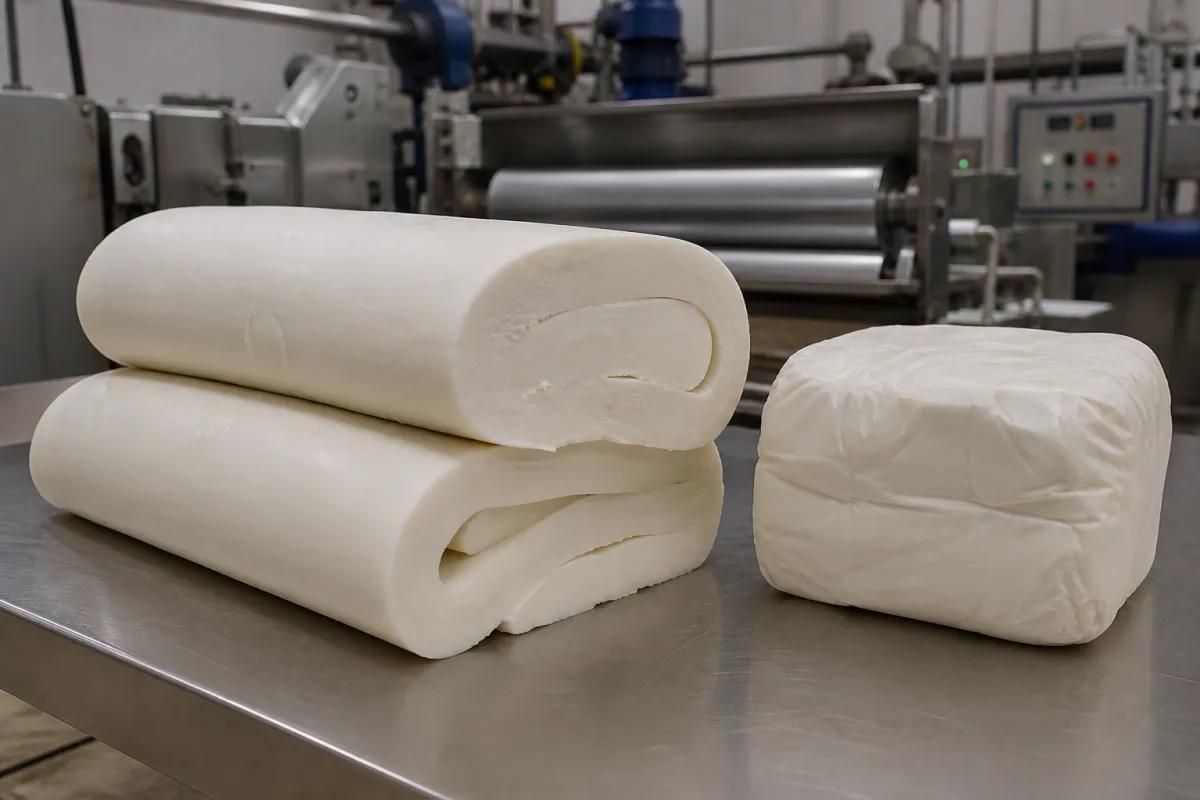
High-temperature silicone rubber compound: heat-stabilised HCR for 250–300 °C oven-door and appliance seals
Heat-stabilised high-consistency silicone compound · stabiliser added at 1.5–3.0% on the mill, rated to 275 °C or 300 °C, judged by how hardness and elongation drift over weeks at 225–300 °C
Ordinary silicone rubber already outlasts organic rubbers in heat, but an oven-door profile or a gasket beside a heating element stays hot for as long as the appliance is in use. A high-temperature compound is the same millable silicone gum and silica with a heat stabiliser — which in Wacker's range also sets the colour — mixed in on the two-roll mill before curing. Buying one means choosing the stabiliser and its dosage, then asking for heat-ageing data at the temperature and duration the part will actually see.
Heat-stabilised high-consistency (millable) silicone rubber compounds intended for continuous service above about 200 °C and up to around 300 °C, such as oven and cooker door gaskets, microwave window seals and hot-air profiles: stabiliser choice, dosage, post-cure and heat-ageing evidence. General VMQ and fluorosilicone compounds selected by hardness, strength, compression set, food-contact rules and fuel resistance are covered on the Silicone rubber (compounds and moulded or extruded parts) page; the post-curing equipment is on the Silicone curing (post-cure) oven page; liquid silicone rubber is on its own page.
CNFX editorial research · Sources checked October 12, 2026 · 4 sources
Heat stabiliser choice: red-brown H1 to 275 °C, beige H2 and black H3 to 300 °C
Wacker's ELASTOSIL R plus 4350/55 is an addition-curing high-consistency silicone for extrusion that is deliberately formulated without a heat stabiliser, leaving the choice to the processor. Wacker says it “is usually mixed with 1.5% ELASTOSIL® AUX BATCH PT 1 and 1.5 – 3.0% of ELASTOSIL® AUX STABILIZER H on a two-roller mill”, and states vulcanisates reach heat resistance up to 300 °C once a suitable stabiliser is added. [1] The stabilisers differ in temperature rating, colour and regulatory status:
Wacker's recommended post-cure for compliance is 4 h at 200 °C for 2 mm thickness. [1] The trade press report on the launch adds that the type of stabiliser and the amount used have a significant influence on the heat resistance of the cured rubber. [2]
Editorial note: because the stabiliser fixes the colour, a white or translucent part and a 300 °C rating may not both be available from the same system; agree colour, stabiliser and dosage together, and for food-zone appliance parts ask which stabiliser the regulatory statement covers.
State the stabiliser type and dosage in the compound specification, the post-cure (time, temperature, wall thickness), and whether food-contact compliance is required for the finished part.
02
Heat-ageing evidence: 70 h at 200 °C for a general grade against 42 days at 225–300 °C for a stabilised one
How long and how hot the ageing test runs separates a general-purpose silicone from a heat-stabilised one. Canyon Components' 50 Shore A orange silicone, made to specification A-A-59588 Class 3B Grade 50 and rated −70 to 205 °C, is aged for 70 h at 200 °C; the requirements and its results are below. [4]
Wacker's leaflet for the H3-stabilised 4350/55 instead plots Shore A hardness and elongation at break over 0, 7, 14, 28 and 42 days at 225, 250, 275 and 300 °C. [1] The European Rubber Journal reported that in Wacker's tests hardness and elongation changed very little above 200 °C even after 2,000 hours, and that sealing profiles and tubing can be used at up to 300 °C for days at a time. [2] Editorial calculation: 42 days is 1,008 h, about 14 times the 70 h of the A-A-59588 test; 2,000 h is about 83 days.
Shin-Etsu describes the baseline: silicone rubber can be used indefinitely at 150 °C with almost no change, withstands 200 °C for 10,000 hours or more, and some products withstand 350 °C for short periods. It also notes that, “generally speaking, silicone rubber hardens when heated in air”, but softens in sealed conditions as it deteriorates, where its high-temperature life is shorter; formula, curing agent and post-cure can be adjusted to counter that. [3]
Editorial note: an oven-door gasket in free air and a seal clamped in a closed housing age differently, so ask for ageing data in the condition that matches the part, and compare hardness and elongation at the same days and temperature rather than a single headline temperature.
What the unstabilised base gives: Shore A 55, 7.9 N/mm², 400% elongation, 6% compression set at 175 °C
Wacker lists these properties for 4350/55 pressed 15 min at 165 °C and post-cured 4 h at 200 °C; For extrusion Wacker writes that “the curing is usually done in hot-air heating channels at temperatures above 200 °C or in specific infrared channels”. [1]
Editorial calculation: the A-A-59588 orange silicone above starts at 1,247 psi (8.6 MPa) tensile and 550% elongation, [4] so the heat-resistant extrusion base is not stronger at room temperature; its case rests on how slowly those values fall over weeks at 250–300 °C.
Where appliance makers use it: oven and stove door profiles, microwave window gaskets, defrosters
Shin-Etsu's application list for consumer electronics names microwave oven window gaskets for heat resistance, microwave oven drive belts for low compression set, defrosters for heat and cold resistance with electrical insulation, and hot-air brushes. [3] The trade press named heat-resistant profile gaskets for oven and stove doors as the target use of the Wacker compound. [2]
Other compound properties matter in the appliance: Shin-Etsu reports water absorption of about 1% on long immersion, but warns that pressurised steam above 150 °C breaks down the siloxane polymer — relevant to steam ovens — and that some grades carry UL94 V-0 ratings when a flame retardant is added. [3]
For a steam oven, ask for steam-ageing data as well as dry hot-air ageing; for parts near live components, ask for the UL94 file of the exact compound and colour.
05
What to send a compounder for a high-temperature silicone
Paste it into your enquiry below or into an email to a maker, then replace every bracket.
Part: [oven-door profile / microwave window gasket / heater seal / other; extruded or moulded]
Service: [continuous temperature; peak temperature and duration; free air or enclosed; steam exposure]
Compound: [base hardness Shore A; peroxide or addition cure; stabiliser type and %; colour]
Post-cure: [time and temperature for the wall thickness]
Evidence: [hardness and elongation after ageing at your temperature for 7–42 days; compression set]
Compliance: [BfR XV / FDA 21 CFR 177.2600 if food zone; UL94 rating if required]
Explore company information and manufacturing capabilities, then discuss the scope of your project with a relevant supplier.
Share this page
Compiled and source-reviewed by the CNFX editorial team.
Each manufacturer above links to the page on that company's own website where the product is listed, with the date we checked it. How we source and review
· Page last updated 13 October 2026
Buyer questions
What makes a silicone compound 'high-temperature'?
A heat stabiliser added to the high-consistency compound. Wacker's 4350/55 is sold without one and reaches up to 300 °C only once 1.5–3.0% of an AUX STABILIZER H grade is milled in. [1]
Which stabiliser for food-contact appliance parts?
In Wacker's table the red-brown H1 (275 °C) and black H3 (300 °C) meet BfR XV and FDA 21 CFR 177.2600 when post-cured properly; the beige H2 (300 °C) does not. [1]
How is heat ageing reported for a general silicone?
A-A-59588 Class 3B Grade 50 sets limits after 70 h at 200 °C: hardness within ±10 points, tensile loss at most 25%, elongation loss at most 30%. [4]
Does silicone always harden with heat?
Shin-Etsu says that, “generally speaking”, silicone rubber hardens when heated in air, but in sealed conditions it softens and its high-temperature life is shorter. [3]
Sources and what still needs a direct check
Sources checked 2026-10-12. Stabiliser ratings, base properties and processing come from Wacker's ELASTOSIL R plus 4350/55 leaflet; launch details and the oven-door use from the European Rubber Journal; heat-life, sealed-condition behaviour and appliance uses from Shin-Etsu's silicone rubber properties brochure; the 200 °C ageing limits from Canyon Components' A-A-59588 datasheet.