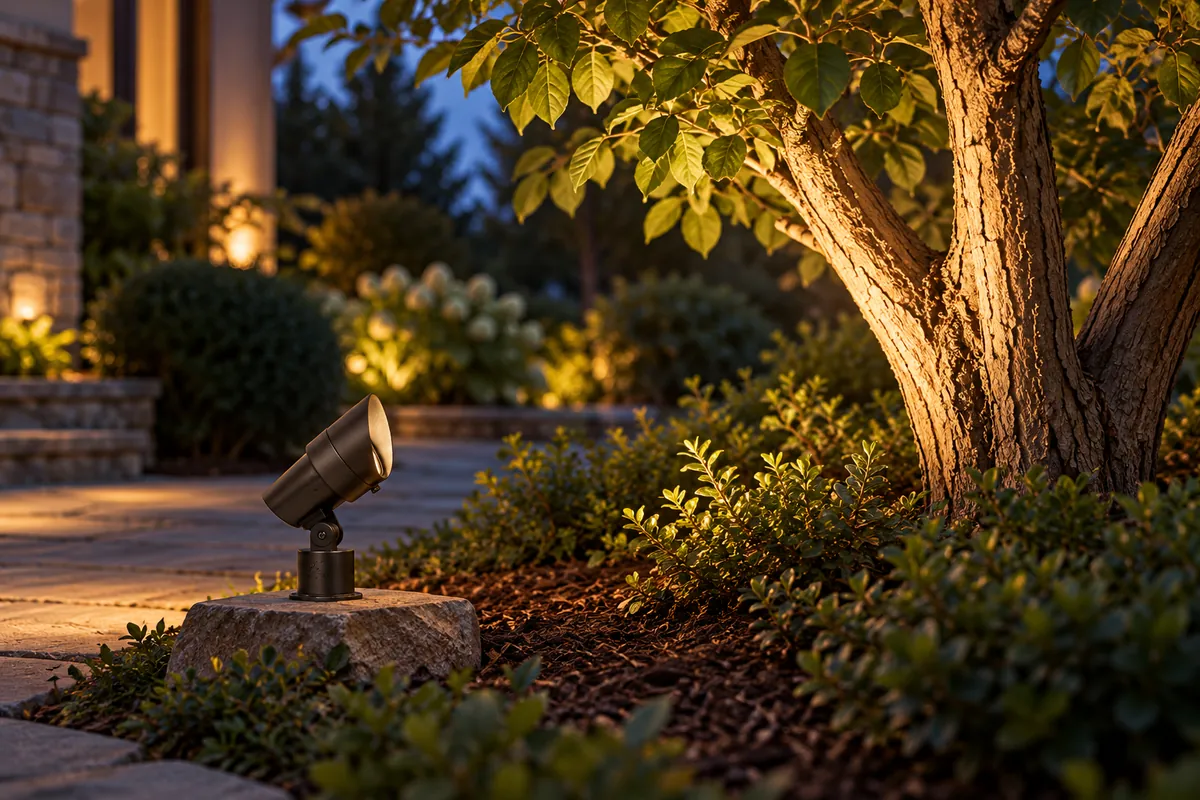
Outdoor LED landscape luminaires · spotlights, in-ground uplights, bollards, path, deck and underwater lights, line versus low-voltage input, colour temperature from 2300 K, dimming and controls, shielding and aiming to limit light pollution
LED landscape lighting covers outdoor luminaires that light gardens, paths, trees, facades and water features: spike and surface spotlights, in-ground uplights, bollards, path, step and deck lights, wall washers and underwater lights. Ask three things first: which fixture type and beam suits each feature, what supply voltage and control system the installation uses, and how the light will be shielded, aimed and coloured to avoid glare and light pollution.
Outdoor LED landscape luminaires for gardens, parks, building surroundings and water features, line- or low-voltage, single-colour or RGB. Street lights (a separate product page), LED drivers and modules sold alone, sports and high-mast floodlighting and indoor lighting are outside this page except where compared.
CNFX editorial research · Sources checked October 12, 2026 · 4 sources
GRNLED, a landscape lighting maker linked to this page, describes outdoor spotlights (tree lights and floodlights) with narrow beams for accent lighting, mounted on surfaces, walls or spikes in soil or lawns, with low-power models for paths and small accents and high-power models as mini floodlights for buildings and tall trees. It lists in-ground uplights from 1 W to 48 W, bollards including DC 12 V/24 V models, linear wall washers, and underwater lights all with IP68 protection and low-voltage input. Its standard input is 110/220–240 V AC 50/60 Hz, with AC/DC 12, 24, 36, 48 or 60 V offered as safer for large commercial projects; colour temperatures of 2300, 2500, 2700, 3000, 4000 and 6500 K plus RGB; and switch, SCR (Triac), 0–10 V, DALI and DMX512 control. [2]
Editorial calculation: ten 9 W fixtures draw 90 W; on a 12 V circuit that is 90 / 12 = 7.5 A, and on 24 V it is 90 / 24 = 3.75 A, so the higher low voltage halves the current the cable must carry for the same load. Fixture count and wattage are assumed examples; ask the supplier for driver or transformer ratings and cable sizing for your run lengths.
A US maker's spec sheet shows what a single accent fixture covers. WAC Lighting's sheet for its 5012 Accent 120V landscape luminaire (June 2018) lists 110–120 V AC input, 3.5 to 14.5 W set by an integral dimmer, 100 to 900 lm, an adjustable and lockable 15° to 60° beam, CRI 85 at 3,000 K, 45,000 hours rated life, IP66 protection against high-pressure water jets, die-cast brass or corrosion-resistant aluminium bodies, UL 1598 listing, and constant lumen output against voltage drop; it is not suitable for external dimmers. Accessories include snoots and 6 in shrouds to reduce glare, coloured and spread lenses, and for its 12 V lines stainless magnetic transformers with 12–15 V output, IP65 and UL 1838, from 75 W to 600 W. [3]
Give the supplier the fixture types and quantities, wattage and lumen output, beam angles, colour temperature or RGB, supply (line voltage or 12/24 V AC/DC), transformer or driver arrangement, control (switch, Triac, 0–10 V, DALI, DMX512, timer or sensor), ingress protection for each location (buried, splash or submerged), housing material and finish, mounting (spike, surface, in-ground, wall), cable entry and connectors, certifications required in your market, and warranty.
02
Aim, limit and control the light
DarkSky International sets out five principles for responsible outdoor lighting. Useful: all light should have a clear purpose, considering the impact on wildlife and habitats. Targeted: use shielding and careful aiming so the beam points downward and does not spill beyond where it is needed. Low level: use the lowest light level required, minding surfaces that reflect light into the sky. Controlled: use timers or motion detectors so light is dimmed when possible and off when not needed. Warm-coloured: limit shorter-wavelength (blue-violet) light to the least amount needed. [1]
Editorial note: uplights aimed at trees and facades send light upward by design; ask for glare shields, louvres or snoots, narrow beams matched to the target, warm colour temperatures such as the 2700 K or 3000 K options above, and dimming or timer control, and check local lighting ordinances before specifying. [2][1]
Editorial calculation: across its dimmer range the WAC 5012 gives about 29 lm/W at 3.5 W (100 ÷ 3.5) and 62 lm/W at 14.5 W (900 ÷ 14.5), so dimming a fixture down cuts light faster than power; choose the beam and wattage that light the target, then add the snoot or shroud the maker offers to limit spill as DarkSky's targeted and controlled principles ask. [3][1]
03
Compare what suppliers offer
Suppliers linked to this page list outdoor landscape or garden lighting; each card links to the page reviewed.
Listings include deck, step, path, up and in-ground lights; landscape spotlights, bollards and fountain lights; garden and lawn lights with street and flood lighting; and solar garden lights. Ask each for input voltage, IP rating, colour temperature, beam angles and control options.
04
Size the 12 V transformer and the cable for each run
Alcon Lighting's landscape design guidelines size a 12 V transformer by adding the wattage of all its lamps plus 10% as a safety factor; the total must stay below the transformer's capacity. Voltage drop dims the last lamps on a run and depends on cable length, cable size and total fixture wattage, so the guide sets maximum cable length = cable constant ÷ total fixture watts × 2: for 12-2 cable carrying 150 W, 7500 ÷ 150 × 2 = 100 ft. Its checklist keeps voltage drop to 2 volts or less. [4]
To limit drop it lists heavier cable (a lower gauge number is thicker), shorter runs, lower wattage, more transformers and fewer fixtures per run, or a loop, a split load with the transformer in the centre, or a T feed whose main cable is 10-2 or 8-2. [4]
Editorial calculation: the ten 9 W fixtures above (90 W) need a transformer above 90 × 1.1 = 99 W, and on 12-2 cable the formula allows 7500 ÷ 90 × 2 ≈ 167 ft (about 51 m); a 2 V drop is about 17% of 12 V. Ask for the transformer rating, cable gauge and length to the last fixture. [4]
Fill the specification fields with values for your site
A landscape lighting quotation needs values for your site. The table explains each field, gives published values where a reviewed source states them, and says what to obtain from the supplier.
Field
What it means and published values
Ask the supplier for
Input voltage
Examples: 110/220–240 V AC; AC/DC 12–60 V; 110–120 V AC; 12–15 V transformers. [2][3]
Explore company information and manufacturing capabilities, then discuss the scope of your project with a relevant supplier.
Share this page
Compiled and source-reviewed by the CNFX editorial team.
Published product pages show what a company offers, not tested performance. Confirm the legal seller, factory and scope for your order. How we source and review
· Page last updated 13 October 2026
Buyer questions
Should landscape lights be line or low voltage?
GRNLED supplies line-voltage input as standard and describes AC/DC 12–60 V input as safer for large commercial projects. [2]
What colour temperature should landscape lighting use?
DarkSky advises limiting blue-violet light to the least needed; GRNLED offers warm options such as 2300 K, 2700 K and 3000 K. [1][2]
How can landscape lighting avoid light pollution?
DarkSky's principles: use light only where needed, shield and aim it, keep it low, control it with timers or sensors, and use warm colours. [1]
What specifications does a landscape accent light sheet give?
WAC Lighting's 5012 sheet lists 3.5–14.5 W, 100–900 lm, a 15°–60° adjustable beam, CRI 85, 45,000 h rated life and IP66, with snoots and shrouds to reduce glare. [3]
How long can a 12 V landscape lighting cable run be?
Alcon Lighting's design guide sets maximum length = cable constant ÷ total fixture watts × 2; for 12-2 cable (constant 7,500) that is 300 ft at 50 W and 100 ft at 150 W, with voltage drop kept to 2 volts or less. [4]
Sources and what still needs a direct check
Sources checked 2026-10-12. DarkSky International is a non-profit authority on light pollution (cited from an Internet Archive copy because its site blocked automated access); GRNLED is a landscape lighting maker describing its own products.