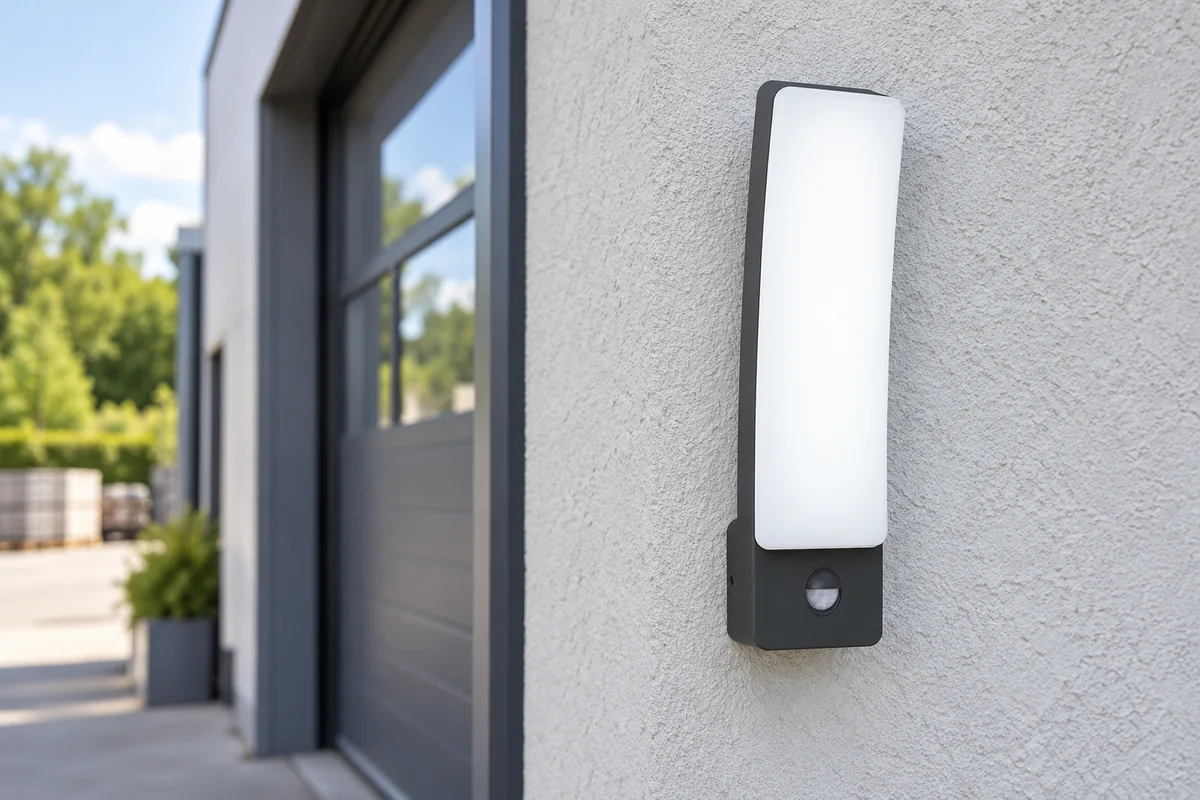
LED wall lights · Measured lumens and efficacy versus claims, light distribution and glare, CCT and CRI, IP rating, mains or solar supply, motion sensors and battery runtime
An LED wall light is a luminaire mounted on a wall, with LED chips or modules, a driver or battery, a heat-sinking housing and a lens or diffuser, that lights façades, entrances, walkways and interiors; outdoor versions range from decorative lanterns and sconces to wallpacks and solar lights with motion sensors. Ask three things first: what lumen output the luminaire delivers and where it sends them, what colour and protection rating it has, and how it is powered and controlled.
Indoor and outdoor wall-mounted LED luminaires: decorative wall lights and sconces, exterior lanterns, wallpacks and solar wall lights with sensors. Flood lights, street lights, landscape and in-ground lights and emergency lighting are outside this page.
CNFX editorial research · Sources checked October 12, 2026 · 4 sources
US DOE's CALiPER Round 13 summary (October 2011) tested three LED wallpacks to IES LM-79-08 at 25 °C and 120 V AC: 30 W giving 1,760 lm at 59 lm/W, 26 W giving 1,433 lm at 55 lm/W, and 40 W giving 1,525 lm at 38 lm/W, with CCTs near 5,100 K and CRI 65, 80 and 69. A 150 W pulse-start metal halide benchmark gave 4,591 lm at 24 lm/W and a 150 W high-pressure sodium benchmark 8,103 lm at 47 lm/W. [1]
The report found that two of the three LED wallpacks claimed to replace 175 W metal halide wallpacks but produced less than half the initial light output of the 150 W metal halide benchmark, and one product's measured performance did not match its Lighting Facts label. It notes that mounting height and required illuminance set how much light a wallpack must emit, that backlight lights the wall, and that too much output at high angles can cause glare. [1]
Editorial note: these 2011 results show why to compare measured lumens and photometric files rather than wattage-equivalence claims; ask for a current LM-79 report and an IES file for the exact model and colour temperature you will buy.
Give the supplier the location (indoor, covered outdoor, exposed outdoor), mounting height and spacing, target illuminance or lumens, distribution and cut-off needs, CCT and CRI, IP rating, supply voltage or solar operation, controls (switch, dimmer, photocell, motion sensor), finish and material, certification marks needed and quantities.
02
Match power supply, sensors and runtime
Grand Lighting lists an exterior LED wall light with up-and-down light, a 1 × 7 W LED chip at 2700 K rated 345 lm, an acrylic diffuser and an aluminium body, about 6¼ in wide and 10¾ in high. [2]
Bosllo lists a solar induction wall light with eight 0.2 W SMD LEDs in 3000 K or 6000 K, a 3.7 V 750 mAh 14500 Li-ion battery, 6–8 h charging and 6–8 h working time, an 8 m sensing distance and 15 s on-time, IP65, a 120° beam and −10 to +50 °C operation. [3]
Editorial calculation: 345 lm from a 7 W LED is about 49 lm/W if 7 W is the input power; ask whether 7 W is the chip rating or the measured input. A 3.7 V 750 mAh battery stores about 2.8 Wh, and eight 0.2 W LEDs draw 1.6 W, so at full output it would run about 1.7 h before losses; a 6–8 h working time therefore depends on the sensor or dimmed mode, so ask how the runtime was measured. [2][3]
03
Check a wall pack against current qualification thresholds
The DesignLights Consortium's SSL Technical Requirements Tables V5.1 (effective 1 July 2020), used by utility rebate programmes in North America, set minimum efficacy for outdoor luminaires at 105 lm/W for DLC Standard and 120 lm/W for DLC Premium across low (250–5,000 lm), mid, high and very high output classes. Outdoor full-cutoff wall-mounted area luminaires must give at least 300 lm with 100% of light in the 0–90° zone and no more than 10% in the 80–90° glare zone. Non-cutoff and semi-cutoff wall packs form a separate designation: they must give at least 300 lm in the 0–90° zone, their efficacy is calculated from the 0–90° lumens divided by total watts, no more than 10% of those lumens may fall in 80–90°, and no more than 15% in 90–110°. [4]
Editorial calculation: the 2011 CALiPER wallpacks above measured 59 lm/W at best, about 56% of today's 105 lm/W Standard threshold, and the 7 W wall light's 345 lm works out to about 49 lm/W if 7 W is the input; both would fall short of DLC qualification. For a rebate-eligible wall pack, ask for its DLC listing number and the LM-79 report showing lumens in the 0–90° zone. [4][1][2]
Fill the specification fields with values for your site
An LED wall light quotation needs values for your site. The table explains each field, gives published values where a reviewed source states them, and says what to obtain from the supplier.
Field
What it means and published values
Ask the supplier for
Luminous Flux (lumens)
1,433–1,760 lm measured for three 2011 LED wallpacks; 345 lm listed for one exterior wall light. [1][2]
LM-79 report.
Power Consumption (watts)
26–40 W measured in the CALiPER wallpacks; 7 W LED in one wall light. [1][2]
Measured input power.
Color Temperature (kelvin)
About 5,100 K in the CALiPER wallpacks; 2700 K, 3000 K or 6000 K in supplier listings. [1][2][3]
Explore company information and manufacturing capabilities, then discuss the scope of your project with a relevant supplier.
Share this page
Compiled and source-reviewed by the CNFX editorial team.
Published product pages show what a company offers, not tested performance. Confirm the legal seller, factory, test reports and scope for your order. How we source and review
· Page last updated 13 October 2026
Buyer questions
Can I trust wattage-equivalence claims for LED wall lights?
Not on their own: in DOE CALiPER testing two of three LED wallpacks claiming to replace 175 W metal halide gave less than half the light of a 150 W metal halide benchmark. [1]
How efficient were the LED wallpacks DOE tested?
Three LED wallpacks tested in 2011 gave 38–59 lm/W, against 24 lm/W for a metal halide benchmark and 47 lm/W for high-pressure sodium. [1]
What should I check on a solar wall light?
Battery capacity, LED power, sensor range and on-time, IP rating and how the working time was measured; one listing gives a 3.7 V 750 mAh battery and 6–8 h working time. [3]
What efficacy must an LED wall pack reach for DLC qualification?
Under DLC V5.1, outdoor luminaires need at least 105 lm/W (Standard) or 120 lm/W (Premium), and wall packs at least 300 lm with no more than 10% of light in the 80–90° zone. [4]
Sources and what still needs a direct check
Sources checked 2026-10-12. The DOE CALiPER report gives independent 2011 test results for LED wallpacks; Grand Lighting and Bosllo describe their own products. Performance for your order must come from current test reports for the exact model.