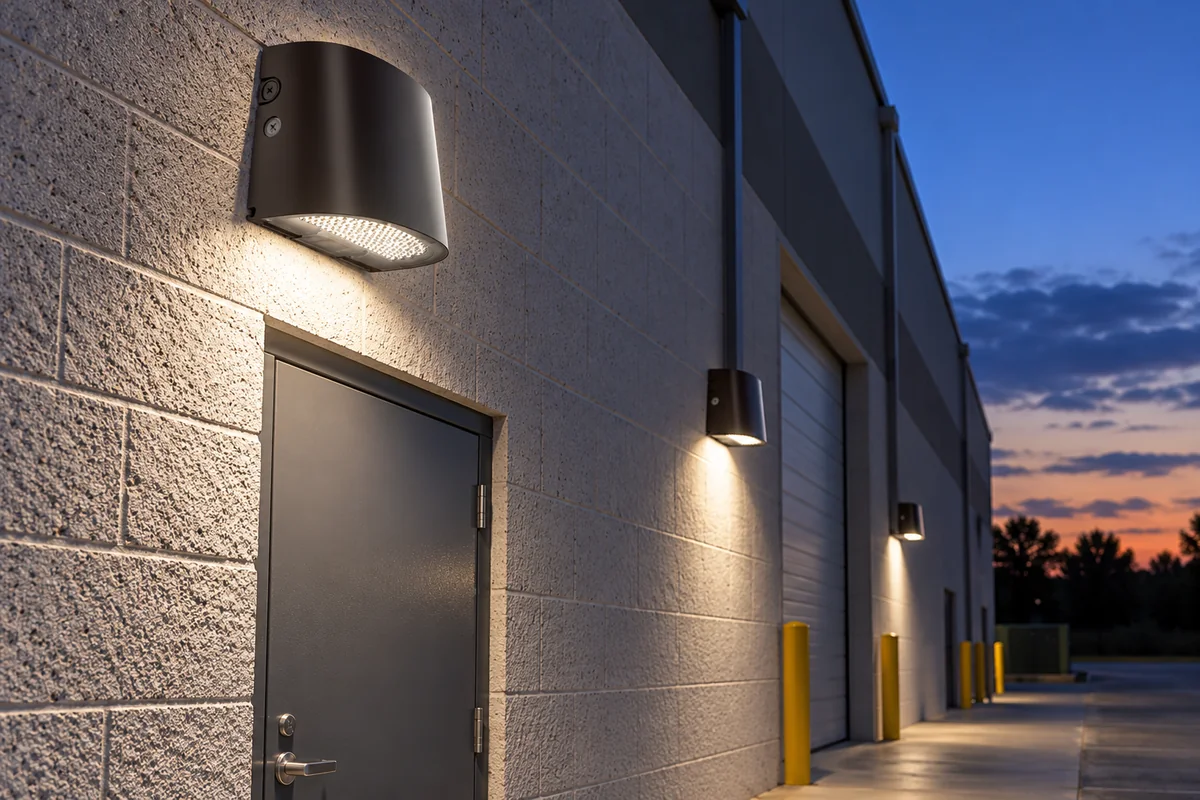
LED wall packs for building perimeters, walkways, loading docks and security lighting · full-cutoff vs non-cutoff and semi-cutoff, lumens and efficacy, glare-zone limits, BUG rating, CRI and CCT, lumen maintenance, power factor, warranty
An LED wall pack is a wall-mounted outdoor luminaire, which DLC says may be box-shaped, that lights walkways, entrances, loading docks and building perimeters for safety and security. Ask three things first: whether the site needs a full-cutoff fixture with no uplight, for example to meet dark-sky or local rules; how much light is needed and how far from the wall; and the efficacy, colour and warranty a rebate programme or specification requires.
LED wall packs and wall-mounted area luminaires — full-cutoff, semi-cutoff and non-cutoff, with photocells, motion sensors and emergency options — and wall-pack retrofit kits. Wall-mounted flood lights, decorative wall sconces, landscape and architectural flood lights and LED street or area poles are outside this page except where compared.
CNFX editorial research · Sources checked October 11, 2026 · 4 sources
Choose full-cutoff or non-cutoff, and the light output
The DesignLights Consortium (DLC), whose qualified-product list is used in DLC members' energy-efficiency rebate and incentive programmes, describes wall-mounted area luminaires as walkway or security lights fixed to a building wall, which may be box-shaped. It separates full-cutoff types, which produce no uplight, from non-cutoff and semi-cutoff types — which DLC says are known as wall packs — which produce a non-negligible amount of uplight and provide general rather than directional illumination. [3] In its SSL V5.1 tables both need at least 300 lm; full-cutoff units must put 100% of their light in the 0–90° zone (97% with tolerance) and no more than 10% in the 80–90° glare zone (13% with tolerance). For non-cutoff and semi-cutoff wall packs, output, efficacy and the glare-zone share are evaluated on the lumens in the 0–90° zone only, while the output class is set by total light output. Outdoor luminaires need efficacy of 105 lm/W for DLC Standard and 120 lm/W for Premium across output classes from 250 lm to above 30,000 lm, and must report a six-character backlight, uplight and glare (BUG) rating to IES TM-15-11. [1]
Editorial calculation: a 30 W wall pack meeting the 105 lm/W minimum gives at least 3,150 lm (in the 0–90° zone for a non-cutoff unit), of which no more than about 315 lm may fall in the 80–90° glare zone; at the Premium 120 lm/W the same 30 W gives 3,600 lm. [1]
Give the supplier the cutoff type (full, semi, non-cutoff), lumen output and wattage, efficacy target, CCT and CRI, distribution and BUG rating, mounting height and wall material, input voltage, surge protection, photocell, motion sensor and dimming, emergency battery option, IP rating and operating temperature, housing material and finish, rebate programme and DLC version, warranty, certifications, and quantity.
02
Check colour, lifetime, power quality and warranty
Under DLC SSL V5.1, all outdoor products must meet a 7-step chromaticity quadrangle for a nominal CCT from 2200 K to 6500 K and a colour rendering index of Ra ≥70 (or TM-30 Rf ≥70 and Rg ≥89), with R9 reported. Lumen maintenance must reach L70 ≥50,000 hours (L90 ≥36,000 hours for Premium), power factor must be ≥0.9 and total harmonic distortion ≤20% at worst-case loading, and the warranty must run at least 5 years and cover the complete luminaire, including light source, housing, power supplies and optics. [1]
DLC has since published SSL V6.0 and LUNA V2.0 requirements and says products not updated to them will be delisted from its qualified-product list, so ask suppliers which version a listing is qualified under. [2] Editorial note: also check local outdoor-lighting rules on uplight and CCT.
03
Compare what suppliers offer
Suppliers linked to this page list LED wall packs; each card links to the page reviewed.
Listings include standard and high-power LED wall pack lights and outdoor LED wall lights; ask each for the cutoff type, IES photometric file, BUG rating, DLC listing and warranty terms.
04
Check the federal efficacy minimum before specifying a wall pack
The US Department of Energy's Federal Energy Management Program (FEMP) sets minimum luminaire efficacy ratings (LER, light output divided by electrical input, in lm/W) that federal purchases must meet or exceed. In its guidance updated June 2023, outdoor wall-mounted luminaires need at least 126 lm/W, against at least 136 lm/W for pole-mounted area and roadway luminaires, 118 lm/W for floodlights and 100 lm/W for bollards. FEMP says only solid-state (LED) exterior lighting is considered FEMP-designated, and names IES LM-79-08 and LM-80-08 among the test standards for performance. [4]
FEMP's lifetime-savings example for wall-mounted luminaires assumes 9,900–10,100 lm of output, 3,600 operating hours a year and $0.099/kWh, the average federal electricity price it used. The required model (126 lm/W) uses 286 kWh a year against 565 kWh for the less efficient model based on the previous requirement (65 lm/W); FEMP calculates that the required model saves money if priced no more than $295 above that model. [4]
Editorial calculation: a wall pack that meets only DLC SSL V5.1's 105 lm/W Standard or 120 lm/W Premium minimum falls below FEMP's 126 lm/W. At 10,000 lm, 126 lm/W is about 79 W against about 95 W at 105 lm/W. Ask for the LM-79 report and check it against the programme your project must meet. [4][1]
Fill the specification fields with values for your project
An LED wall pack quotation needs values for your project. The table explains each field, gives published values where a reviewed source states them, and says what to obtain from the supplier.
Explore company information and manufacturing capabilities, then discuss the scope of your project with a relevant supplier.
Share this page
Compiled and source-reviewed by the CNFX editorial team.
Published product pages show what a company offers, not tested performance or DLC listing. Confirm the legal seller, factory and scope for your order. How we source and review
· Page last updated 13 October 2026
Buyer questions
What is the difference between full-cutoff and non-cutoff wall packs?
DLC says full-cutoff wall-mounted luminaires produce no uplight, while non-cutoff and semi-cutoff wall packs produce a non-negligible amount. [3]
What efficacy do DLC-listed wall packs need?
Under SSL V5.1, outdoor luminaires need 105 lm/W for DLC Standard and 120 lm/W for Premium. [1]
How is glare limited?
No more than 10% of the light may fall in the 80–90° zone (13% with tolerance). [1]
What efficacy must an LED wall pack reach for US federal purchases?
The US Department of Energy's FEMP requires at least 126 lm/W for outdoor wall-mounted luminaires (guidance updated June 2023). [4]
Sources and what still needs a direct check
Sources checked 2026-10-11. The DesignLights Consortium is a non-profit whose qualified-product list is used in DLC members' energy-efficiency rebate and incentive programmes.