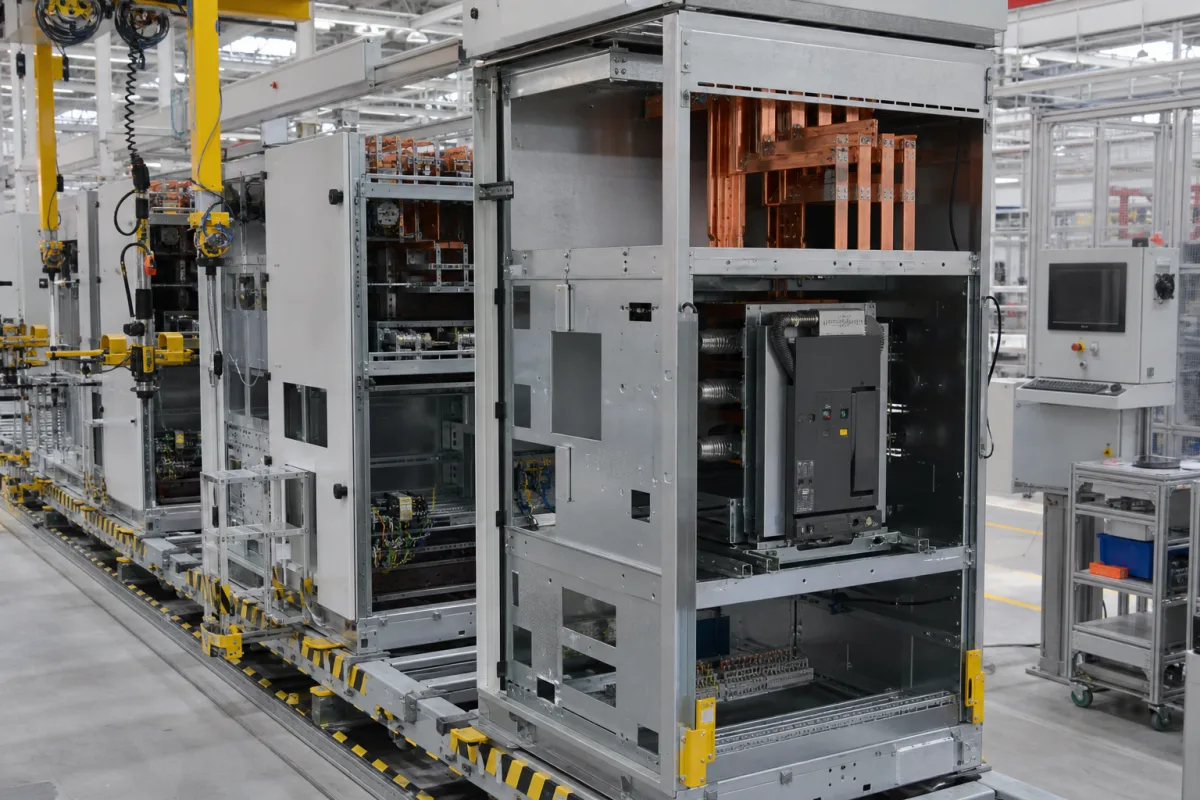
Medium-voltage switchgear assembly system: the complete panel line from frame to production-tested panel
Switchgear factory planning · The complete panel assembly line for medium-voltage switchgear: output, floor area, busbar finishing and production tests on each panel
This page treats the assembly system as one investment: the sequence of stations, conveyors and test areas that a switchgear maker installs to build medium-voltage panels in volume. The individual stations each have their own pages. What a buyer of a complete line has to fix first is the output the line must reach and the floor it may occupy, the build quality the stations must reproduce on every panel, and the production tests each finished assembly must pass before shipment.
Complete assembly lines and semi-automated factory systems for medium-voltage metal-enclosed switchgear panels, planned as a whole: output, floor area, station sequence, busbar finishing and production testing. Individual stations are covered on their own pages: Frame welding station for switchgear, Automatic wiring system for control cabinets and switchgear, Cabinet assembly transport line, Final test chamber for medium-voltage switchgear panels and High-voltage test chamber for switchgear components. The switchgear products themselves, vacuum interrupters and pole assemblies are outside this page.
CNFX editorial research · Sources checked October 17, 2026 · 4 sources
Panels per year and square metres: sizing the line
One published reference point: ABB's medium-voltage air-insulated switchgear factory in Tangerang, Indonesia, opened in October 2015, occupies 3,700 square metres, builds the UniSwitch, UniSec, UniGear and UniGear Digital ranges, and was described as a semi-automated factory designed for lean manufacturing with the capability to produce over 4,000 switchgear panels a year. [1]
Editorial calculation: 4,000 panels over an assumed 250 working days is 16 panels a day; over an assumed two 7.5-hour shifts (900 minutes) that is a takt of about 56 minutes per panel. Per square metre, 4,000 / 3,700 ≈ 1.1 panels per m² per year. The working days and shift pattern are assumptions, not ABB figures, and the press release gives capability, not actual output. [1]
The calculation shows why the line has to be specified by output and mix together: a 56-minute takt is the average for the whole panel, so stations whose work varies with panel type (feeder, incomer, metering) need buffers or parallel stations to hold it.
02
Busbar edges, barrier bolting and bus supports the stations must reproduce
Eaton attributes the low corona levels of its VacClad-W metal-clad switchgear to fabrication and assembly techniques: rounding and buffing all sharp copper edges at the joints, using star washers when bolting metal barriers, and using specially made standoff insulators for the primary bus supports. It notes that metal-clad switchgear to IEEE C37.20.2 isolates the major primary circuit components from each other by grounded metal barriers, with primary conductors fully insulated for the rated maximum voltage. [2]
For a line buyer these are station requirements rather than product features: the busbar processing station needs an edge-finishing step after punching and bending, the barrier and bus-support assembly station needs the specified hardware and torque at hand, and the final inspection needs a way to confirm them before the panel is closed.
03
Production tests on every assembly before it ships
Two US Unified Facilities Guide Specifications for pad-mounted medium-voltage switchgear ask the manufacturer to furnish reports of design and production tests and to perform production tests on each switchgear assembly to ensure that design performance is maintained in production. UFGS-26 13 00 (May 2021, SF6 or high-firepoint-fluid insulated) cites IEEE C37.74 for this, adding IEEE C37.60 and IEC 62271-111 where the switchgear has fault-interrupting ways; UFGS-26 13 02 (November 2024) for pad-mounted solid-dielectric switchgear cites IEEE C37.74 and, for fault-interrupting ways, IEEE C37.60 and C37.62. [3][4]
Eaton states that each of its VCP-W vacuum circuit breakers ships with its own Quality Assurance Certificate documenting all tests and inspections performed. [2] A line that builds for more than one market therefore needs its test area and records to follow the standard each order cites, and a per-panel record that travels with the panel.
Editorial calculation: at the 56-minute takt estimated above, a single final test position must complete connection, testing, recording and disconnection of each panel within 56 minutes, or the line needs a second test position. [1]
04
Line requirements to send to a line integrator
Paste it into your enquiry below or into an email to a maker, then replace every bracket.
Products: [switchgear families; panel widths; mix]
Output: [panels per year; shifts; target takt]
Floor: [area; crane and floor load; existing buildings]
Stations: [frame; busbar processing and edge finishing; mechanism and breaker fitting; wiring; inspection; test]
Tests: [standards per market; production test list; records per panel]
Explore company information and manufacturing capabilities, then discuss the scope of your project with a relevant supplier.
Share this page
Compiled and source-reviewed by the CNFX editorial team.
Each manufacturer above links to the page on that company's own website where the product is listed, with the date we checked it. How we source and review
· Page last updated 17 October 2026
Buyer questions
How many panels a year is a switchgear plant built for?
One example: ABB's 3,700 m² Tangerang plant was described as capable of over 4,000 medium-voltage panels a year. [1]
Must every switchgear panel be tested before shipment?
US guide specifications for pad-mounted switchgear require production tests on each switchgear assembly, with reports, under the IEEE standards they cite. [3][4]
Sources and what still needs a direct check
Sources checked 2026-10-17. Sources are thin for complete lines. The plant figures come from ABB's October 2015 press release (now hosted by Hitachi Energy); build-quality details from Eaton's VacClad-W design guide DG022001EN; production-test requirements from two US Unified Facilities Guide Specifications for pad-mounted switchgear.