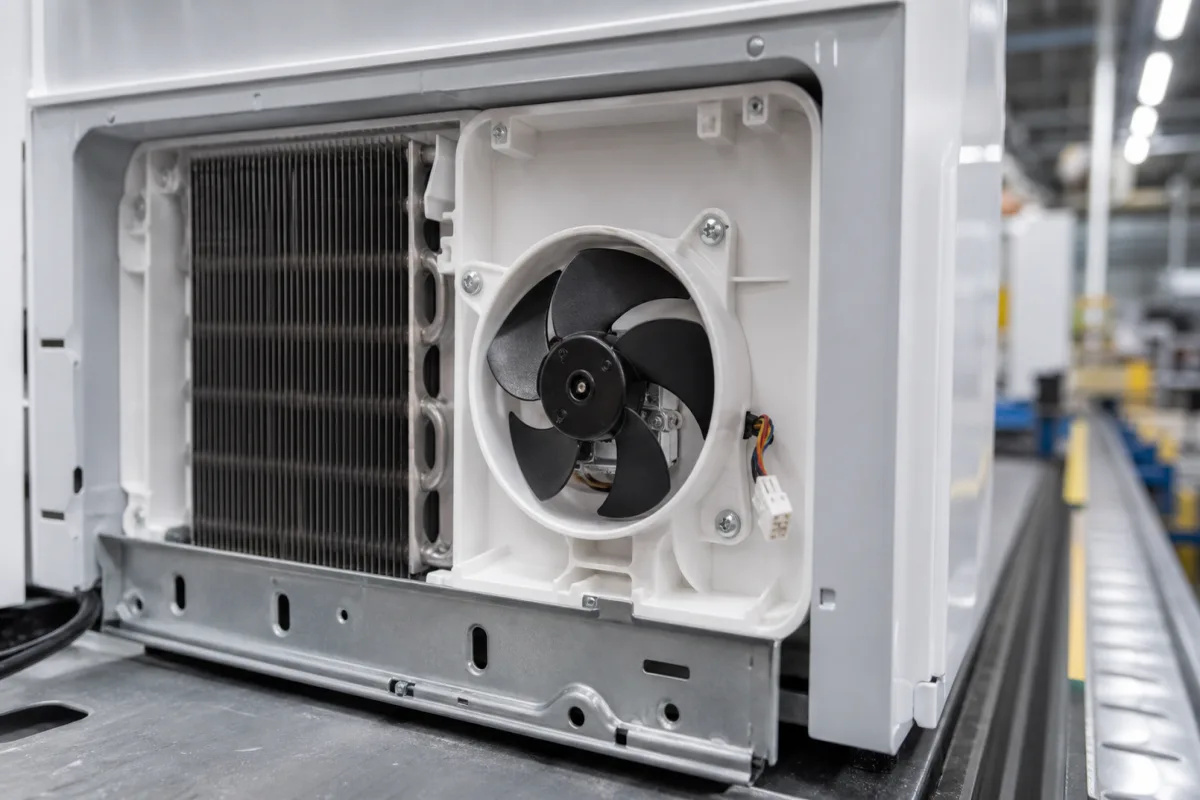
Evaporator fan motors for refrigerators and refrigerated cabinets · AC shaded-pole (115/230 V) or 12 V DC brushless, input power, speed and airflow, rotation, bearings, insulation class, cold and icing conditions, IEC 60335-2-24 and UL 1004-1
A refrigerator evaporator fan motor is a small motor, either an AC shaded-pole motor or a DC brushless fan with its impeller, that blows air across the evaporator coil and through the cabinet so that the cold produced at the coil reaches the food compartments. Ask three things first: whether the appliance supplies AC mains or a 12 V DC rail and how much power and airflow the fan must give; which way it must turn and how it mounts; and whether it is built for sub-zero, icing service with the insulation and safety approvals the appliance needs.
Evaporator fan motors and fan-motor assemblies for household refrigerators and freezers and for refrigerated cabinets, walk-ins and reach-ins: AC shaded-pole, electronically commutated (EC) and 12 V DC brushless types, including replacement units. Condenser fan motors are compared where the same motor serves both; compressors, evaporator coils, evaporative air-cooler motors and HVAC blower motors are outside this page.
CNFX editorial research · Sources checked October 11, 2026 · 5 sources
MinebeaMitsumi lists DC fan motors made for refrigerator evaporators. Its 12537JE series runs on 12 V nominal (7.0–13.2 V operating), drawing 0.07–0.14 A and 0.84–1.69 W at 1,900–2,550 min⁻¹, with maximum airflow of 1.62–2.17 m³/min, maximum static pressure of 24.8–42.9 Pa, noise of 26.0–35.0 dB and a mass of 220 g. [1] Its 12038GE series draws 0.15–0.24 A and 1.80–2.88 W at 1,600–1,950 min⁻¹, with 1.03–1.28 m³/min airflow, 50.0–76.0 Pa static pressure, 32.0–38.0 dB and 170 g; airflow values are averages in free air. [2]
For AC mains supply, a Fasco bulletin introducing Elco's NU series describes aftermarket shaded-pole motors (AC, 4 poles, single speed) for condensing and evaporating units, freezers and walk-in and reach-in coolers, from 1/375 HP to 1/20 HP (2 to 34 W). Its table lists each rating at 1,550 rpm in 115 V and 230 V versions, from EC4W115 (4 W, 0.36 A) to EC34W230 (34 W, 0.80 A); the 9 W model draws 0.58 A at 115 V and 0.35 A at 230 V. [3]
The same bulletin describes Elco's ECM-IP electronically commutated motors for refrigeration condensing and evaporating units, rated at 10 to 15 W, 115 V and 1,450–1,600 rpm, with efficiency up to 70%, which it calls 4–5 times that of a traditional shaded-pole fan motor. [3]
Editorial calculation: MinebeaMitsumi's airflow of 1.62–2.17 m³/min for the 12537JE equals 1.62 × 60 ≈ 97 to 2.17 × 60 ≈ 130 m³/h, and 1.03–1.28 m³/min for the 12038GE equals about 62–77 m³/h. [1][2]
Editorial calculation: at 115 V the 10 W ECM-IP EC-HE-0182 is listed at 0.19 A against 0.58 A for the 9 W shaded-pole EC9W115, about 0.19 ÷ 0.58 ≈ one third of the current. [3]
Give the supplier the supply (115 V or 230 V AC and frequency, or 12 V DC with its operating range), input power limit, speed, required airflow and static pressure through your evaporator and ducts, noise limit, rotation and airflow direction, shaft or hub and fan-blade dimensions, mounting, lead wires and connector, operating temperature and icing conditions, insulation class and protection, approvals and quantity.
02
Check cold duty, rotation, insulation and standards
MinebeaMitsumi states that its refrigerator evaporator fans can be built with ice-resistant and dust-proof structures, operate from −40 to +40 °C (storage to +70 °C for the 12537JE and +60 °C for the 12038GE) in a non-condensing environment, have auto-restart motor protection, and are specified to 10 MΩ or more insulation resistance at DC 500 V and AC 700 V for 1 s dielectric withstand. Expected life is 70,000 hours at −20 °C (L10). Both series use ball bearings, UL94V-0 plastic casing and impeller, and UL1007 AWG26 leads. [1][2]
Rotation and airflow direction differ by model: the 12537JE turns clockwise seen from the label side and blows out on the label side, while the 12038GE turns counterclockwise and blows out sideways. Elco's ECM-IP motors turn counterclockwise from the shaft end and mount a fan blade on a hub with 4 pins of .133" diameter on a 1" bolt circle, with M4 studs on a 3.72" circle for the guard. [1][2][3]
Elco's NU shaded-pole motors are totally enclosed for continuous air-over duty, with self-lubricating, self-aligning sleeve bearings (ball bearings on request), Class B insulation, impedance or thermal protection and a standard operating range of −40 °F to 104 °F (−40 °C to 40 °C); the ECM-IP motors are totally enclosed to IP65 and IP66 with sealed ball bearings. [3]
IEC 60335-2-24:2020, adopted as GSO IEC 60335-2-24:2024, covers the safety of refrigerating appliances for household and similar use rated up to 250 V single-phase, 480 V for other appliances and 24 V DC when battery operated, including compression-type appliances with flammable refrigerants; motor-compressors and commercial refrigerating appliances fall under other parts. [4] An Intertek notice on UL 1004-1, the UL general requirements for rotating electrical machines, says a revision narrowed its scope to motors rated 1,000 V or less, with 1,000 to 7,200 V moved to UL 1004-9, effective June 22, 2017. [5]
03
Motor type, ratings, airflow curve and icing tests to ask each fan motor supplier for
When requesting quotations, ask each supplier for the motor type (shaded-pole, EC or DC brushless), electrical ratings, a speed and airflow curve, rotation, bearing type, insulation class, low-temperature and icing test results, outline drawings, approvals and samples.
04
Motor, bearings, impeller and hub, frame and mounting, leads and protection
Bearings and protection are where AC and DC designs part: Elco's NU shaded-pole motors use sleeve bearings with impedance or thermal protection, while MinebeaMitsumi's 12 V DC fans list ball bearings and auto restart. [3][1]
Part
Role
Fix in the order
Motor
Shaded-pole AC or DC brushless; 2–34 W AC range. [3][1]
Find refrigerator evaporator fan motor manufacturers
2 companies list this product among what they make. Company figures are quoted from each
company's own website; every card states where the relationship came from.
Hangzhou Jinjiu Electric Appliance Co., Ltd.
Manufacturing site to be confirmed for the order
Lists shaded-pole fridge and freezer fan motors, including the YZF 18 fridge motor, for condensers, evaporators and refrigeration equipment.
Explore company information and manufacturing capabilities, then discuss the scope of your project with a relevant supplier.
Share this page
Compiled and source-reviewed by the CNFX editorial team.
Each manufacturer above links to the page on that company's own website where the product is listed, with the date we checked it. How we source and review
· Page last updated 13 October 2026
Buyer questions
How much power does a refrigerator evaporator fan draw?
MinebeaMitsumi's 12 V DC refrigerator evaporator fans draw 0.84–2.88 W; Elco's NU shaded-pole motors are rated 2 to 34 W. [1][2][3]
What temperature must an evaporator fan motor withstand?
MinebeaMitsumi rates its refrigerator evaporator fans from −40 to +40 °C, non-condensing; Elco's NU motors run from −40 °C to 40 °C. [1][3]
Which safety standard covers household refrigerators?
IEC 60335-2-24 covers household refrigerating appliances up to 250 V single-phase; motor-compressors are under IEC 60335-2-34. [4]
Sources and what still needs a direct check
Sources checked 2026-10-11. Sources are two MinebeaMitsumi product pages for refrigerator evaporator fans, a Fasco bulletin listing Elco refrigeration fan motors, a GSO standards-store scope of IEC 60335-2-24 and an Intertek notice on UL 1004-1.