Industry-Verified Manufacturing Data (2026)

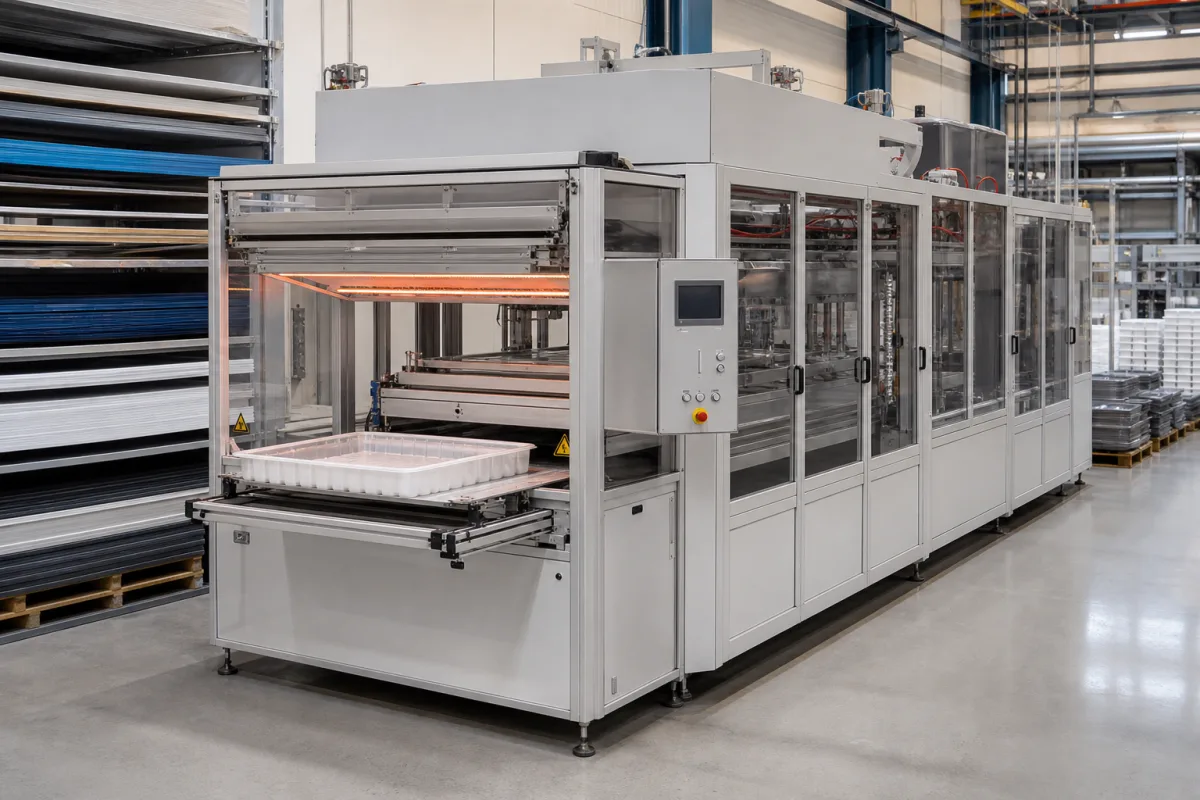
Industrial Vacuum Forming Machine

Based on aggregated insights from multiple verified factory profiles within the CNFX directory, the standard Industrial Vacuum Forming Machine used in the Manufacture of Domestic Appliances sector typically supports operational capacities ranging from standard industrial configurations to heavy-duty production requirements.

Technical Definition & Core Assembly

A canonical Industrial Vacuum Forming Machine is characterized by the integration of Heating Oven and Vacuum Chamber. In industrial production environments, manufacturers listed on CNFX commonly emphasize Stainless Steel 304 construction to support stable, high-cycle operation across diverse manufacturing scenarios.

Industrial machine that thermoforms plastic sheets into appliance components using vacuum pressure.
Product Specifications

Technical details and manufacturing context for Industrial Vacuum Forming Machine

Definition
An industrial vacuum forming machine is a specialized manufacturing equipment used in domestic appliance production lines to create plastic housing components, interior liners, and structural parts. It operates by heating thermoplastic sheets to a pliable state, then using vacuum pressure to draw the material over precision molds to achieve consistent dimensional accuracy. This machine enables high-volume production of refrigerator door liners, washing machine control panels, dishwasher tubs, and other complex plastic components with uniform wall thickness and surface finish. It serves as a critical capital equipment in appliance manufacturing facilities, allowing for rapid prototyping and mass production of plastic parts with minimal material waste compared to injection molding for certain applications.
Working Principle
Plastic sheet is clamped and heated until pliable, then vacuum pressure draws it onto a mold where it cools and solidifies into the desired shape.
Common Materials
Stainless Steel 304, Aluminum Alloy 6061, Industrial-grade Silicone
Technical Parameters
  • Maximum forming area dimensions (mm) Per Request
  • Maximum draw depth capability (mm) Per Request
Components / BOM
  • Heating Oven
    Evenly heats plastic sheets to forming temperature
    Material: Stainless Steel with ceramic heating elements
  • Vacuum Chamber
    Creates negative pressure to draw material onto mold
    Material: Aluminum alloy frame with acrylic viewing panels
  • Clamping Frame
    Secures plastic sheet during heating and forming
    Material: Hardened steel with pneumatic actuators
  • Mold Platform
    Supports and positions forming molds
    Material: Aluminum alloy with T-slots for mold mounting
  • Vacuum Pump System
    Generates required vacuum pressure for forming
    Material: Cast iron pump housing with stainless steel components
  • PLC Control System
    Automates heating, forming, and cooling cycles
    Material: Industrial-grade electronics in steel enclosure
Engineering Reasoning
0.8-1.2 bar vacuum pressure, 150-220°C heating temperature, 0.5-3.0 mm/s forming speed
Vacuum pressure below 0.6 bar causes incomplete forming; heating element temperature exceeds 280°C causing polymer degradation; forming speed below 0.3 mm/s results in thermal degradation
Design Rationale: Insufficient vacuum pressure fails to overcome atmospheric pressure (101.325 kPa) for proper mold contact; excessive heating exceeds polymer glass transition temperature (Tg) by >100°C causing chain scission; slow forming allows excessive heat transfer causing non-uniform crystallization
Risk Mitigation (FMEA)
Trigger Vacuum pump motor bearing wear exceeding 0.1 mm radial play
Mode: Vacuum pressure decay below 0.6 bar within 30 seconds
Strategy: Install vibration monitoring sensors with 0.01 mm resolution and automatic shutdown at 0.08 mm wear threshold
Trigger Heating element ceramic insulation breakdown at 650°C localized hotspots
Mode: Polymer sheet thermal degradation with 15% thickness variation
Strategy: Implement infrared thermal imaging with 2°C resolution and PID control maintaining ±5°C uniformity

Industry Taxonomies & Aliases

Commonly used trade names and technical identifiers for Industrial Vacuum Forming Machine.

Industrial Ecosystem & Supply Chain DNA

Complementary Systems
Downstream Applications
Specialized Tooling

Application Fit & Sizing Matrix

Operational Limits
pressure: 0.8-1.2 bar vacuum pressure (typical forming pressure)
other spec: Sheet thickness: 0.5-6 mm, Cycle time: 30-120 seconds, Max mold size: 1500x1000 mm
temperature: 150-300°C (thermoforming temperature range)
Media Compatibility
✓ ABS plastic sheets ✓ Polycarbonate sheets ✓ High-impact polystyrene
Unsuitable: Continuous high-moisture environments (causes mold corrosion and electrical issues)
Sizing Data Required
  • Maximum part dimensions (LxWxH)
  • Required production rate (parts/hour)
  • Plastic sheet material type and thickness

Reliability & Engineering Risk Analysis

Failure Mode & Root Cause
Heating element degradation
Cause: Cyclic thermal stress from repeated heating/cooling cycles causing element fatigue, oxidation, and reduced heating efficiency
Vacuum seal failure
Cause: Wear and compression set of elastomeric seals due to repeated clamping cycles, temperature exposure, and particulate contamination
Maintenance Indicators
  • Inconsistent vacuum pressure readings or inability to maintain set vacuum levels during forming cycles
  • Uneven or incomplete plastic sheet forming with visible wrinkles, thin spots, or poor detail reproduction
Engineering Tips
  • Implement predictive maintenance using infrared thermography to monitor heating element temperature uniformity and identify failing elements before complete failure
  • Establish a preventive seal replacement schedule based on cycle count rather than time, and maintain proper seal lubrication with manufacturer-approved compounds

Compliance & Manufacturing Standards

Reference Standards
ISO 12100:2010 Safety of machinery - General principles for design - Risk assessment and risk reduction ANSI B151.1 Plastic and Rubber Machinery - Safety Requirements for Injection Molding Machines CE Marking (Machinery Directive 2006/42/EC) for conformity with EU health, safety, and environmental protection standards
Manufacturing Precision
  • Heater Plate Flatness: +/-0.1mm across entire surface
  • Platen Parallelism: +/-0.05mm between upper and lower platens
Quality Inspection
  • Vacuum Leak Test (pressure decay method) to ensure seal integrity
  • Thermal Uniformity Test (infrared thermography) across heating elements

Factories Producing Industrial Vacuum Forming Machine

Verified manufacturers with capability to produce this product in China

✓ 95% Supplier Capability Match Found

P Project Engineer from Brazil Feb 18, 2026
★★★★★
"Standard OEM quality for Manufacture of Domestic Appliances applications. The Industrial Vacuum Forming Machine arrived with full certification."
Technical Specifications Verified
S Sourcing Manager from Canada Feb 15, 2026
★★★★★
"Great transparency on the Industrial Vacuum Forming Machine components. Essential for our Manufacture of Domestic Appliances supply chain."
Technical Specifications Verified
P Procurement Specialist from United States Feb 12, 2026
★★★★★
"The Industrial Vacuum Forming Machine we sourced perfectly fits our Manufacture of Domestic Appliances production line requirements."
Technical Specifications Verified
Verification Protocol

“Feedback is collected from verified sourcing managers during RFQ (Request for Quote) and factory evaluation processes on CNFX. These reports represent historical performance data and technical audit summaries from our B2B manufacturing network.”

19 sourcing managers are analyzing this specification now. Last inquiry for Industrial Vacuum Forming Machine from USA (1h ago).

Frequently Asked Questions

What materials can this industrial vacuum forming machine process for appliance manufacturing?

This machine is designed to thermoform various plastic sheets commonly used in domestic appliance production, including ABS, HIPS, PVC, and PETG, with a maximum sheet thickness specified for optimal performance.

How does the PLC control system improve vacuum forming efficiency for appliance components?

The PLC control system automates the entire forming cycle, ensuring precise temperature control, consistent vacuum pressure, and repeatable results, which reduces cycle time and minimizes material waste in high-volume appliance manufacturing.

What maintenance is required for the vacuum pump system in industrial forming operations?

Regular maintenance includes checking oil levels, cleaning filters, and inspecting seals to maintain optimal vacuum pressure. The industrial-grade construction with stainless steel and aluminum alloy components ensures durability with minimal downtime.

Can I contact factories directly on CNFX?

CNFX is an open directory, not a transaction platform. Each factory profile provides direct contact information and production details to help you initiate direct inquiries with Chinese suppliers.

Get Quote for Industrial Vacuum Forming Machine

Request technical pricing, lead times, or customized specifications for Industrial Vacuum Forming Machine directly from verified manufacturing units.

Your business information is encrypted and only shared with verified Industrial Vacuum Forming Machine suppliers.

Thank you! Your message has been sent. We'll respond within 1–3 business days.

Need to Manufacture Industrial Vacuum Forming Machine?

Connect with verified factories specializing in this product category

Add Your Factory Contact Us
Previous Product
High-Temperature Silicone Rubber Compound
Next Product
Industrial Washing Machine Drum Forming Press