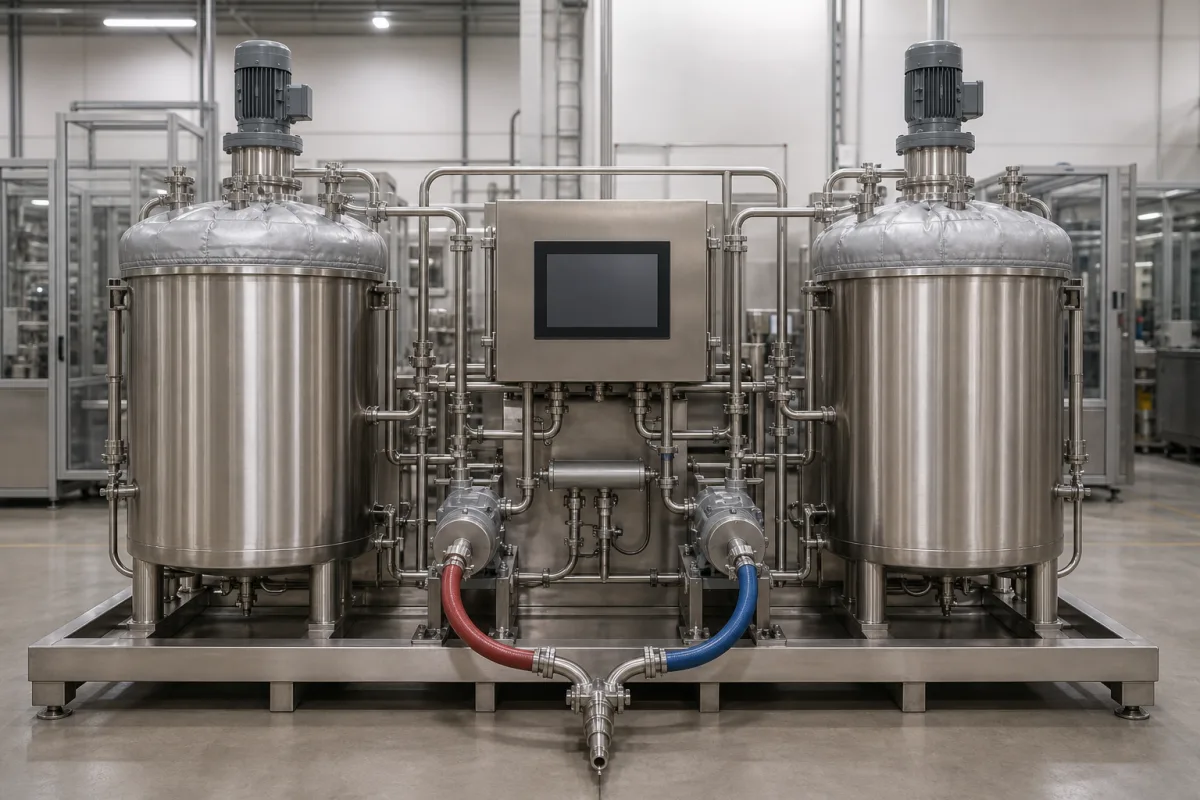
Resin storage and metering system for cast-resin transformer coils: separate resin and hardener premix tanks, piston dosing pumps and a static mixer for filled epoxy
Cast-resin dry-type transformer coils · two heated premix tanks for resin and hardener with quartz filler, thin-film vacuum degassing, ceramic piston dosing pumps on one synchronised drive, and a heated static mixer feeding the moulds
A cast-resin dry-type transformer coil is embedded in epoxy loaded with quartz filler. The resin side and the hardener side are prepared separately, each with its own share of filler, and only meet in a mixer on the way into the mould. The storage and metering system decides whether the two streams arrive in the right ratio, free of gas, and without the filler settling out or wearing the pumps away.
Storage, degassing and metering equipment for two-component filled epoxy used to vacuum-cast the windings of dry-type transformers and similar high-voltage parts: resin and hardener premix tanks with filler feeding, thin-film vacuum degassing, heating, dosing pumps for abrasive media, static mixers and the controls that set the filling rate into the mould. Vacuum pressure impregnation vessels and their resin systems are covered on the Vacuum pressure impregnation (VPI) chamber page, and chilled storage of one-component impregnating resin on the Resin storage and conditioning skid for winding impregnation page; piston boosters on the Pressure intensifier page. The casting compound itself is covered on the Electrical insulation epoxy casting compound page, and A/B metering for liquid silicone rubber on the LSR metering and mixing unit for silicone injection moulding page.
CNFX editorial research · Sources checked October 13, 2026 · 4 sources
Two premix tanks: resin with filler, flexibiliser and colour on one side, hardener with filler and accelerator on the other
A Bharat Heavy Electricals (BHEL) specification for a vacuum resin casting plant for F- and H-class dry-type transformer coils with quartz filler asks for automatic drying, degassing and dosing of liquid epoxy resin, hardener and quartz filler as single components under vacuum, in two thin-film degassing mixers sized together for a final quantity of 300 litres. [1]
Wilhelm Hedrich Vakuumanlagen's patent EP 0 206 309 B1 (granted 1993) explains why such tanks keep their contents moving: circulating each component holds the fillers in suspension, degasses it when the tank is under vacuum, and evens out its temperature. The patent also prefers spreading the circulated mass into thin layers from which trapped gas escapes more easily, and sloping tank bottoms so the filler does not settle. [2]
Item in the BHEL specification
What it asks for
Resin premix mixer
Thin-film degassing mixer for resin, flexibiliser, colour and quartz powder, with mixing, degassing and homogenising device and vacuum rotary seal [1]
Hardener premix mixer
Same design for hardener, accelerator and quartz filler [1]
Mixer fittings
Illuminated sight glass, temperature sensor shown on the monitor, minimum and maximum level probes, three valves for resin, hardener and flexibiliser, vacuum gauge, water-cooled separator to protect the vacuum pump [1]
Mixer heating
Hot water in forced circulation through a double wall, supply temperature up to 90 °C [1]
Filler feed
Dust-free emptying station for SiO₂ filler sacks with vibrator, conveyor screw, Y-pipe with automatic valves and an electronic platform balance, feeding both mixers [1]
Minor components
Accelerator dosing vessel with scale and level control; pneumatic press for high-viscosity colour paste straight from the drum [1]
Give the resin system's mix ratio by weight, the filler content and grade, the batch volume per casting cycle, and the premix temperature the resin maker sets, so tank size, heating and filler feed can be matched.
02
Dosing a quartz-filled resin: ceramic pistons, gap cooling and one synchronised drive so a static mixer is enough
BHEL specifies one dosing pump for each premix, built for abrasive media with the dosing piston and sleeve in ceramic and additional gap cooling, non-return valves, and a hydraulic synchronising drive with a hydraulic cylinder so that every stroke doses exactly; the pumps sit directly on the outside of the mixers in their own housing. [1]
The Hedrich patent describes the earlier arrangement, in which each tank had its own circulation pump and its own metering pump, each with a separate drive. Because metering there was by quantity alone, the mixer had to work the components hard and was complicated. Its answer puts a circulation piston and a metering piston on one piston rod for each tank, drives all rods from one device so that they convey synchronously, and uses a continuous mixer; synchronous operation, the patent says, allows a static mixer. A valveless pump design is preferred for viscous masses that may contain abrasive fillers. [2]
Downstream, BHEL asks for a stainless static flow mixer with heating and cooling pockets that can be cleaned even if material cures in it unintentionally, four valves for inlet and circulation, and a temperature sensor that releases casting only when the resin temperature is within a preset value. The mixer, the line to the casting nozzles and the dosing pumps share a heating and cooling unit running between 15 °C and 90 °C supply temperature, and the plant has 16 programme-controlled casting valves that can be heated or cooled. [1]
Ask how the ratio is held (mechanical or hydraulic coupling of the two pistons), what the wetted pump parts are made of, and how the mixer is cleared if resin gels in it.
03
Filling the coil mould: programmed filling rate, a circulating fill and the casting vacuum
Hedrich's US patent 5,551,486 (1996) sets out why the rate of filling matters for cast insulators: resin from a pressurised vessel ages and its viscosity changes, so the pressure has to be readjusted constantly, and compressed air puts gas back into a vacuum-prepared mass; even a continuous meter-mix supply holds a steady filling rate only while viscosity stays constant. [3]
The patent fills each mould according to a programmed filling function, the quantity of resin per unit time, using a metering pump followed by a piston buffer: during each pump stroke part of the flow goes to the mould and part into the buffer, which then feeds the mould while the pump refills. The actual rate can also be measured from the weight loss of the tank or vessel and corrected. [3]
Volta-Werke's patent EP 0 118 073 B1 (1986), written for the high-voltage windings of dry-type transformers, goes further: a pump pushes resin into the evacuated mould from below, resin leaving a riser on the mould returns to the vacuum storage vessel and is spread into a thin film over a cone before falling back, and the mould is flushed with a multiple of the quantity one casting needs until that film is free of bubbles. The pressure in the filled mould is then raised above 1 bar before the lines are disconnected for curing. [4]
For the casting tank itself, BHEL asks for a welded vessel of 3,500 mm diameter and 5,000 mm length designed for 0.01 Torr and 3 kg/cm², a leakage rate of no more than 0.01 mbar·l/s, and a pumping unit for an operating vacuum of 1 mbar. Editorial calculation: 0.01 Torr is about 0.013 mbar, and 3 kg/cm² is about 2.9 bar. [1]
04
Data for a cast-resin storage and metering system
Paste it into your enquiry below or into an email to a maker, then replace every bracket.
Resin system: [resin, hardener, accelerator, flexibiliser; mix ratio by weight; pot life]
Filler: [type; grade; content in each premix; sack or bulk feed]
Batch: [premix volume per tank; moulds per cycle; resin per coil]
Conditioning: [premix temperature; degassing vacuum; heating medium]
Dosing: [pump type; wetted materials; ratio coupling; flow range]
Mixing and casting: [static mixer; number of casting valves; filling-rate programme]
Casting tank: [size; vacuum; overpressure; leak rate]
Explore company information and manufacturing capabilities, then discuss the scope of your project with a relevant supplier.
Share this page
Compiled and source-reviewed by the CNFX editorial team.
Each manufacturer above links to the page on that company's own website where the product is listed, with the date we checked it. How we source and review
· Page last updated 13 October 2026
Buyer questions
Why are resin and hardener stored in separate tanks?
They react once mixed, so each is prepared with its share of filler in its own degassing mixer and they meet only in the static mixer before the mould, as in BHEL's transformer casting plant specification. [1]
Why do filled resin tanks need stirring or circulation?
Hedrich's patent states that circulation keeps fillers in suspension, degasses the mass under vacuum and evens out its temperature; it also uses sloping tank bottoms against settling. [2]
What dosing pump suits quartz-filled epoxy?
BHEL specifies piston dosing pumps for abrasive media with ceramic piston and sleeve, gap cooling and hydraulic synchronisation of the two pumps. [1]
How is the mould filled without bubbles?
Volta-Werke's patent pumps resin in from below under vacuum and recirculates it through the mould into a thin film in the storage vessel until the film is bubble-free, then raises the pressure above 1 bar. [4]
Sources and what still needs a direct check
Sources checked 2026-10-13. A Bharat Heavy Electricals purchase specification for a dry-type transformer vacuum resin casting plant, two Wilhelm Hedrich Vakuumanlagen patents on synchronised piston metering and programmed mould filling, and a Volta-Werke patent on circulating, thin-film degassed casting of transformer windings.