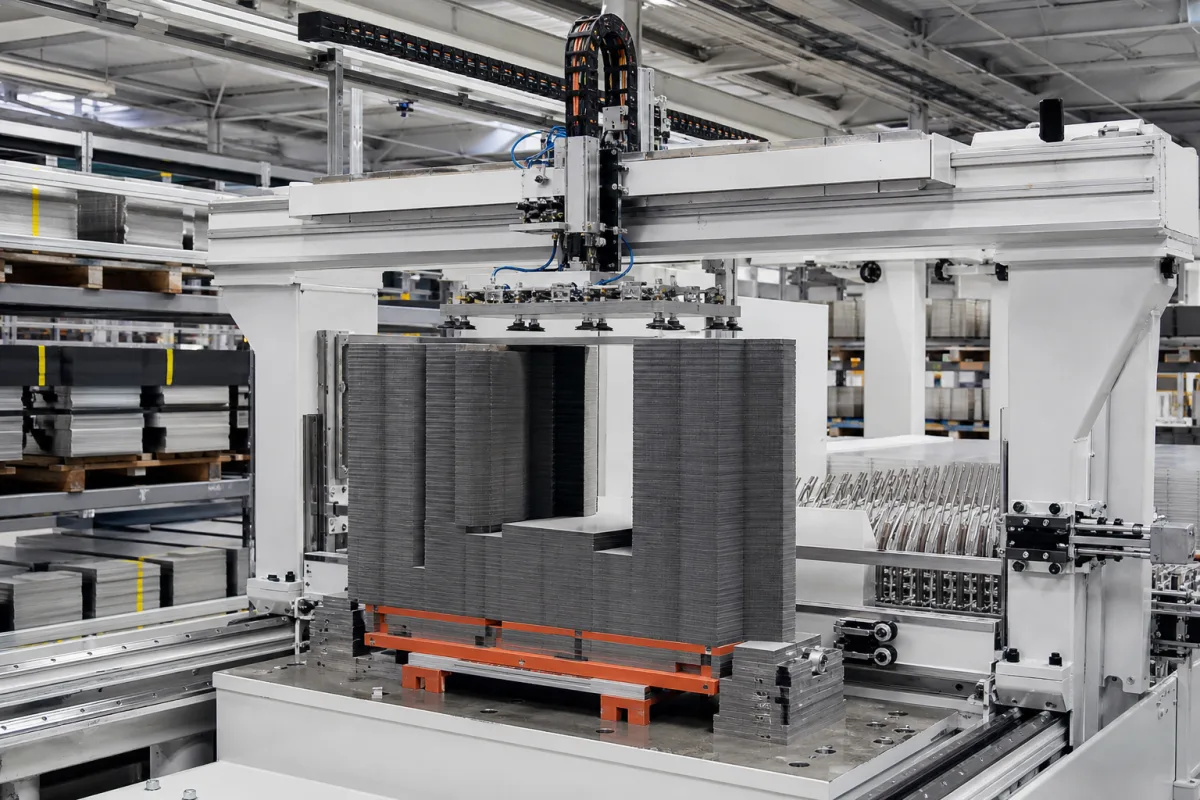
Automatic stacking systems for stacked transformer cores · lamination width, inline vs offline stacking, E-stacking with grippers or robots, step-lap patterns, stacking rate in sheets per minute, stack height control, sheet thickness
A transformer core stacking machine takes the grain-oriented silicon steel sheets cut by a core cutting line and lays them into legs, yokes or complete E-shaped cores, replacing manual stacking. Ask three things first: the lamination widths and core sizes it must handle; whether it stacks inline behind your cutting line or offline from pre-cut sheets, and how far it goes (sheet piles, separate legs and yokes, or a complete core); and the output in stacked sheets per minute for your step-lap pattern.
Automatic and semi-automatic stacking systems for stacked (cut-sheet) transformer and reactor cores: timing-belt and pick-and-place stackers on core cutting lines, inline and offline E-stackers, robot stackers, and EI lamination stacking and inserting machines for small transformers. Core cutting lines themselves, wound-core forming machines, coil winding machines, motor lamination stacking and electrical steel are outside this page except where compared.
CNFX editorial research · Sources checked October 11, 2026 · 5 sources
Tuboly-Astronic's core manufacturing leaflet shows how stacking systems are sized by lamination width and by how much of the core they build. Its conveyor stacker CSB2 handles 250 mm laminations for small distribution transformer cores; the timing-belt CSC2 handles 250, 450 or 650 mm on two levels, with or without pins; the five-position CSD(M)5 handles 250, 350 or 450 mm and stacks all three legs and both yokes from a full sequential cutting process, with automatic stack height control and compensation; and the CSA2 and CSI2 take 650 to 1,250 mm laminations. Its pick-and-place CSP uses two grippers that alternately pick sheets from the timing belt onto pallets on the left and right side, for 450 to 1,050 mm widths. [1]
The highest-automation concepts build the whole core. Tuboly-Astronic's inline E-stacking systems CSE and CSEC (450 to 1,050 mm) produce stacked 2- and 3-leg cores inline with the cutting line, with automatic stack height control, single-log production on separate pallets and an up-ending station. Its offline E-stacker CSO works independently of the cutting line for power transformer cores up to five legs, and lists detection of each sheet's position on the stack, measurement and correction of the air gap, detection of yoke-to-leg overlap and wrong sheets, and automatic change between core steps. [1]
Robot stacking is the other route. L.A.E.'s TO 25 AGILE core cutting line produces grain-oriented laminations of up to 250 mm width for step-lap distribution transformer cores from 50 to 2,500 kVA; its optional robot stacker assembles cores up to 1,500 mm long, measured tip to tip, and handles flat yokes, closed cores, E-cores or separate logs. [3]
Give the supplier the lamination width range, sheet lengths and core shapes (2-leg, 3-leg, 5-leg, E-core with open or closed top yoke), the transformer rating range, the cutting line it must work with or whether it stacks offline, how far the machine should build the core (sheet piles, legs and yokes, or the complete core on a pallet), pin or pinless stacking, maximum core height and weight, required output, floor space and controls.
02
Set the step-lap pattern, sheet thickness and output
A Westinghouse patent on step-lap cores describes the joint the stacker has to reproduce: the butt joints of each layer are offset in successive layers in the same direction to create at least three steps, and preferably at least six or seven, before the pattern repeats; it gives about 0.200 inch as a suitable step increment and notes that the best performance comes with one lamination per step, while a six-step pattern with two laminations per step gives 12 laminations per group. [4] An LSIS patent describes core laminations of silicon steel sheets with 3 to 4% silicon and a thickness of 0.23 to 0.35 mm. [5]
Tuboly-Astronic rates its CCM 450 core cutting line with the automated E-stacking system CSEC-2500 at a maximum of 40 stacked sheets per minute; the E-stacker has five independent grippers (two yokes, two side legs and one centre leg), two automatically positioned overhead stacking pins, and two stacking pallets with one up-ending station as standard. [2]
Editorial calculation: 40 sheets per minute is 40 × 60 = 2,400 sheets per hour. Ignoring the stacking factor, 100 mm of core build needs about 100 ÷ 0.23 ≈ 435 sheets of 0.23 mm steel or 100 ÷ 0.35 ≈ 286 sheets of 0.35 mm steel, about 10.9 or 7.1 minutes at that rate; the step increment of 0.200 inch is 0.200 × 25.4 ≈ 5.08 mm. [2][5][4]
03
EI lamination stacking and inserting machines for small transformers
The reviewed listing covers EI lamination stacking and inserting machines for small transformers, which push E and I laminations into wound bobbins, rather than stackers for distribution or power transformer cores; ask which core sizes and lamination types each machine handles.
04
Cutting-line interface, timing belts, grippers, stacking pins and height control
The gripper row separates the concepts: Tuboly-Astronic's CSEC-2500 E-stacker uses five independent grippers for two yokes, two side legs and the centre leg, while L.A.E. offers a robot stacker on its cutting line. [2][3]
Element
Role
Fix in the order
Cutting line interface
Inline stackers take sheets from V-notch, hole-punch and 45°/135° shearing tools. [1]
Lamination width, sheet thickness, step-lap pattern and sheets per minute for a stacker quotation
Only four rows carry a published figure — width, thickness, step-lap and the 40 sheets per minute of one line; stack height, accuracy, power and footprint have to come from the bidder's offer. [1][2]
Field
What it means and published values
Ask the supplier for
Maximum stack height
Not stated in reviewed sources.
mm of core build.
Stacking pressure
Not stated in reviewed sources.
Clamping method.
Lamination size range
Widths 250 to 1,250 mm by model; robot cores to 1,500 mm tip to tip. [1][3]
Width, length.
Positioning accuracy
Not stated in reviewed sources; offline E-stacker measures and corrects air gap. [1]
mm, how measured.
Power consumption
Not stated in reviewed sources.
kW.
Machine footprint
Not stated in reviewed sources.
Layout drawing.
Operating pressure
Not stated in reviewed sources.
Air supply.
Cycle time
Max. 40 stacked sheets per minute (CCM 450 with CSEC-2500). [2]
1 company lists this product among what they make. Company figures are quoted from each
company's own website; every card states where the relationship came from.
Grewin Industrial Group Co., Ltd.
Manufacturing site to be confirmed for the order
Lists EI lamination stacking and inserting machines for small transformers, including the GWH-EI114 for EI-28 to EI-162 laminations.
Explore company information and manufacturing capabilities, then discuss the scope of your project with a relevant supplier.
Share this page
Compiled and source-reviewed by the CNFX editorial team.
Each manufacturer above links to the page on that company's own website where the product is listed, with the date we checked it. How we source and review
· Page last updated 13 October 2026
Buyer questions
How fast can an automatic E-stacker lay transformer laminations?
Tuboly-Astronic rates its CCM 450 line with the CSEC-2500 E-stacker at up to 40 stacked sheets per minute. [2]
How many steps does a step-lap joint use?
A Westinghouse patent calls for at least three steps, preferably six or seven, before the pattern repeats. [4]
What lamination widths do core stacking systems handle?
Tuboly-Astronic lists stackers from 250 mm up to 1,250 mm lamination width, depending on model. [1]
Sources and what still needs a direct check
Sources checked 2026-10-11. The sources are a stacking-system maker's leaflet and magazine item, a trade-magazine article on a cutting line with robot stacking, and two patents on step-lap and stacked transformer cores.