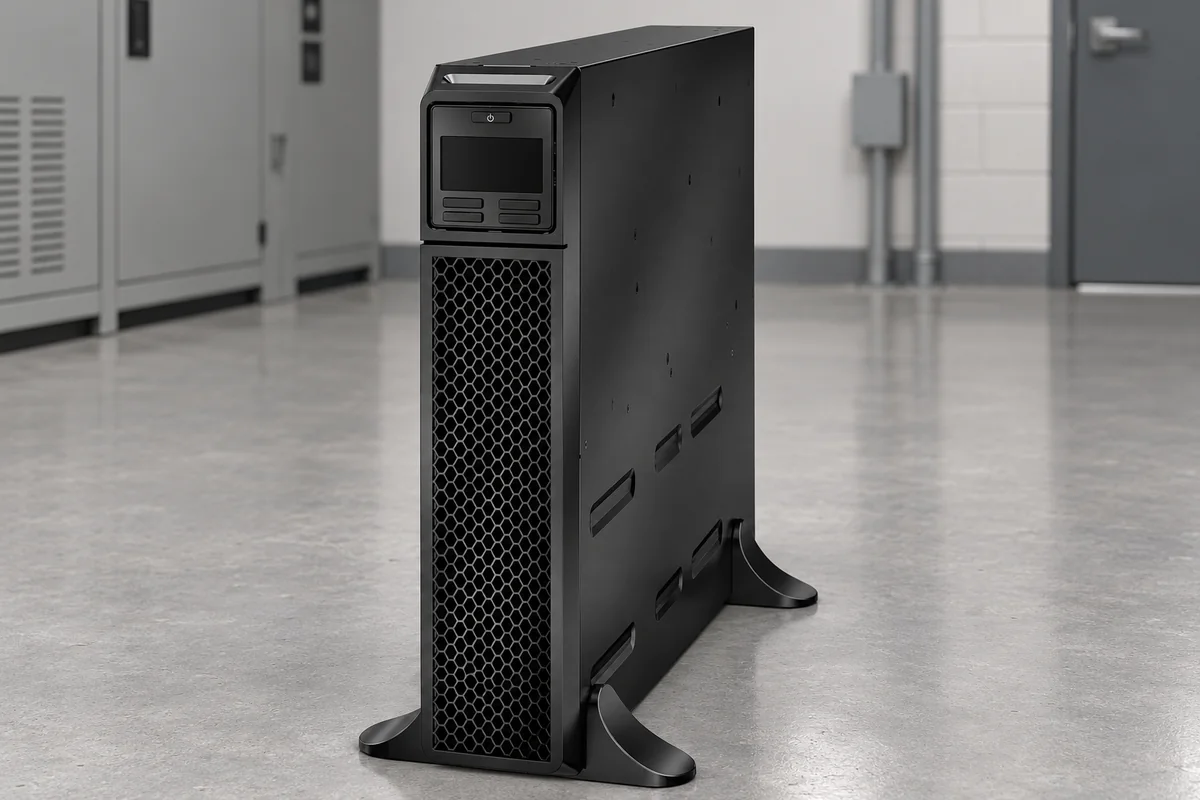
Uninterruptible power supplies · VFD, VI and VFI input dependency, normal, battery and bypass modes, loading-weighted average efficiency, efficiency minimums by rating, modular and multi-mode units
An uninterruptible power supply (UPS) keeps a load running when mains power fails or goes out of tolerance: a rectifier/charger keeps a battery charged, an inverter supplies the load from the battery, and a bypass path carries the load during faults or maintenance. Ask three things first: how independent the output must be from input disturbances (VFD, VI or VFI), what power and runtime the load needs, and how efficient the unit is at the load it will actually carry.
AC-output UPSs from desktop units to large three-phase systems, single- or multiple-normal-mode and modular, with lead-acid or lithium batteries. Voltage stabilisers without stored energy, standby generators, inverters for solar systems and DC rectifier systems are outside this page except where compared.
CNFX editorial research · Sources checked October 12, 2026 · 4 sources
The ENERGY STAR Program Requirements for UPSs (Version 2.0), following US DOE test definitions, class AC-output UPSs by input dependency: a voltage and frequency dependent (VFD) UPS produces output whose voltage and frequency depend on the input; a voltage independent (VI) UPS also protects the load from continuous under- and over-voltage, its output staying within a voltage band narrower than the input window while its frequency follows the input; and a voltage and frequency independent (VFI) UPS stays in normal mode producing output independent of input voltage and frequency variations without drawing on its stored energy. It defines normal, battery (stored-energy) and bypass modes, maintenance and automatic bypass paths, and multiple-normal-mode UPSs that can run as, for example, VFI or VFD. [2]
Editorial note: VFI units protect against the widest range of input disturbances; multiple-normal-mode units may offer a higher-efficiency mode, so ask which mode the unit ships in and under which conditions it changes mode.
Give the supplier the load (kW and kVA, power factor, inrush), input supply (voltage, phases, frequency, generator backup), required input dependency (VFD, VI or VFI), runtime at full and actual load, battery chemistry and life, bypass and maintenance bypass needs, redundancy (N+1, modular), efficiency and heat-load limits, communication and monitoring, environment and footprint, and the efficiency or safety certifications required.
02
Check the efficiency at the load you will run
ENERGY STAR measures efficiency at 25, 50, 75 and 100% of the reference load and averages it with time weights that depend on size: for units of 1,500 W to 10 kW, 30% of time at 50%, 40% at 75% and 30% at 100% load; above 10 kW, 25% at 25%, 50% at 50% and 25% at 75%. Its minimum average efficiencies are 98.2% (VFD) and 98.4% (VI) for 350–1,500 W; 98.1% and 98.0% for 1.5–10 kW; 97.0% and 94.0% above 10 kW; and for VFI units 0.011 × ln(P) + 0.824 up to 1.5 kW, 0.0145 × ln(P) + 0.800 for 1.5–10 kW and 0.0058 × ln(P) + 0.886 above 10 kW, where P is the rated output in watts, with a 0.004 allowance for modular units of 1.5–10 kW. [2]
Editorial calculation: for a 6 kW VFI UPS, 0.0145 × ln(6,000) + 0.800 ≈ 0.926, so the ENERGY STAR minimum average efficiency is about 92.6%; at full load such a unit would turn about 6,000 × (1/0.926 − 1) ≈ 480 W into heat. For a 1 kW VFI unit the formula gives about 90.0%, and for 100 kW about 95.3%. Ratings are assumed examples; ask for measured efficiency curves and compare them at your real load.
US federal standards in 10 CFR 430.32(z)(3) also set minimum average load-adjusted efficiencies for UPSs made from 10 January 2022 that use a NEMA 1-15P or 5-15P plug and have an AC output, by class (VFD, VI, VFI) and rated output power. [1] Editorial calculation: for a 1,000 W VFI unit, the formula above 700 W, −1.70 × 10⁻⁸ × P² + 3.85 × 10⁻⁵ × P + 0.876, gives about 0.898, close to the ENERGY STAR figure of about 0.900 for the same size.
A maker's sheet shows the figures to compare against that minimum. Eaton's technical specifications for its 9PX G2 5–6 kVA double-conversion online UPS (February 2025) list efficiency of 96.5% in online mode, 99% in high-efficiency mode and 94% on battery, with 0 ms transfer time; heat dissipation for the 6 kVA unit of 767 BTU/h online, 205 BTU/h in high-efficiency mode and 1,155 BTU/h on battery; full-load input range of 176–276 V (derated to 100 V), input power factor above 0.99 and input current THD below 3% (linear load); output regulation of ±1% with voltage THD below 1%; output power factor 1.0 (0.9 on the 6 kVA L6-30P model); audible noise below 42 dB at 1 m; operating temperature 0–40 °C; and up to 12 external battery modules. [3]
Editorial calculation: at 6 kW output and 96.5% efficiency the losses are about 218 W (6,000 ÷ 0.965 − 6,000), or about 743 BTU/h, close to the 767 BTU/h Eaton lists; its high-efficiency mode at 205 BTU/h is about 60 W, so the mode choice changes cooling load by about 165 W per unit (767 BTU/h ≈ 225 W). Both online figures sit above the ≈92.6% ENERGY STAR minimum worked out above. [3][2]
03
Compare what suppliers offer
Suppliers linked to this page list UPS units; each card links to the page reviewed.
Listings include UPSs with inverters and batteries, UPSs alongside voltage stabilisers and regulators, and UPSs from broadcast equipment makers. Companies listing only UPS parts (cooling plates, PCB assemblies) or battery-backed products such as sirens and lights are hidden here. Ask each for topology, efficiency curve, runtime, battery type and certifications.
04
Compare three-phase efficiency by load point and operating mode
Schneider Electric's Galaxy VS efficiency tables list each three-phase rating at 25, 50, 75 and 100% load and at 380, 400 and 415 V, separately for normal operation, ECO mode, eConversion and battery operation. At 400 V the 20 kW unit with external batteries lists 94.4% at 25% load and 96.9% at full load in normal operation, against 96.7% to 98.9% in ECO mode; the 100 kW unit lists 96.6% at 25% load and 96.8% at full load in normal operation, and 98.8% to 99.3% in ECO mode. [4]
Editorial calculation: the ENERGY STAR weights above 10 kW (25% of time at 25% load, 50% at 50%, 25% at 75%) applied to normal operation give about 95.8% for the 20 kW unit (0.25 × 94.4 + 0.5 × 96.1 + 0.25 × 96.6), against a VFI minimum of about 94.3% (0.0058 × ln(20,000) + 0.886), and about 97.0% for the 100 kW unit against about 95.3%. At 50 kW output the 100 kW unit loses about 1.49 kW in normal operation (50 ÷ 0.971 − 50) and about 0.45 kW in ECO mode (50 ÷ 0.991 − 50). Ask which mode each quoted figure applies to. [4][2]
Load point (400 V)
20 kW: normal / ECO
100 kW: normal / ECO
25% load
94.4% / 96.7%
96.6% / 98.8%
50% load
96.1% / 98.2%
97.1% / 99.1%
75% load
96.6% / 98.7%
97.1% / 99.3%
100% load
96.9% / 98.9%
96.8% / 99.3%
05
Trace the UPS blocks
This is a functional reference built from the sources cited; it is not one maker's specification.
Fill the specification fields with values for your load
A UPS quotation needs values for your load. The table explains each field, gives published values where a reviewed source states them, and says what to obtain from the supplier.
Explore company information and manufacturing capabilities, then discuss the scope of your project with a relevant supplier.
Share this page
Compiled and source-reviewed by the CNFX editorial team.
Published product pages show what a company offers, not tested performance. Confirm the legal seller, factory and scope for your order. How we source and review
· Page last updated 13 October 2026
Buyer questions
What do VFD, VI and VFI mean?
ENERGY STAR classes UPSs as voltage and frequency dependent (VFD), voltage independent (VI) or voltage and frequency independent (VFI), by how far the output is protected from input variations. [2]
How efficient should a UPS be?
ENERGY STAR sets minimums by rating and type, e.g. 97.0% (VFD) and 94.0% (VI) above 10 kW; for a 6 kW VFI unit its formula gives about 92.6%. [2]
Why is efficiency averaged over four load points?
ENERGY STAR weights measured efficiency at 25, 50, 75 and 100% load with time proportions that depend on the UPS rating. [2]
How efficient is a 6 kVA online UPS in practice?
Eaton's 9PX G2 specification lists 96.5% in online mode, 99% in high-efficiency mode and 94% on battery, with heat output of 767 BTU/h online for the 6 kVA unit. [3]
How much does ECO mode change three-phase UPS efficiency?
Schneider Electric's Galaxy VS efficiency tables list the 100 kW unit at 400 V at 97.1% in normal operation and 99.1% in ECO mode at 50% load. [4]
Sources and what still needs a direct check
Sources checked 2026-10-12. The ENERGY STAR UPS specification is a US EPA program requirement for qualifying UPSs; 10 CFR 430.32 is the US federal efficiency standard for plug-in UPSs. Both define input dependency classes and efficiency minimums.