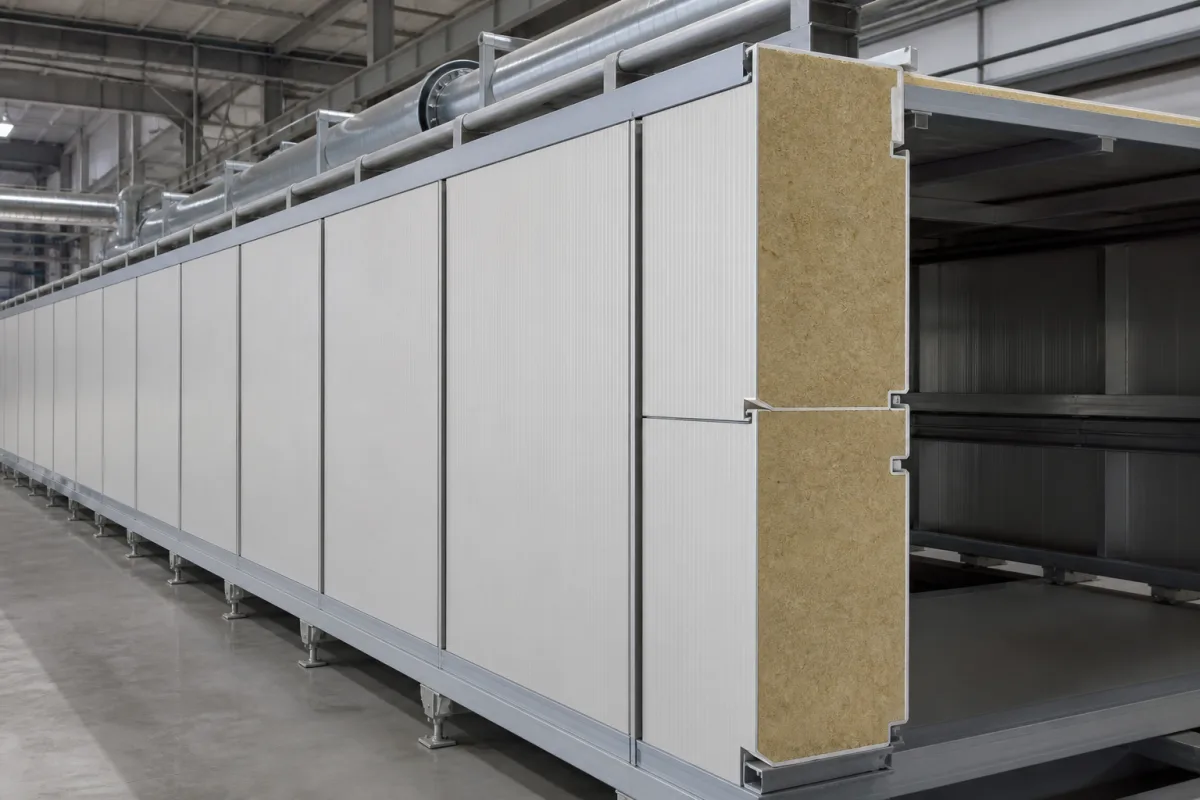
Insulated sandwich panels for enclosures, cold rooms and tunnel housings
Metal-faced sandwich panels · Core material and U-value by thickness, reaction to fire and fire resistance, facings, joints and tolerances
Insulated panels are factory-made sandwich elements with an insulating core bonded between two coated steel facings, joined edge to edge to form walls, ceilings and enclosures such as cold rooms, clean rooms and the housings of process tunnels. Ask three things first: which core material and thickness give the thermal value you need, what reaction-to-fire and fire-resistance classes the panel has for your use, and which facings, joints and seals the enclosure needs.
Self-supporting double-skin metal-faced insulating panels with mineral wool, PIR/PU or EPS cores for walls, ceilings and enclosures. Loose insulation boards, single-skin cladding, honeycomb and magnesium-oxide boards, and complete cold-room refrigeration systems are outside this page.
CNFX editorial research · Sources checked October 12, 2026 · 4 sources
Pick the core material and thickness for the thermal value
A SINTEF technical approval (2016) for Ruukki's mineral wool core panels gives declared thermal conductivity λD of 0.039–0.045 W/mK depending on the stone or glass wool grade, core densities of 58–120 kg/m³, and U-values calculated to EN 14509:2013 and EN ISO 6946 from 0.49 W/m²K at the 80 mm class to 0.17 W/m²K at the 230 mm class for its standard wall panel; the denser fire-structure grade at λD 0.045 runs from 0.54 to 0.19 W/m²K. [1]
Kingspan's KSN1100CS coldstore panel, with a polyisocyanurate (PIR) core, lists material R-values of 2.1 to 9.02 m²K/W for 50 to 200 mm cores (4.31 at 100 mm), aged values at 15 °C to AS/NZS 4859, and installed R-values including air films of 2.22 to 9.14 m²K/W. [2] Editorial calculation: 100 mm / 4.31 m²K/W implies about 0.023 W/mK for the PIR core, and an installed R of 4.43 m²K/W gives U ≈ 0.23 W/m²K; SINTEF's mineral wool wall panel reaches 0.23 W/m²K only at the 175 mm class (174 mm nominal). The two documents use different standards, so treat this as an approximate comparison. [1][2]
Kingspan's Hoesch Thermorock Dach mineral wool roof panel shows two U-values for each thickness, for example 0.42 W/m²K to EN 14509:2013 and 0.39 W/m²K to EN ISO 6946:2017 at 100 mm, valid for 0.60/0.50 mm faces, with a core λD of 0.044 W/mK. [3] Editorial calculation: for 100 m² of enclosure at a 40 K temperature difference, heat flow Q = U × A × ΔT is about 1,600 W at U 0.40 and about 920 W at U 0.23; ask the supplier which method their U-value follows.
Give the supplier the use (cold room, clean room, process tunnel or enclosure), inside and outside temperatures, target U-value or heat gain, fire requirements, wall and ceiling heights and spans, wind or internal pressure, facing steel and coating, hygiene or food-contact needs, joints, doors and penetrations, and certificates required.
02
Check reaction to fire, fire resistance and structure
SINTEF classifies the mineral wool panels as reaction to fire A2-s1,d0 to EN 13501-1, with fire resistance tested to EN 1364-1 and classified to EN 13501-2 from EI 30 up to EI 240 depending on panel type, thickness and span. [1] Kingspan lists its Thermorock Dach mineral wool roof panel as A2-s1,d0 with an A1 non-combustible core. [3]
Kingspan describes its PIR core as a thermosetting foam that does not melt, flow or drip in fire and forms a char protecting the core, and lists FM approvals for internal wall and ceiling use. [2] Editorial note: foam-cored and mineral wool panels carry different fire classifications; ask for the classification report for the exact core, thickness and facing, not a generic claim.
SINTEF states the panels are self-supporting and not loadbearing for vertical loads, that load resistance is calculated to EN 14509 with the design temperature difference between faces from EN 1991-1-5, and that static calculations are required for each building; it lists facing thicknesses of 0.50, 0.60 or 0.70 mm in S280GD+Z steel. [1] Kingspan's coldstore sheet gives separate span tables for chiller (0 °C) and freezer (−25 °C) conditions. [2]
03
Specify facings, joints and tolerances
SINTEF describes tongue-and-groove joints in both sheets and core, with elastic EPDM sealing strips in the grooves for tightness, a 1,200 mm module and lengths up to 13,500 mm. [1] Kingspan fits its roof panel with factory sealing tape against convection and condensation water, and gives EN 14509 Annex D tolerances such as ±2 mm on thickness up to 100 mm and ±2% above. [3]
Kingspan's coldstore panel uses 0.55 mm Z275 coated steel on both faces and describes the system as hygienic and fibre-free for food processing, freezers and clean rooms. [2] SINTEF lists coatings to EN 10169 and notes food-safe laminates for special applications. [1]
04
Check that the panel falls within EN 14509
EN 14509 specifies requirements for factory made, self-supporting, double skin metal faced insulating sandwich panels for discontinuous laying in roofs and roof cladding, external walls and wall cladding, and walls, partitions and ceilings within the building envelope. It covers cores of rigid polyurethane (including PIR), expanded and extruded polystyrene, phenolic foam, cellular glass and mineral wool, and includes cold store panels; panels sold as part of a cold storage room or building kit fall under ETA-Guideline 021. The 2013 edition (NS-EN 14509 published 1 January 2014) replaced the 2006 edition and is referenced to the EU Construction Products Regulation 305/2011. [4]
The exclusions are worth checking on a quotation. The mineral wool panels SINTEF approved have λD of 0.039–0.045 W/mK, inside EN 14509's 0,06 W/m·K ceiling, and their U-values are calculated to EN 14509:2013 [1]; Kingspan's data sheets also cite EN 14509 for U-values and tolerances [3][2]. Ask any supplier whose panel has a two-material core, perforated facing or curved shape which standard it is declared to instead, since EN 14509 excludes them.
For enclosures and cold rooms the distinction between panels and kits matters: EN 14509 includes cold store panels, but a complete cold storage room supplied as a kit is pointed to ETA-Guideline 021 [4]. Ask whether the panels are CE-marked under EN 14509 on their own or as part of a kit assessment.
Editorial calculation: SINTEF's highest declared λD of 0.045 W/mK is 75% of EN 14509's 0,06 W/m·K ceiling; the 2013 edition replaced the 2006 edition after just under seven years (1 March 2007 to 1 January 2014). [1][4]
Item
EN 14509:2013 (Standard Norge catalogue)
Covers
Self-supporting double skin metal faced insulating sandwich panels
Applications
Roofs, external walls, internal walls, partitions and ceilings; cold store panels
Core materials
PUR/PIR, EPS, XPS, phenolic foam, cellular glass, mineral wool
Cold storage room or building kits under ETA-Guideline 021
Legal reference
EU Regulation 305/2011 (Construction Products Regulation)
Values are from the Standard Norge catalogue pages for NS-EN 14509:2013 and NS-EN 14509:2006; the test methods in the full standard were not reviewed.
05
Compare what suppliers offer
Suppliers linked to this page list insulated sandwich panels; each card links to the page reviewed.
Listings include PU, rock wool, EPS and glass wool panel ranges and cold-room panel systems; ask each for the core's declared conductivity, the U-value method, fire classification reports and span tables.
06
Trace the panel layers
This is a functional reference built from the sources cited; it is not one maker's specification.
Fill the specification fields with values for your enclosure
An insulated panel quotation needs values for your enclosure. The table explains each field, gives published values where a reviewed source states them, and says what to obtain from the supplier.
Field
What it means and published values
Ask the supplier for
Panel thickness (mm)
Mineral wool classes 80–230 mm; PIR 50–200 mm. [1][2]
Thickness and tolerance.
Core material
Mineral wool, PIR/PU or EPS.
Material and grade.
Thermal conductivity (W/mK)
Mineral wool λD 0.039–0.045 [1]; EN 14509 excludes cores above 0,06 W/m·K at 10 °C. [4]
Explore company information and manufacturing capabilities, then discuss the scope of your project with a relevant supplier.
Share this page
Compiled and source-reviewed by the CNFX editorial team.
Published product pages show what a company offers, not tested performance. Confirm the legal seller, factory and scope for your order. How we source and review
· Page last updated 13 October 2026
Buyer questions
What U-value does a mineral wool panel reach?
SINTEF's approval for one mineral wool wall panel lists 0.49 W/m²K at 80 mm and 0.17 W/m²K at 230 mm. [1]
Is PIR thinner than mineral wool for the same insulation?
From Kingspan's PIR R-value at 100 mm and SINTEF's mineral wool U-values, a similar U of about 0.23 W/m²K needs roughly 100 mm PIR versus 174 mm mineral wool (editorial calculation, different standards). [2][1]
What fire class do mineral wool panels have?
SINTEF classifies the approved panels as A2-s1,d0 with fire resistance up to EI 240 depending on type and span. [1]
Which standard covers insulated sandwich panels for cold rooms?
EN 14509 covers factory made, self-supporting, double skin metal faced sandwich panels, including cold store panels, with PUR/PIR, EPS, XPS, phenolic, cellular glass or mineral wool cores; complete cold storage room kits fall under ETA-Guideline 021. [4]
Sources and what still needs a direct check
Sources checked 2026-10-12. SINTEF is a Norwegian technical approval body; its 2016 approval covers one maker's panels. Kingspan's data sheets describe its own products. EN 14509 governs metal-faced insulating panels.