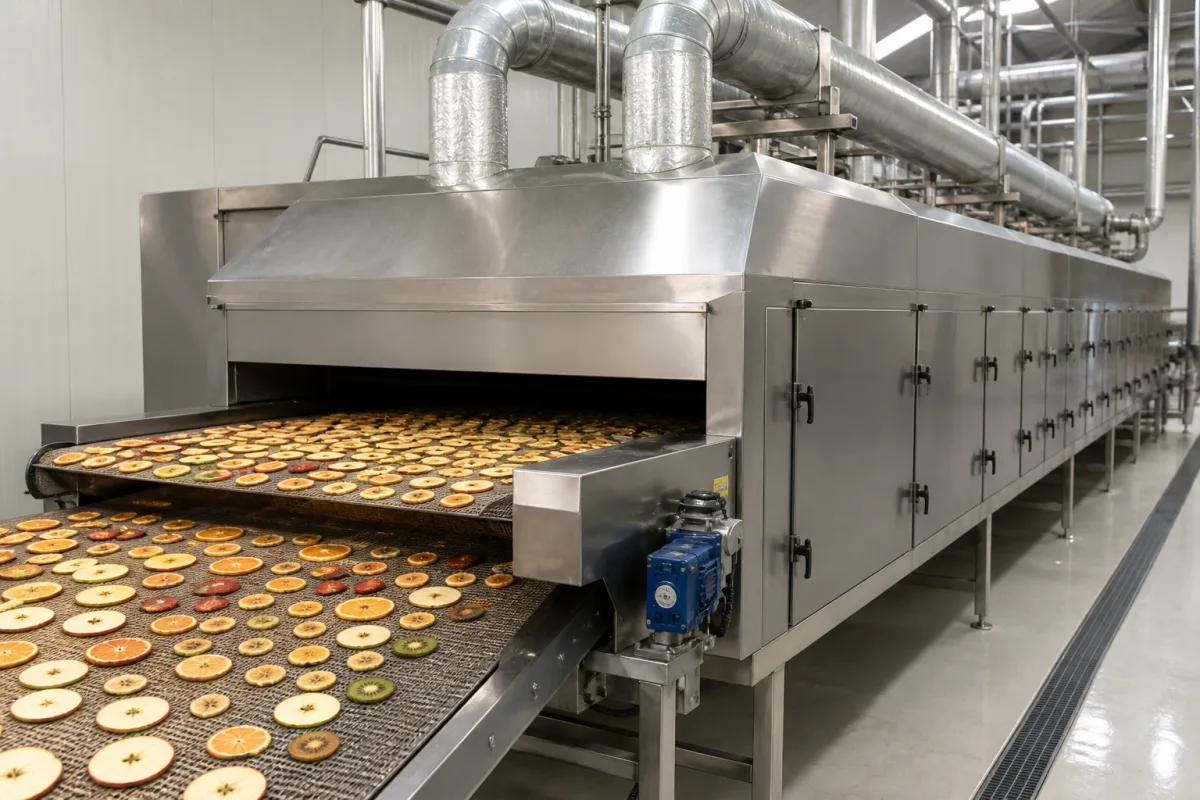
Industrial food dehydrator (belt and tray dryers for fruit and vegetables)
Fruit and vegetable drying · Belt and tray dryers, drying temperature and stages, air velocity and feed rate, final moisture and yield
A belt or tray food dryer transfers heat to prepared food and removes moisture in the air stream. Piece geometry, bed loading, inlet moisture and the required final product condition determine the drying trial. A stated mass yield by itself cannot define the water evaporation duty or establish shelf life.
Hot-air belt (conveyor) dryers and tray or cabinet dryers for fruit, vegetables and similar foods. Freeze dryers, spray dryers, drum dryers, surface-water drying tunnels after washing and domestic dehydrators are outside this page. The separate Air circulation system for industrial food dehydrators page covers the fan, duct and damper assembly; the Industrial ultrasonic vegetable washer page covers wet ultrasonic washing.
CNFX editorial research · Sources checked October 18, 2026 · 4 sources
Set the drying temperature, stages and final moisture
The 2003 Indian MSME project profile describes washing, cutting and pretreating vegetables before staged drying. Its printed notation is first-stage moisture “20+5%” at “60+5°C”, followed by “8+2%” at “40+5°C”. The plus signs are reproduced as printed, without replacing them with a confirmed ± tolerance. Obtain the intended tolerance notation and moisture basis before specifying a process or acceptance range. [1]
The profile states that drying is the bottleneck, taking about 8–12 hours depending on the vegetable, so it splits each load between a larger and a smaller tray drier to keep both in use. It assumes an average yield of 12% of the fresh vegetable weight, notes that apples, figs and apricots can be dried on the same equipment, and lists historical Indian standards for dehydrated potato, onion, garlic, cabbage, carrot, okra and peas; this project model does not establish the currently applicable food law or a tested production guarantee. [1]
Editorial calculation: assuming the profile’s planned 90 metric tonnes of finished product per year, its assumed 12% fresh-to-finished mass yield, and 300 operating days with output distributed evenly, fresh feed would be 90/0.12 = 750 metric tonnes per year, or 2.5 metric tonnes per operating day. This is a conditional planning calculation, not manufacturer-published production or measured operation. The missing mass cannot all be assigned to dryer evaporation: separately measure preparation rejects, inlet and final moisture and solids losses to determine that duty. [1]
Give the supplier the products and piece size, pre-treatment (blanching, sulphiting), fresh feed rate and hours per day, initial and target final moisture, temperature limits for colour and quality, the heating source available (steam, gas, electric, heat pump), hygiene and material requirements for food contact, floor space, and how output will be tested.
02
Size the belt or trays, air flow and feed rate
Rajkumar and co-authors at Tamil Nadu Agricultural University built a belt-conveyor dryer for dehulled tamarind (Madras Agricultural Journal, 2022): a total belt width of 400 mm in its design discussion, while its conveying-unit description gives 35 cm wire-mesh width; obtain the drawing to resolve the intended width. The belt ran at 0.002 m/s. Its centrifugal blower provided adjustable air velocity from 0.1 to 2.0 m/s, with four 1,000 W heating coils and an air-recirculation unit. Tested at 50, 60 and 70 °C and 5, 7.5 and 10 kg/h with 1.5 m/s air, it identified 60°C and 5 kg/h as its selected combination, taking the fruit from 19% to 11.35% moisture (dry basis) in its abstract and results, while its conclusion says 11% (dry basis); retain both source positions and confirm the reporting precision with the authors; 10 kg/h at 50 °C dried too slowly. Dryer efficiency rose with temperature and drying time. [2]
Shanghai Jump describes its continuous belt air dryer as a series of units, each recirculating hot air independently with part of the exhaust removed by a dedicated fan; air passes up or down through the product on a heat-resistant steel wire mesh belt whose speed is adjusted to control drying time. It lists 1, 3 or 5 layers, drying temperature from room temperature to 80 °C, and heat sources including heat pump, gas, steam and electric. [3] The MSME profile's tray driers hold 96 or 48 trays, with 21 kW and 14 kW heating elements. [1]
Editorial calculation: assuming food travels with the belt without slip, at a constant 0.002 m/s along a single heated pass, speed is 0.12 m/min and nominal travel time is 1/0.12 ≈ 8.33 min per metre of heated path. This is a kinematic illustration, not manufacturer-published drying performance or measured food residence time. Required moisture reduction must be demonstrated separately at the actual bed loading, air conditions and path length. [2]
03
Choose a moving belt or a batch tray chamber
The reviewed Jump offering moves material through separately circulating hot-air units. The government project model instead transfers batches between a larger and a smaller tray dryer. These arrangements require different loading and scheduling information. [3][1]
For a belt, record effective heated path, layer depth, turnover points and feed distribution. For trays, record loading per tray, usable area, air access and batch handling. Arrange a trial with the proposed fruit or vegetable preparation. [3][1]
04
Use product-specific drying curves with their moisture basis
Mercer’s University of Guelph manual describes Armfield UOP-8 laboratory tray-dryer trials and records sample mass and air temperature at one-minute intervals. The listed product models use about 50°C and 0.5 m/s air, with dry-basis moisture M = M₀ exp(−kt). The author calculates t = ln(M₀/M)/k for a target of 10% wet-basis moisture, represented as approximately 0.111 g water per g dry solids. The table gives the author’s calculated estimates using the source’s rounded starting values, not measured endpoint times or industrial dryer ratings. [4]
Mercer states that the results should be reproducible in any dryer that delivers air at these set temperatures and linear velocities, while counter-top home dehydrators may differ because of their preset air velocities. Slices were cut about 5 to 6 mm thick; jalapeño peppers were quartered lengthwise. [4] The manual’s statement about reproducibility is its own claim; match preparation, loading and actual air conditions in a production trial before transferring any model. [4]
The fitted coefficients and endpoint calculations describe the named food preparations. They do not establish a ratio of industrial chamber lengths or a production belt-speed setting for another dryer. Obtain a drying curve and outlet-moisture distribution from the offered machine at its actual product loading and air conditions. [4][2]
Product (prepared piece)
Initial moisture, wet basis; rate constant k
Author-calculated estimate to 10% wet-basis moisture
Define food loading, air distribution and humid-air exhaust
Jump describes independent recirculation with partial exhaust in each dryer unit. The tamarind study uses a controlled blower, electric coils and a moving mesh belt. Identify these arrangements in the offered dryer’s air-path drawing. [3][2]
Separate fresh-feed capacity, evaporation duty and outlet moisture
A feed rate is meaningful with the food preparation and initial/final moisture. State the moisture basis and whether energy consumption is per mass of evaporated water or per mass of food before comparing quotations. [2][4]
Field
What it means and published values
Ask the supplier for
Processing Capacity (kg/hour)
Fresh feed rate, e.g. 5–10 kg/h tested in a pilot belt dryer. [2]
Rate on your product.
Temperature Range (°C)
Historical MSME profile prints “60+5°C” then “40+5°C”; confirm that notation. Jump lists room temperature to 80°C for its belt dryer. [1][3]
1 company lists this product among what they make. Company figures are quoted from each
company's own website; every card states where the relationship came from.
Shanghai Jump Machinery
TBC
Lists continuous belt air dryers, hot air drying cabinets and other food drying machines with fruit and vegetable processing lines.
Explore company information and manufacturing capabilities, then discuss the scope of your project with a relevant supplier.
Share this page
Compiled and source-reviewed by the CNFX editorial team.
Each manufacturer above links to the page on that company's own website where the product is listed, with the date we checked it. How we source and review
· Page last updated 13 October 2026
Buyer questions
At what temperature are vegetables dehydrated industrially?
The historical MSME profile prints staged values “60+5°C” to “20+5%” moisture, then “40+5°C” to “8+2%”. Confirm the intended tolerance and moisture basis rather than treating the printed plus signs as a defined ± process specification. [1]
How long does vegetable dehydration take?
About 8–12 hours depending on the vegetable, per the MSME profile. [1]
What air velocity do belt food dryers use?
The TNAU tamarind study selected 1.5 m/s air, 60°C and 5 kg/h among the treatments tested. Its abstract/results give 11.35% final dry-basis moisture; the conclusion says 11%. Confirm reporting precision and validate the offered dryer’s conditions. [2]
How long do fruit slices take to dry at 50 °C?
For about 50°C and 0.5 m/s air, Mercer’s laboratory-derived models calculate approximately 11.8 h for mango, 17.3 h for pineapple and 7.0 h for plantain to reach 10% wet-basis moisture, with slices/rings prepared about 5–6 mm thick. These are the author’s calculated estimates, not measured endpoint times or production-belt ratings. [4]
Sources and evidence scope
Sources checked 2026-10-18. The MSME profile is a government project model and the TNAU article is a pilot-scale study; Shanghai Jump describes its own dryer. Settings for your product should be confirmed by a drying trial.