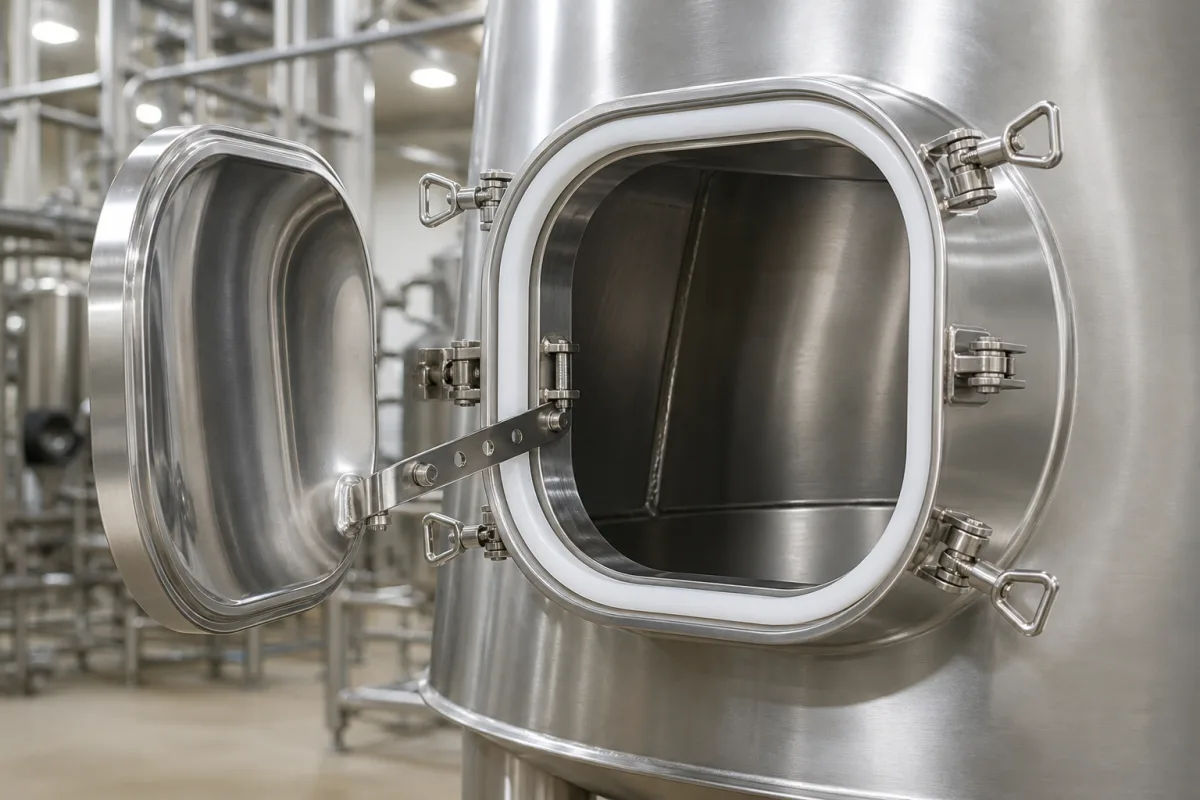
Interlocked inspection port for food-ingredient hoppers, bins and mixers: a gasketed cover wired so the screw, agitator or beater cannot run while it is open
The opening into an ingredient hopper, bin or mixer that someone will reach through · interlocked covers that stop agitators and screws, locks for the open and closed positions, and the rubber seal that touches the food
Opening a port on a flour bin, a premixer or a hopper over a feed screw is when a hand goes inside. Whether the cover is a small hinged lid or a full entrance hatch, three things decide whether it is safe and fit for food: whether opening it shuts off the motors behind it (and, where the parts run on, holds the cover shut until they stop), whether it can be secured both closed and open, and whether the gasket that seals it is made from a rubber accepted for repeated food contact.
Inspection ports, hatches and top covers on hoppers, storage bins, premixers, mixers and screw conveyors for food ingredients, considered as the guarded opening: cover interlocks and guard locking, cover latches and hasps, opening size, and the food-contact gasket. Inspection doors for bulk-handling chutes, drums and conveyor enclosures are covered on the Inspection hatches and access ports page; hygienic manways on tanks on the Sanitary manway page; guard doors in machine and robot cell fencing on the Hinged access door for machine guarding page; the switches alone on the Safety interlock switch for machine guard doors page. Hopper discharge gates, agitated feed hoppers and bag-tip hoppers are covered on the Hopper discharge gate, Agitated ingredient feed hopper and Ingredient hopper pages, and bulk storage hoppers on the Bulk storage hopper page.
CNFX editorial research · Sources checked October 13, 2026 · 3 sources
Which openings must cut the power: OSHA's bakery rules for bin covers, premixer lids, grinder hoppers and mixer ingredient doors
The US bakery equipment standard, 29 CFR 1910.263, is one of the few regulations that names hopper, bin and mixer covers one by one. Its cover and interlock provisions read as a checklist for an ingredient-handling line: [1]
For horizontal dough mixers the same section sets a size limit: the bowl has a full enclosure that stays closed while the agitator runs, and only minor openings such as ingredient doors and flour inlets, each under 1½ square feet in area, may be opened during operation. Overhead covers or doors that could close by accident must be counterbalanced or held open until the operator releases them. [1]
Editorial calculation: 1½ ft² is about 0.139 m². As an example value only, a 300 × 450 mm ingredient door (0.135 m²) falls just under it, while a 400 × 400 mm door (0.16 m²) does not and would have to stay shut while the agitator turns. Bins deeper than 5 feet also need fixed ladders inside and outside, kept away from the moving screw — the reason the entrance cover above them is interlocked to both screws. [1]
Equipment (29 CFR 1910.263)
What the cover or opening must do
Storage bins, (d)(6)(ii)
Gaskets and locks or latches keep the cover closed and dust-tight; covers where a person may enter also get a hasp and lock so the cover can be locked open while someone is inside
Large storage bins, (d)(6)(vi)
The main entrance cover at the interior exit ladder has an electric interlock for the motors of both the feed and unloading screws, so they cannot run with the cover open
Screw conveyors, (d)(7)(iii)
Covers removable in convenient sections, held by stationary clamps at intervals, kept dust-tight
Flour sifters, (d)(8)(i)
Enclosures dust-tight but readily accessible for interior inspection
Ingredient premixers and emulsifiers, (i)(11)(i)
Top openings have covers attached to the machine, arranged and interlocked so power is shut off when a cover opens far enough for fingers to reach the beaters
Meal, peanut and fig grinders, (k)(1)
A removable hopper is interlocked so the machine cannot run without it; enclosed hoppers get hinged covers with an electric interlock
List every motor that can move parts within reach of the port (feed screw, discharge screw, agitator, beater), and state for each whether the cover interlock must stop it, whether the cover must be lockable open, and the clear opening of the port.
02
Holding the cover shut until the parts stop: a 1,500 N solenoid interlock, high coding, and releases from inside and outside
A position switch only stops the motors when the cover opens. Where an agitator or screw runs on after the power is cut, the cover is held shut by a solenoid interlock until it is safe. Schmersal's AZM150 is one such device: an electromechanical solenoid interlock with a holding force (FZh) of 1,500 N, for applications up to PL d / Category 3. [2]
Schmersal gives the AZM150 a high coding level against tampering, and notes that with high coding fewer additional measures under ISO 14119 are needed, such as mounting the device out of reach or concealed. Its actuator head rotates through 360° and has two actuator entrances, so one switch body suits different cover hinges and approach directions. [2]
The accessories address the two ways a locked cover can trap someone. A rear-mounted push button gives emergency release from inside a guarded area or emergency unlocking from outside; it comes in a 45 mm version for door pillars of about 40 mm and a 170 mm version for pillars up to 170 mm. A Bowden cable release 6 m long allows unlocking where the interlock itself is out of reach. [2] On a walk-in storage bin, OSHA's hasp-and-lock rule for covers that a person may enter meets the same need from the other side: the person inside holds the cover open with their own lock. [1]
Editorial note: the holding force has to exceed what an operator can pull on the cover's handle or lever, and the switch must be fitted where cleaning water and ingredient dust will not bridge or jam it; ask for both the device rating and the mounting arrangement on the hopper drawing.
State whether the port needs a plain interlock or guard locking, the run-on time of the screw or agitator, the required holding force, coding level, the PL or category targeted, and which emergency release or unlocking is needed.
03
The port gasket against the ingredient: FDA's rubber list and its 20 mg/in² and 175 mg/in² extraction limits
In the United States the rubber in a repeat-use gasket that touches food is governed by 21 CFR 177.2600. The regulation lists the base polymers that may be used, among them natural rubber, ethylene-propylene copolymer elastomers, five silicone elastomer types (methyl; methyl-phenyl; methyl-vinyl; methyl-fluorine; phenyl-methyl-vinyl) and vinylidene fluoride-hexafluoropropylene copolymers, and limits the additives, for example activators to 5 % by weight of the rubber product. [3]
The test is run on the food-contact surface of the finished article, and finished rubber articles must be thoroughly cleaned before their first use with food. [3] For a hopper handling dry flour or sugar the aqueous and fatty limits describe how the gasket compound behaves when the port is washed down or when fat-bearing ingredients pass; ask the gasket supplier which paragraph its compliance statement covers.
Editorial calculation: a gasket strip 10 mm wide around a 300 × 450 mm port (example dimensions) has a food-contact face of about 2 × (300 + 450) × 10 = 15,000 mm², or about 23 in²; at the 20 mg/in² aqueous limit that would allow at most about 0.47 g of total extractives in the first 7 hours of the reflux test. [3]
Food type (21 CFR 177.2600)
Extraction
First 7 hours
Succeeding 2 hours
Aqueous foods, (e)
Distilled water at reflux
≤ 20 mg/in²
≤ 1 mg/in²
Fatty foods, (f)
n-Hexane at reflux
≤ 175 mg/in²
≤ 4 mg/in²
Name the gasket polymer, the 21 CFR 177.2600 paragraph its compliance statement covers (aqueous, fatty or both), the cleaning chemicals and temperatures it will see, and how the gasket is retained in the cover or frame.
04
Port details to send
Paste it into your enquiry below or into an email to a maker, then replace every bracket.
Vessel: [hopper, bin, premixer, mixer or screw conveyor; ingredient]
Opening: [clear size; hinged or removable cover; walk-in or hand access]
Motors behind the port: [screws, agitators, beaters; run-on time]
Interlock: [position switch or guard locking; holding force; coding; PL/category]
Releases: [emergency release inside; unlocking outside; lock-open hasp]
Gasket: [polymer; 21 CFR 177.2600 statement; cleaning conditions]
Explore company information and manufacturing capabilities, then discuss the scope of your project with a relevant supplier.
Share this page
Compiled and source-reviewed by the CNFX editorial team.
Each manufacturer above links to the page on that company's own website where the product is listed, with the date we checked it. How we source and review
· Page last updated 13 October 2026
Buyer questions
Does an inspection cover on an ingredient premixer need an interlock?
Under 29 CFR 1910.263(i)(11)(i), premixer and emulsifier top openings need covers attached to the machine and interlocked so power is shut off when a cover opens far enough for fingers to reach the beaters. [1]
How large an opening can be opened while a dough mixer runs?
OSHA 1910.263 allows only minor openings such as ingredient doors and flour inlets, each under 1½ square feet, to be opened while the agitator is in motion. [1]
How strong is a guard-locking interlock for a cover?
Schmersal rates its AZM150 solenoid interlock at a holding force of 1,500 N, for applications up to PL d / Category 3. [2]
What does FDA require of a rubber gasket on a food hopper port?
21 CFR 177.2600 lists the permitted rubbers and limits total extractives to 20 mg/in² in the first 7 hours (water) or 175 mg/in² (n-hexane) for repeat-use articles. [3]
Sources and what still needs a direct check
Sources checked 2026-10-13. Three sources from three publishers: OSHA's bakery equipment standard 29 CFR 1910.263 for cover, interlock and opening rules; Schmersal's product information on the AZM150 solenoid interlock for holding force, coding and releases; and FDA's 21 CFR 177.2600 for rubber articles in repeated food contact.