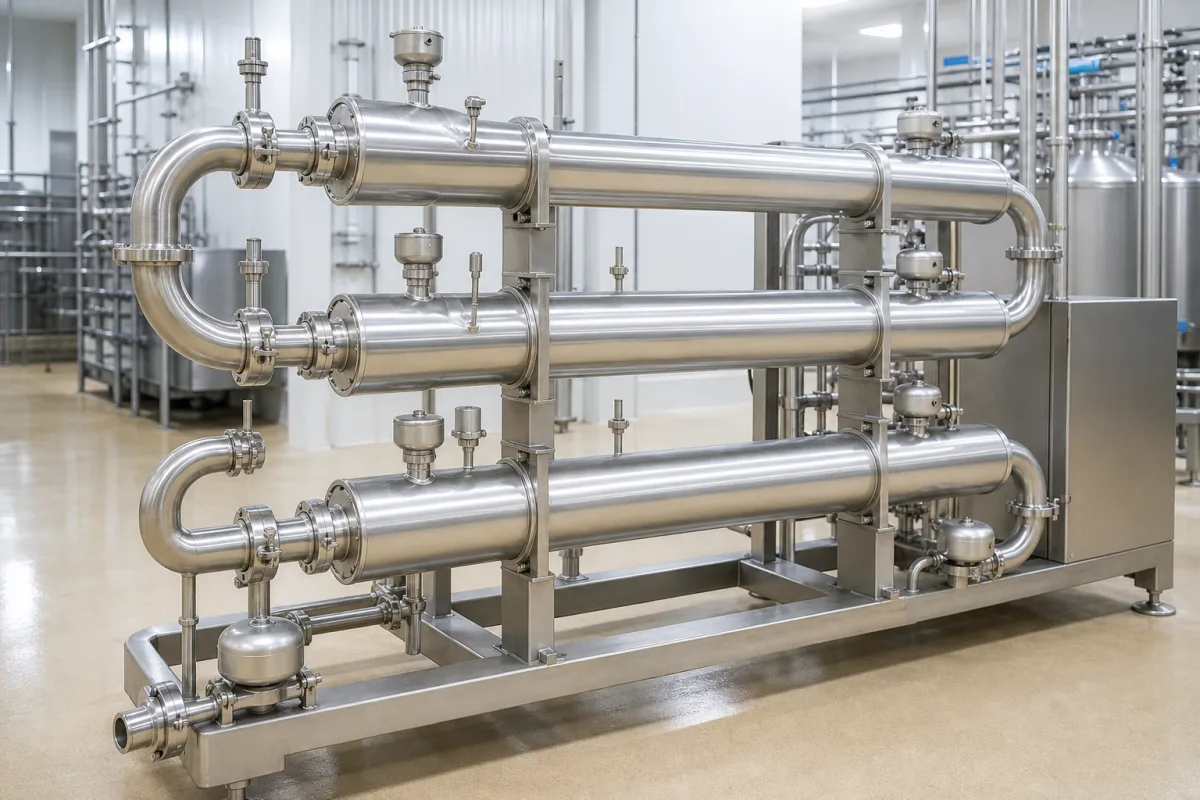
Tubular heat exchanger for food and dairy processing
Hygienic tube-type heat exchangers · regenerator pressure rules, holding-tube length and slope, pasteurization time and temperature
A tubular heat exchanger for food processing heats, regenerates or cools liquid products such as milk, juice or sauces as they flow through stainless steel tubes, such as concentric tube-in-tube or multi-tube bundles in a shell, with water, steam or product on the other side. Ask three things first: whether its sections will be arranged so that treated product can never be contaminated by raw product or service water, how the holding tube gives every particle the required time, and what surface finish and cleaning it is built for.
Hygienic tube-in-tube, double/triple-tube and multi-tube heat exchangers used in pasteurization, UHT/aseptic and cooling lines for liquid foods, dairy and pharmaceutical water. Plate heat exchangers, general chemical shell-and-tube exchangers and evaporators are outside this page.
CNFX editorial research · Sources checked October 12, 2026 · 4 sources
The FDA's Grade A Pasteurized Milk Ordinance (2019) requires regenerators to be built, installed and operated so that pasteurized product in the regenerator is automatically under greater pressure than raw product at all times. Pasteurized product leaving the regenerator must rise to 30.5 cm (12 in) above the highest raw product level downstream of the constant-level tank before it is open to the atmosphere. [1]
Where raw product-to-water-to-pasteurized product plate or double/triple tube type heat exchangers are used for heat exchange other than legal pasteurization, pasteurized product must be under greater pressure than the heat-transfer water at all times; one accepted method wires the water pump so it runs only when pasteurized product is flowing and its pressure exceeds the pump's maximum by at least 6.9 kPa (1 psi), with a pressure differential controller. Booster pumps on the raw side are interlocked the same way. [1]
For aseptic systems, 21 CFR 113.40(g) requires a product-to-product regenerator to keep sterilized product at higher pressure than unsterilized product, so that any leak runs from sterile to non-sterile, and requires a differential pressure recorder-controller accurate to within 2 psi (13.8 kPa) with sensors at the sterilized outlet and unsterilized inlet. [2] Editorial note: ask the supplier to show the pressure profile of each section at your flow and viscosity, and where the differential sensors and pumps will sit.
Give the supplier the product and its viscosity and particulates, flow rate, inlet and target temperatures, heat-treatment schedule (time and temperature), regeneration percentage wanted, heating and cooling media, cleaning (CIP) regime, applicable rules (PMO, 21 CFR 113, 3-A, EHEDG), and available space.
02
Size and slope the holding tube
The PMO defines continuous-flow pasteurization by temperature and time, including 72 °C for 15 seconds and, for HHST, 89 °C for 1.0 second, 90 °C for 0.5 seconds, 94 °C for 0.1 seconds, 96 °C for 0.05 seconds and 100 °C for 0.01 seconds; temperatures rise by 3 °C for products with 10% fat or more, 18% total solids or more, or added sweeteners. [1]
Holding tubes must hold every particle for at least the required time, have a continuously upward slope in the direction of flow of not less than 2.1 cm per metre (0.25 inch per foot), be supported against movement, and have no heated portion between the inlet and the recorder-controller sensor. For HHST, because laminar flow can make the fastest particle travel twice as fast as the average, holding tube lengths are calculated as twice the length needed to hold the average flow. [1] 21 CFR 113.40(g) applies the same unheated, upward-sloping (at least 2.1 cm/m) holding tube rule to aseptic systems. [2]
Editorial calculation: at 10 m³/h through a 50 mm internal-diameter tube, the average velocity is 10 / 3600 / 0.001963 m² ≈ 1.41 m/s. Holding at 89 °C for 1.0 second needs 1.41 m at the average velocity; doubled under the PMO HHST rule, about 2.83 m. Flow and diameter are assumed examples; use your actual tube bore and maximum flow.
Editorial calculation: the DTA 76/51 is listed at 18 m³/h maximum product flow with 11 L of product-side volume in 6 m; at that flow the product passes through one 6 m unit in about 2.2 seconds (11 ÷ 18,000 × 3,600). [3]
The holding-tube time is not the whole heat load in a tubular system. A University of Queensland review of extended shelf-life (ESL) milk notes that indirect heating uses plate or tubular exchangers for all heating and cooling stages and can recover up to about 90% of the heat by using hot milk after the holding tube to heat incoming milk, while direct steam heating changes temperature by 50–60 °C in about 0.5 s after an indirect preheat to 70–80 °C. A nominal condition such as 125 °C for 5 s describes the holding tube only and underestimates the heat input of an indirect system: in a cited comparison of equal bactericidal effect, an indirect process at a nominal 127 °C for 1 s gave 83.5% β-lactoglobulin denaturation against 13.6% for direct steam infusion at 135 °C for 0.5 s. The review proposes ESL conditions with a B* above 0.3 and no more than 50% β-lactoglobulin denaturation (at least 1600 mg/L undenatured). [4]
Editorial calculation: with 90% regeneration, heating milk from 4 °C to 127 °C (a 123 °C rise, assumed inlet) leaves about 0.10 × 123 ≈ 12 °C of the rise for the heating medium section, which is why the regenerator's pressure rule above matters for nearly all of the heat transferred. [4][1]
03
Double-tube designs and the makers listing them
HRS Heat Exchangers' DTA Series data sheet (PDDTA1811UK) describes a hygienic double-tube design: product runs in the inner corrugated tube and service fluid in the shell, giving a continuous free-pass section for fibres and particles, with bellows to absorb differential expansion. Standard materials are AISI 316L on the product side and AISI 304 on the service side, product connections are clamps, the internal finish is below 0.8 µm, and both sides are designed for 10 bar at 185 °C to PD 5500, PED 2014/68/EU and ASME, with FDA and 3-A compliance. Six models from DTA 51/25 to 129/104 come in 3–6 m lengths; for 6 m units, product-side maximum flow runs from 4 to 77 m³/h and surface area from 0.4 to 1.8 m². [3]
Listings include tubular exchangers alongside sanitary plate heat exchangers, tubular exchangers in pharmaceutical purified-water systems, and tubular exchangers sold with evaporation systems for food and pharmaceutical plants. Ask each for drawings, surface finish and the hygienic standard the unit is built to.
04
How the exchanger sections fit together
Part
Role
Fix in the order
Product tubes
Carry product; corrugated inner tube in one design. [3]
Area, flow and tube bore depend on your heat-treatment schedule and holding-tube length; pressure rows also have to respect the regenerator rule set out at the top of the page.
Field
What it means and published values
Ask the supplier for
Heat Transfer Area (m²)
Set by duty; e.g. 0.4–1.8 m² per 6 m double-tube unit. [3]
Area per section and calculation.
Operating Pressure (MPa)
Treated product above raw or water side; e.g. 10 bar design. [1][3]
Baode lists tubular exchangers beside sanitary plate units, Shanghai Chongyang inside purified-water and water-for-injection systems, and Saideli with evaporation systems for food and pharmaceutical plants.
Explore company information and manufacturing capabilities, then discuss the scope of your project with a relevant supplier.
Share this page
Compiled and source-reviewed by the CNFX editorial team.
Each manufacturer above links to the page on that company's own website where the product is listed, with the date we checked it. How we source and review
· Page last updated 13 October 2026
Buyer questions
Why must pasteurized milk be at higher pressure in a regenerator?
The PMO requires it at all times so that any leak runs from pasteurized to raw product; 21 CFR 113.40 applies the same rule to aseptic regenerators. [1][2]
How steep must a holding tube slope?
Upward in the direction of flow by at least 2.1 cm per metre (0.25 inch per foot). [1][2]
Why are HHST holding tubes doubled in length?
The PMO says laminar flow can make the fastest particle travel twice as fast as the average, so lengths are calculated at twice the average-flow length. [1]
What design pressure do hygienic double-tube exchangers have?
HRS lists its DTA Series at 10 bar and 185 °C on both product and service sides, with 316L product tubes and internal finish below 0.8 µm. [3]
How much heat can a tubular UHT or ESL line recover?
A University of Queensland review states that indirect plate or tubular systems can recover up to about 90% of the heat by using hot milk after the holding tube to heat the incoming milk. [4]
Sources and what still needs a direct check
Sources checked 2026-10-12. The PMO is the FDA's model regulation for Grade A milk, adopted by US states; 21 CFR 113 is the federal rule for low-acid canned and aseptically packaged foods. Requirements in other markets may differ. HRS publishes data for its own double-tube range, and the University of Queensland review compares direct and indirect milk heating.