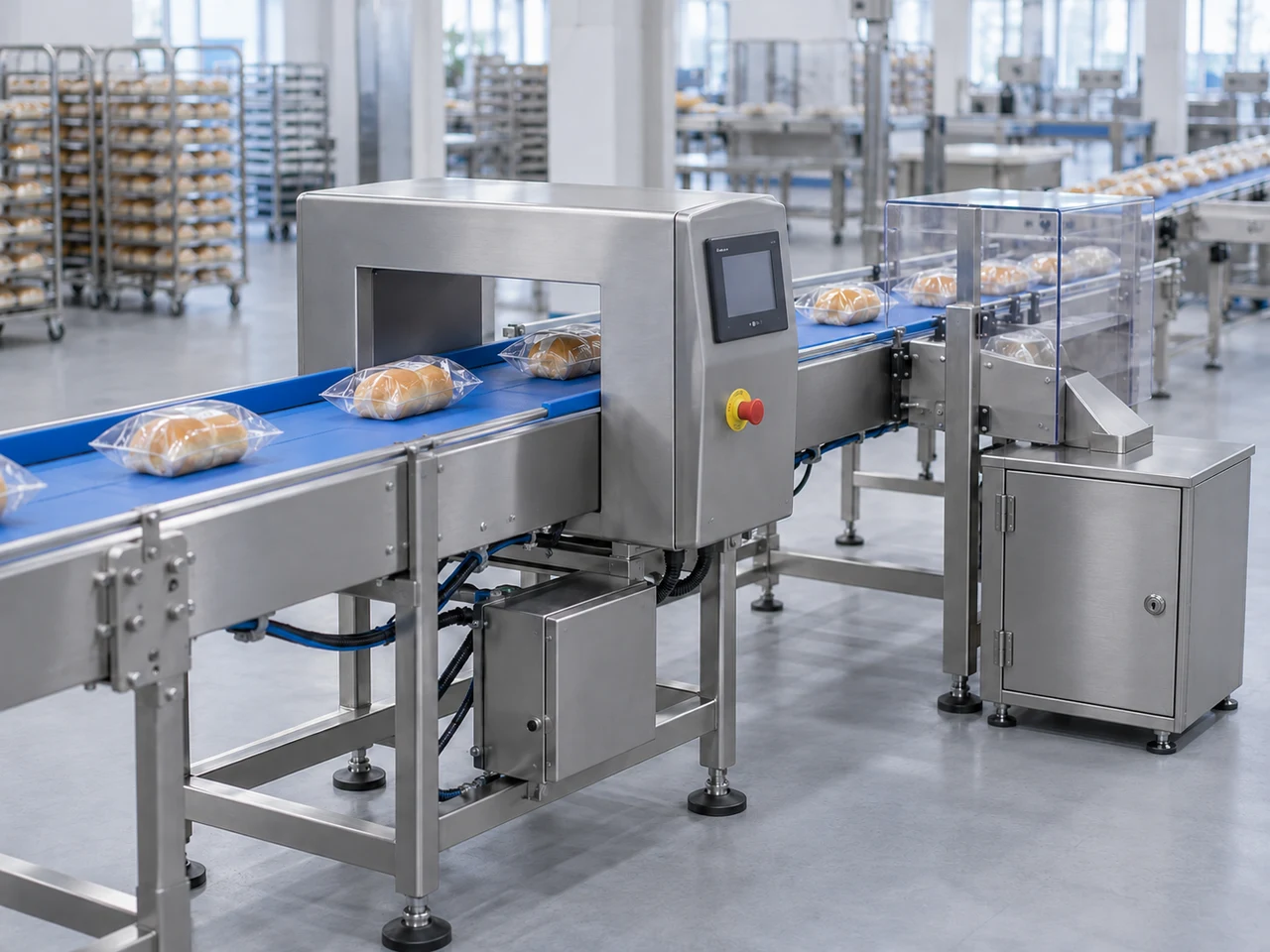
Food inspection · Product trials and line acceptance
The purchase is a working inspection point: the detector must find the agreed test pieces in your food, then keep the affected product out of the accepted flow. A sensitivity number on an empty-belt demonstration does not complete that brief.
For conveyorized food inspection. Foil inspection and other transport arrangements need their own configuration. Named equipment examples below explain purchase decisions; their specifications do not apply to every machine in this category.
CNFX editorial research · Sources checked October 10, 2026 · 9 sources
Choose the inspection point with the actual packaging in hand
Bring the final package and laminate specification to the trial. LOMA distinguishes balanced-coil from ferrous-in-foil inspection; metallized film is not the same application as a full aluminium-foil enclosure. [1]
For a foil pack, name the contaminants you need to find
Kenwei describes JW-GL2415 as a magnetic-metal detector for aluminium-foil packs. Its “Sus” headline does not identify a stainless grade or a test condition. Obtain results for your actual ferrous, non-ferrous and stainless challenges before treating that label as coverage of all three. [7]
If the intended metal cannot be detected through the final pack, assess an earlier inspection point or another inspection technology. Any earlier point also leaves the later process to be assessed for new contamination. Choose this as part of the plant’s hazard analysis, not from a catalogue’s broad application list. [4]
Identify the detector, belt, reject arrangement and acceptance protocol in the quotation. The terms “intelligent” and “food grade” do not establish certification.
02
Turn a sensitivity claim into a trial with your own product
Techik's IMD table illustrates why the aperture and test conditions belong beside the number. These are two configurations from the same 400 mm detection-width group, each with a 360 mm belt. The published results use only a test sample on the belt; Techik explicitly says product, working conditions and speed affect actual sensitivity. [2]
Compare columns side by side. On a narrow screen, scroll the table horizontally.
METTLER TOLEDO describes sensitivity using a specified metal sphere passing through the aperture centre, its least-sensitive position. A belt-surface result and a centre-of-aperture result therefore need their positions stated before comparison. Aperture size, product orientation, speed and environment belong in the trial record. [3]
Wet or salty food can itself produce a signal. Include the normal variation in product temperature and composition when agreeing a stable setting and false-reject acceptance. [3]
A sphere result does not describe every wire fragment
FDA's seafood guidance gives an orientation example: a detector set for a 2 mm sphere may miss a thinner stainless wire up to 24 mm long if calibration and orientation are unfavourable. This is an example of detection limitations, not a permissible contaminant size. Let the likely contaminant shape inform the trial as well as the sphere diameter. [5]
Techik's table does not give a non-ferrous result for these configurations. Request it; do not calculate it from the Fe or SUS304 column. The delivered system needs documented results with the agreed product, package and setup. [2]
03
Follow the detection signal through four functional assemblies
A balanced-coil head uses one transmitter and two receivers; passing metal changes the signal processed by the electronics. Its aperture liner is non-metallic. This is a functional assembly reference, not a model-specific manufacturing BOM. [1]
Assembly
Job on the line
Material or configuration to identify
Detection head and aperture liner
Creates the inspection zone and supplies the detection signal.
Obtain the head and liner specification. Do not describe the entire aperture as stainless steel. [1]
Signal processor and operator interface
Sets the product recipe and handles detection events and outputs.
Identify the controller, software revision, access levels and enclosure. A touchscreen is not proof of an automatic reject system. [4]
Product transport
Presents the product at the agreed position and speed.
Techik lists a food-grade PU belt with chain conveyor as an option. Record the supplied belt material and obtain its applicable food-contact documentation. [2]
Reject or controlled-stop assembly
Separates the affected product, or stops the line for controlled removal.
Confirm the supplied mechanism, guards, reject container, sensors and air requirements. These are configuration items, not one universal pneumatic assembly. [4]
Specify who supplies and commissions each assembly. A search head purchased for an existing conveyor leaves transport and reject integration to be resolved; a complete-system offer must identify what is actually included.
04
Witness the test pack leaving the accepted stream
Techik's standard IMD description is alarm and belt stop, with a rejecter optional. Treat that as a different operating arrangement from a conveyor that continues while an automatic device removes the affected pack. Agree the removal and restart procedure before ordering. [2]
Challenge the front and rear of the pack
LOMA tests the leading and trailing ends of a pack and observes entry into the reject bin. This checks removal timing as well as detection. Agree the pack spacing and speeds to witness. [1]
Include the failure states in acceptance
Demonstrate the agreed response to failed rejection, low air pressure, detector fault and a full bin. LOMA describes confirmation sensors and belt-stop safeguards. Record the fault response and who may restart production. [1]
Recover every test piece
Identify the test packs and account for their test pieces before releasing production. Keep test material distinct from saleable food. Record recipe, speed, challenge identity, result and any corrective action in the site's verification procedure. [4]
Set the test interval in the plant's own control plan
FDA's seafood guidance includes a four-hour challenge interval in its example control strategy, alongside startup, changes and end-of-processing checks. It is not a universal interval for every food line. Establish the applicable interval and affected-product procedure with the site's food-safety team and customer requirements. [5]
05
Specify cleaning protection for each part of the system
LOMA's IQ4 conveyor sheet, document IQ4_V2_893202205, separates three protection statements. Keep them separate when comparing a washdown quotation. These are named-document values, not ratings for the Chinese suppliers listed below. [6]
Describe water temperature and pressure, cleaning agents, exposure and required access. The same IQ4 sheet lists 0–40°C ambient and 0–95% RH, non-condensing; those operating conditions are not wash-water limits. Its electrical entry gives 230 V/50 Hz or 110 V/60 Hz, single phase, and 3.0 A. Amperes are not a kilowatt rating. [6]
Reserve the detector's installation clearances
Obtain the selected head's metal-free-zone drawing before placing nearby metalwork. Clearance depends on the detector design; don't adopt a universal distance. Include adjacent drives, vibration, transfer points and maintenance access in the line review. [4]
Kenwei's GL2415 page gives 1570 × 880 × 1490 mm and 170 kg near the top, but 1450 × 850 × 1620 mm and 160 kg in its lower table. Resolve the actual ordered build with a signed arrangement drawing; do not choose one set silently. [7]
06
Attach an acceptance record to the equipment schedule
Complete these purchasing fields for the selected configuration. Where a public document supplies no value, request the supplier's current drawing or declaration instead of filling the gap with a category-wide range.
Field
Put this on the order or test record
Aperture
Clear width and height, belt thickness, pack envelope and orientation; distinguish aperture width from belt width.
Non-ferrous sensitivity
Test metal, sphere diameter, test-piece identity and placement, actual product and recipe. Include a separate Fe challenge.
Stainless sensitivity
Alloy and sphere diameter, placement and product condition; include any agreed wire or fragment challenge.
Ingress protection
Ratings and evidence for the head, conveyor, controls, sensors and air preparation; cleaning regime.
Removal arrangement
Controlled stop or exact automatic reject type; confirmation, collection and failure/restart behaviour.
Conveyor speed
Minimum, normal and maximum speed, pack spacing and mass; show which conditions were witnessed.
Detection performance
Document successful challenges and agreed repeatability/false-reject criteria. A positional ±mm value does not state contaminant sensitivity.
Temperature
Product temperature and permitted equipment ambient, plus separate cleaning exposure.
Humidity
Ambient range and condensation conditions at the installation.
Electrical supply
Voltage, phase, frequency, earth and connection details for the complete supplied system.
Electrical and air demand
Installed load/current and the rejector's compressed-air demand; keep the quantities and units separate.
Materials
Housing grade, food-contact belt/liner materials and applicable declarations for the delivered parts.
Mass
Net installed mass and lifting/handling information for the selected build.
Installed envelope
Approved arrangement, line height, reject-bin access, guards, service space and head clearance zone.
The schedule is a CNFX purchasing worksheet, not a manufacturer specification. Its trial fields follow the source discussions above; acceptance values must be agreed for the actual line.
07
Send a trial brief with the request for quotation
Paste it into your enquiry below or into an email to a maker, then replace every bracket.
Food / recipe variants: [product; wet/dry; temperature and normal variation]
Packaging: [material/laminate; sealed sample; dimensions and orientation]
Line duty: [pack mass; spacing; minimum/normal/maximum speed]
Inspection point: [before/after final pack; downstream contamination risks]
Challenges: [Fe; named non-ferrous; stainless alloy; sizes and test-piece identities]
Trial conditions: [placements; repeat passes; acceptance and false-reject criteria]
Removal: [controlled stop or automatic reject; bin; confirmation; fault response]
Installation: [line height; available space; transfers; nearby metalwork/drives]
Utilities / cleaning: [electrical supply; air; ambient; wash and chemical exposure]
Evidence: [signed configuration; arrangement; materials; test report; operating and maintenance instructions]
Witness / handover: [trial samples; factory/site test; training; records; responsible approvers]
Conveyor, foil, pipeline and combination systems have different briefs. The companies below are described from their public product pages, not factory audits or a guarantee that your acceptance test will pass.
Techik Instrument (Shanghai) Co., Ltd.
Shanghai company record; manufacturing site to be confirmed
Lists the IMD conveyor family. The source distinguishes alarm/stop from optional rejection and qualifies its sensitivity figures as test-sample-only belt results. Request the actual-food trial and the precise reject configuration.
Lists G3012, G5020, GL2415 foil and gravity-feed equipment. The GL2415 page describes magnetic-metal inspection; its two dimension/weight blocks conflict. Obtain a signed build drawing and metal-specific trial results.
Publishes ZL-4001A conveyor equipment with optional rejection, alongside pipeline and head-only products. Its 4001A introduction mentions foil, while the application table specifies non-metallic packaging. Resolve that scope with the proposed pack and test pieces before ordering.
Lists NG-706A conveyor, NG-7067 combined checkweighing, NG-706F foil and pipeline offers. It requests product and contaminant details for sample testing. Quote the transport and rejection arrangement explicitly.
Sangyuan, Dongcheng, Dongguan — published contact address
Lists conveyor inspection with optional rejection. The examined page mixes CN-520 and SA-990 identifiers and conflicting specification blocks. Request one current configuration sheet and witnessed product trial; its broad sensitivity headline is not a guarantee across every aperture and food.
Explore company information and manufacturing capabilities, then discuss the scope of your project with a relevant supplier.
Share this page
Compiled and source-reviewed by the CNFX editorial team.
Ask the selected supplier to identify the manufacturing entity, exact model, supplied options and applicable documentation. Certification badges and general compliance statements have not been independently verified. How we source and review
· Page last updated 13 October 2026
Buyer questions
Does a failed routine challenge affect only the pack used for the test?
No. FDA's example seafood control strategy considers product made since the controls were last confirmed to be functioning. Your procedure must identify, hold and evaluate the affected production and define how control is restored. Passing a later test does not by itself release the earlier product. [5]
Does the Shanan CN-520 page provide one unambiguous build specification?
No. Its header identifies CN-520 while its technical blocks identify SA-990; the blocks also give different supply voltages and recipe capacities. It establishes an equipment offering, but a quotation needs one identified model and controlled specification. The inconsistent temperature and humidity entries should not be copied into a purchase order. [8]
Why is the GVDA record not offered for a food-line enquiry here?
Not from the category reviewed. Its industrial-metal-detector category lists wall/stud finders and underground metal-search equipment, which are different instruments from a conveyorised food-line detector. Ask any supplier for a named food-line model and test-piece results. [9]
Sources and what still needs a direct check
Sources checked 2026-10-10. Sources support named configurations and the stated inspection principles. Product pages do not establish the delivered machine's performance, certification or hygienic suitability. Original paid standards and retailer codes were not reviewed.
Agree the trial with actual food, packaging, contaminant materials, placements, speeds and acceptance criteria; no universal minimum detectable size is asserted.
Resolve Kenwei dimensions, Shanan model/specification identity and Zhongli packaging scope against signed documents for the offered build.
Confirm food-contact materials, the complete cleaning regime, required machinery documentation and supplier identity for the destination and application.
Set the plant's verification interval, affected-product controls and restart responsibilities; the FDA seafood example is guidance, not a universal requirement for every food process.
Buyer enquiry
Request manufacturing insight
for Intelligent Food Grade Metal Detector
Ask for use case, specification boundaries, supplier type, and RFQ preparation
information for this product.
Where it goes
Straight to the CNFX editorial desk, and to the manufacturer if this product is
linked to a claimed profile. Nothing is broadcast to a supplier list.
Your details stay here
We do not sell or rent enquiry data, and we do not add you to a mailing list.
Used only to answer this request.
No commission, no middleman
CNFX is a directory. We take no cut of any order and never negotiate on a
supplier's behalf.
What to include
Share your product specifications, quantity, destination and target delivery date.
Need to Manufacture Intelligent Food Grade Metal Detector?
Compare manufacturer profiles with relevant product and process capability.