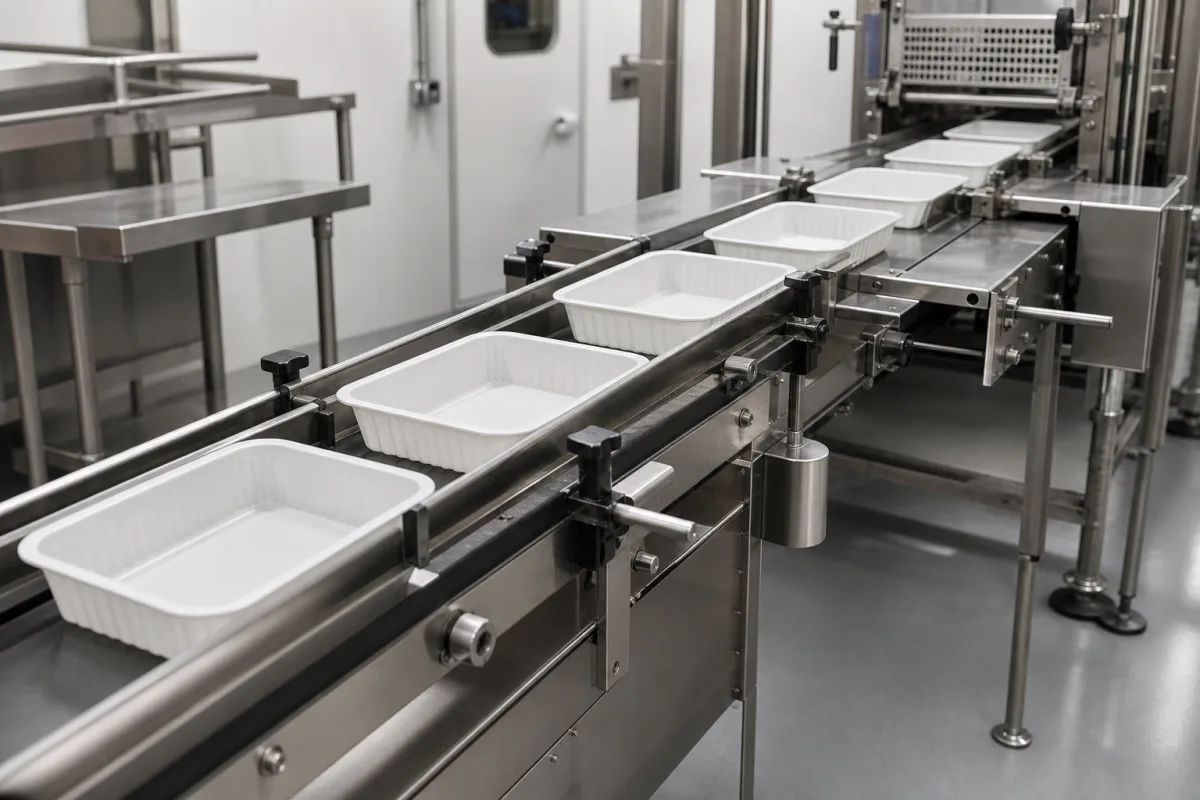
Tray infeed conveyor for tray sealing lines: setting tray pitch, moving filled trays without spilling, and taking the belt off for cleaning
The conveyor that carries empty and filled food trays from the denester past the filler to a tray sealer · fixed flights, pop-up flights that switch pitch at up to 22.5 m/min, collating belts timed by tray length, independently driven linear-motor pushers, and S-curve push-bar motion that keeps sauce off the seal flange
Between the tray denester and the sealing station, trays of food travel on an infeed conveyor and stop or slow under the fillers. That conveyor decides the spacing between trays, how hard a full tray is accelerated, and how quickly the line can be changed to a different tray size or stripped down for cleaning.
Infeed, collating and indexing conveyors that carry preformed plastic or aluminium food trays from a denester through filling to the sealing station of a tray sealer, and the push bars, flights, grippers and pushers that set tray pitch. The heated sealing tool is covered on the Sealing head for cup and tray lidding machines page; gas flushing at the lidding station on the Gas-flush and lid-sealing station page; belt and tray dryers for fruit and vegetables, where trays carry product through drying air, on the Industrial food dehydrator page; in-pack pasteurising of sealed trays on the Automated food sterilization tunnel page.
CNFX editorial research · Sources checked October 13, 2026 · 4 sources
Fixed flights, pop-up flights, a timed collating belt or independent pushers: four ways to set tray pitch
Ishida Europe's application US 2014/0014477 A1 names two forms of infeed conveyor for tray sealers: flat belts, on which trays are not evenly spaced and which it associates with product placed by hand, and chains with indexing flights, which hold a known pitch so the filler can be timed to the tray and which it associates with automatic filling. [1]
Multivac's patent US 9,346,576 B2 starts from the cross-bar pusher whose ends are fixed in a chain: such pushers are spaced at constant distances, each larger than the tray length in the conveying direction. Driving each pusher separately lets the conveyor take trays that arrive irregularly and form them into a regular arrangement, and the patent proposes position sensors for trays or pushers so that a pusher is available when a tray arrives. [3]
Editorial calculation: chain speed equals trays per minute times pitch. At Ishida's 22.5 m/min, an assumed 250 mm pitch gives 90 trays per minute per lane; halving the pitch to 125 mm for a small tray doubles the rate to 180 per minute at the same chain speed, while keeping 250 mm pitch would need 45 m/min for the same 180 trays. [1]
Pitch method
How spacing is set
What the source reports
Fixed indexing flights on a chain
Flight spacing chosen for the largest tray to be run
Smaller trays let the sealer work faster, but with fixed spacing the chain must run faster than is optimal, which compromises tray stability and filling; the alternatives were changing the chain or a second line [1]
Pop-up flights switched by a cam
Each flight pivots to a raised or retracted position as a cam beside the idler sprocket moves
Cam travel about 2 mm, flight working angle about 30° either side of neutral, conveyor speed up to 22.5 m/min without the jam risk of the earlier two-channel peg design [1]
Collating belt timed by tray length
An optical sensor starts the collating belt at infeed speed for a time set by tray length
Trays land at a predetermined pitch for the gripper arm; the infeed belt stops until the gripper has drawn the group into the sealing station; two parallel rows [2]
Independently driven pushers
Each pusher runs on a linear motor with its own speed profile
Slower along the filling line, faster to the sealing station, gaps matched to the sealing tool, faster return of empty pushers, buffer sections, and two, three or more tracks side by side [3]
Give the supplier every tray size the line will run, the trays per minute for each, and how many lanes, and ask how pitch is changed between sizes and how long it takes.
02
S-curve push-bar motion and gentle sprocket transfer for filled trays
Omron's case study of a tray sealer with an indexing flight bar drive describes empty trays loaded by a tray denester onto the infeed line and carried the whole length of the machine by transverse push bars mounted at equal spacing between two lateral driving chains, to a sealing station whose top bell housing holds 4 welding heads. [4]
The push-bar servo drives run S-curve speed profiles, programmed in the PLC so that acceleration and deceleration can be set to the tray contents, in particular to avoid liquids slopping onto the seal area. Sensors detect transparent trays and the flight bar position, and a 4-loop controller holds each of the 4 heater plates at its own temperature. [4]
Ishida Europe adds a static cam beside the drive sprocket so that raised flights travelling round the sprocket are not accelerated harshly, which could spill tray contents, and allows the chain pin joints enough sideways play for the flights to follow curves around existing plant. The application links indexing motion, with trays positioned under the filler one or two at a time, and continuous motion, to throughput: continuous motion is chosen where high throughput leaves too little time to stop and restart trays without displacing the product. [1]
Ask for the acceleration profile with a full tray of your wettest product and check the seal flange after the transfer into the sealing station.
03
Taking the infeed belt off for cleaning: hooks, a quarter-turn lock and automatic tension release
In Ishida Europe's tray sealer patent US 8,240,353 B2, each infeed and collating belt runs on a support frame that lifts off the machine. [2]
The frame hangs on a hook on each side engaging pins on the conveyor support and is held by a quarter-turn lock that moves between locked and unlocked through 90 degrees. A tensioning mechanism sets belt tension automatically when the frame is in place and removes it when the frame is taken off, so the endless belt can be slipped off for cleaning; the patent presents this as quicker dismantling and reassembly than earlier designs. [2]
Ask how long it takes to remove and refit each belt section without tools, and which parts must be lifted out to clean under the tray guides.
04
Information for a tray infeed conveyor quotation
Paste it into your enquiry below or into an email to a maker, then replace every bracket.
Trays: [every size; material; transparent or opaque]
Rate: [trays per minute per size; lanes]
Filling: [manual, indexing or continuous; liquid content]
Pitch: [fixed flights, switchable flights, collating belt or independent pushers; changeover time]
Transfer: [denester infeed; handover to sealing station by gripper or push bars]
Cleaning: [belt removal; tools needed; washdown]
Explore company information and manufacturing capabilities, then discuss the scope of your project with a relevant supplier.
Share this page
Compiled and source-reviewed by the CNFX editorial team.
Each manufacturer above links to the page on that company's own website where the product is listed, with the date we checked it. How we source and review
· Page last updated 13 October 2026
Buyer questions
Why does a fixed flight pitch limit a tray sealer?
Ishida Europe explains that flight spacing must fit the largest tray, so running smaller trays at the higher rate the sealer allows forces the chain to run faster than is optimal for tray stability. [1]
How fast can a switchable-flight infeed conveyor run?
Ishida Europe's pop-up flight design, switched by a cam moving about 2 mm, is stated to run at up to 22.5 m/min without the risk of a mechanical jam. [1]
How do tray sealers stop sauce slopping onto the seal?
In Omron's flight bar sealer case the push-bar servo drives use S-curve speed profiles adjusted to the tray contents to avoid liquids slopping onto the seal area. [4]
Can each tray pusher move on its own?
Multivac's patent drives each pusher by linear motor with its own speed profile, so tray spacing can change along the path and match the sealing tool. [3]
Sources and what still needs a direct check
Sources checked 2026-10-13. Pitch methods and belt removal come from two Ishida Europe patent documents and a Multivac patent; push-bar motion from an Omron Europe machine case study for a tray sealer.