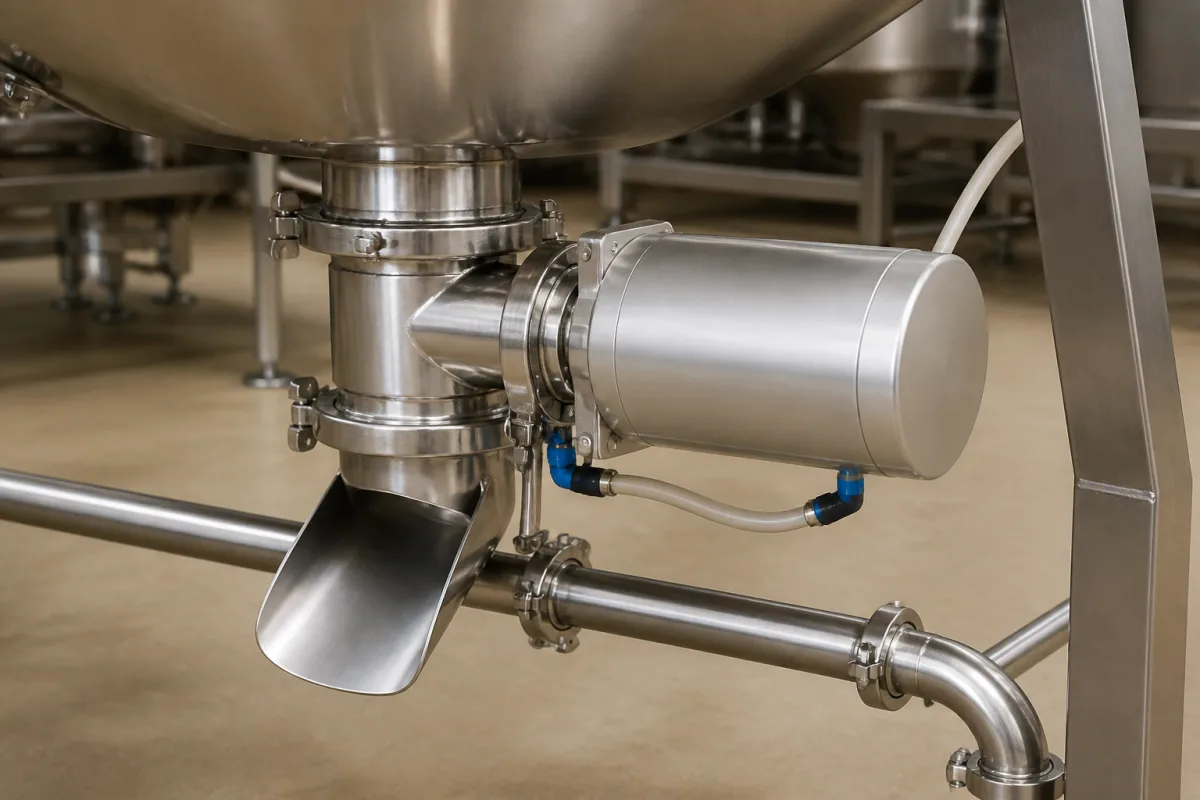
Sanitary discharge valve for food blenders and mixing kettles: knife gate, spherical disc, flush plug or flush-mounted ball valve at the trough outlet
The valve in the bottom outlet of a ribbon or paddle blender, or a mixing kettle, for food ingredients · dust-tight or liquid-tight knife gate, ball, spherical disc or flush plug, and flush-mounted 3-A kettle ball valves from 1½ to 4 in
When a batch of spice blend, drink mix, sauce or dressing is finished, it leaves the blender or kettle through a single outlet in the bottom, and the valve in that outlet decides three things: whether the closed valve holds dust, liquid or vacuum; how much product sits in the outlet neck during mixing, out of reach of the agitator; and how the valve is cleaned between batches. Among the valves one blender maker offers for the same machine, the difference that matters for the product is where the closing element sits relative to the trough wall.
Valves fitted in the bottom outlet of ribbon, paddle and ribbon/paddle blenders and of mixing kettles and tanks for food ingredients — knife gate, ball, spherical disc and flush plug valves, and flush-mounted ball valves welded to the vessel bottom — chosen by seal (dust-tight, liquid-tight, vacuum or pressure), dead space in the outlet, actuation and sanitary certification. Ball valve assemblies for on/off duty in beverage lines are covered on the Sanitary ball valve assembly page; disc-rising and disc-lowering flush-bottom valves for reactors and process tanks on the Flush-bottom discharge valve for reactors and process tanks page; slide gates under food-ingredient hoppers on the Hopper discharge gate page; butterfly valves, rotary airlocks and dosing valves at hopper and silo outlets on the Powder hopper valve page; hygienic seat-type control valves on the Hygienic pneumatic regulating valve page; the blender's drive on the Blender drive motor page; finish, radii and drain slope of the vessel itself on the Sanitary mixing vessel construction page.
CNFX editorial research · Sources checked October 13, 2026 · 4 sources
Knife gate, ball, spherical disc or flush plug: how each seals the trough outlet and how much product it leaves in the neck
Ross's Model 42N ribbon blender is a useful reference because it lists the standard valve and four options side by side, each with the reason for choosing it. [1] The 42N's ribbon agitator is designed for centre discharge [1], and Ross's selection article adds that the valve assembly must seal well enough to prevent leakage and keep the work area safe. [2]
Ross describes the spherical disc as minimising dead space and the flush plug as eliminating dead spots in the trough, and lists neither claim for the knife gate. [1] Editorial note: a gate that closes below the outlet neck leaves the neck filled with product during mixing. Ross's article also suggests considering a pneumatically operated valve for more precise control of discharge. [2] Editorial note: on a food blend that has to be uniform from the first kilogram discharged, product left in the neck below a gate has not been mixed with the rest of the batch, so the valve choice affects the start of discharge as well as cleaning.
The rest of the 42N specification shows what the valve sits on: 304 stainless wetted parts with a 60-grit finish as standard and sanitary finish and construction as an option, supports giving 36 in (about 914 mm) of discharge clearance, and product densities up to 64 lb/ft³. [1]
Valve in the trough outlet
What Ross states
What Ross's selection article suggests it suits
Knife gate, dust-tight
Manually operated; the 42N's standard discharge valve [1]
Optional; for vacuum or pressure operation and liquid-solid blending [1]
Wet applications, as well as vacuum and pressure [2]
Spherical disc valve
Optional; pneumatically operated, minimises dead space and gives a large opening [1]
Sensitive products that need minimal dead spots in the trough [2]
Flush plug valve
Optional; eliminates dead spots in the trough; manual or pneumatic [1]
Sensitive products that need minimal dead spots; shown as two pneumatic 10 in valves on a vacuum-rated blender [2]
Tell the blender or valve supplier whether the batch is dry, wet or run under vacuum or pressure, how much unmixed product may sit in the outlet, whether the valve must be pneumatic, and the clearance under the outlet for the receiving container or conveyor.
02
Flush-mounted 3-A kettle and tank ball valves: 1½–4 in, welded mounting flange, 300 psig and 450 °F
For kettles, tanks and blenders handling liquids and slurries, Lee Industries offers a flush-mounted ball valve (BFT) whose mounting flange is welded into the vessel bottom, in 1½, 2, 3 and 4 in full-port sizes, with vacuum-rated mounting flanges available. [4] Lee's ribbon blenders, which handle products from talcum powder to barbecue sauce, salad dressing and sausage, list these Fluid Transfer flush-bottom ball valves as an outlet option that meets 3-A requirements and is USDA approved. [3]
Lee's manual ball valve line is 3-A certified and USDA approved, with 316L stainless contact parts, PTFE or mica-filled PTFE seals, a #4 finish inside and out, breakdown for cleaning without special tools, and maximum ratings of 300 psig and 450 °F; Tri-Clamp outlets are standard, with I-line, Acme and flanged outlets as options. [4] Its three-way valves are rated lower, 150 psig and 300 °F, unless mica-filled seals are specified. [4] On the vessel side, Lee offers finishes from #4 up to its #7 mirror finish of less than 6 Ra. [3]
Editorial calculation from the table: the 4 in valve body weighs about nine times the 1½ in body (48½ against 5½ lb), and the 3 in to 4 in step alone more than doubles it; plan handling for removal and cleaning accordingly.
State the vessel bottom shape and thickness the flange will be welded into, whether vacuum rating is needed, the seal material for your product and cleaning temperature, the outlet connection, and whether 3-A certification of the valve is required.
03
Data for a blender or kettle discharge valve
Paste it into your enquiry below or into an email to a maker, then replace every bracket.
Vessel: [ribbon/paddle blender or kettle; outlet position; bottom shape and thickness]
Product: [dry, wet or slurry; density; sensitivity to unmixed product in the neck]
Valve: [knife gate, ball, spherical disc, flush plug or flush-mounted ball; size]
Seal: [dust-tight, liquid-tight, vacuum or pressure; seal material]
Actuation: [manual or pneumatic; position feedback]
Hygiene: [finish Ra; 3-A or USDA requirement; cleaning method]
Installation: [clearance under outlet; connection to receiving equipment]
Explore company information and manufacturing capabilities, then discuss the scope of your project with a relevant supplier.
Share this page
Compiled and source-reviewed by the CNFX editorial team.
Each manufacturer above links to the page on that company's own website where the product is listed, with the date we checked it. How we source and review
· Page last updated 13 October 2026
Buyer questions
Which discharge valve leaves the least product in a blender outlet?
Ross describes its flush plug valve as eliminating dead spots in the trough and its pneumatic spherical valve as minimising dead space with a large opening. [1]
When is a ball valve used under a blender?
Ross offers it for vacuum or pressure operation and liquid-solid blending. [1][2]
What sizes do flush-mounted sanitary kettle valves come in?
Lee lists its flush-mounted BFT kettle/tank ball valves in 1½, 2, 3 and 4 in full-port sizes, with a mounting flange welded to the tank bottom. [4]
What pressure and temperature does a 3-A manual ball valve take?
Lee rates its 3-A sanitary manual ball valves to 300 psig and 450 °F; its three-way valves to 150 psig and 300 °F unless mica-filled seals are fitted. [4]
Sources and what still needs a direct check
Sources checked 2026-10-13. Charles Ross & Son's 42N ribbon blender specification and its Powder Bulk Solids selection article describe the valve choices at the trough outlet; Lee Industries' ribbon blender fact sheet and 3-A ball valve sheet give the flush-mounted kettle valve sizes, ratings and weights.