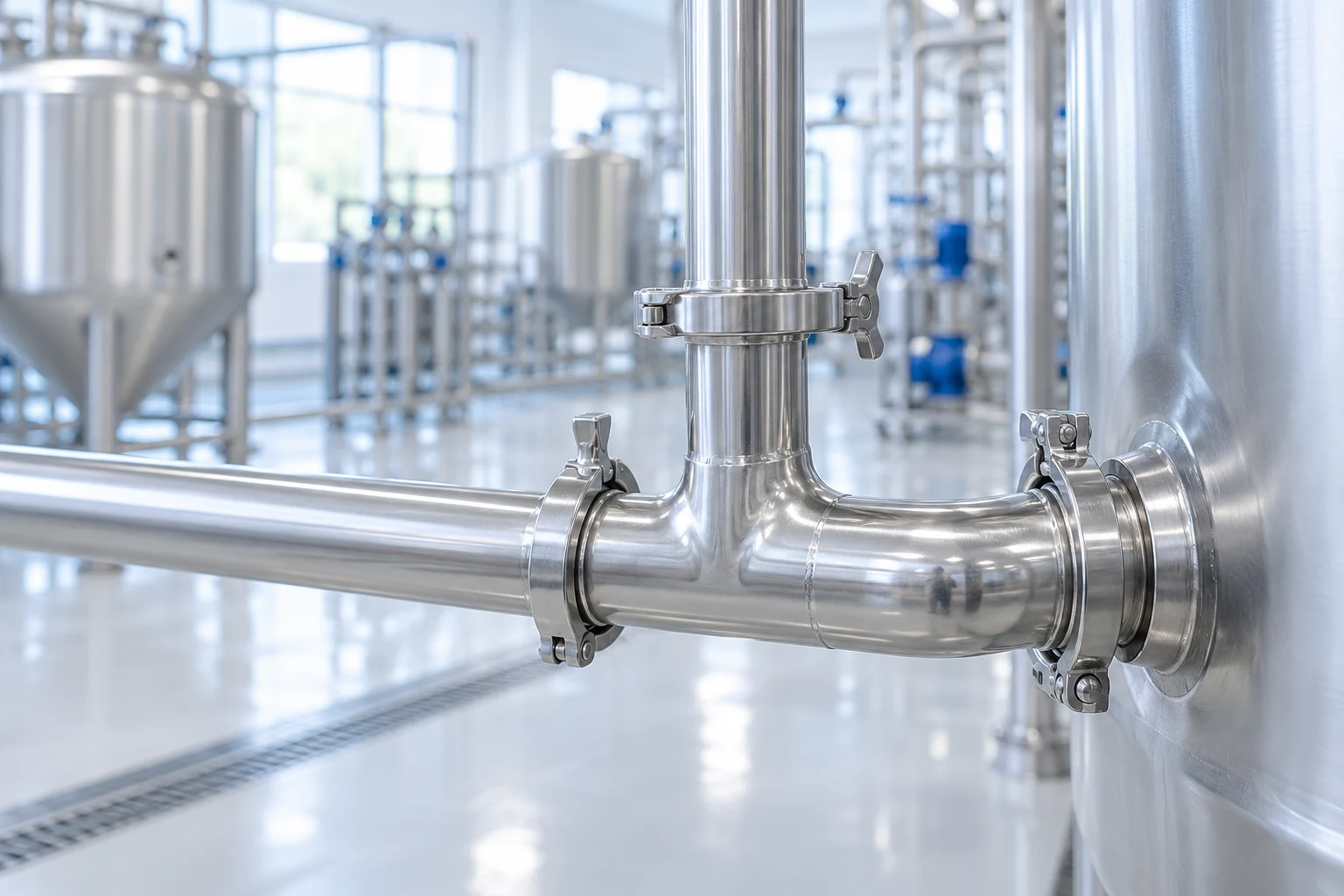
A hygienic pipe connection must match the tube bore, ferrule face, seal and clamp—not just the nominal size. Compare three actual small-bore tube entries below, then check the complete joint against its pressure and cleaning duty before ordering elbows, tees, reducers or unions.
CNFX editorial research · Sources checked October 9, 2026 · 15 sources
These are three Alfa Laval catalogue entries, not the full dimensional tables of the standards. The listed article numbers let a buyer check the same records. Tube dimensions describe the weld end; they do not by themselves identify a compatible clamp face.
DN25 to DIN is 4 mm larger than ISO 25 mm
The DIN-family entry has 29 mm OD while the ISO-family entry has 25 mm OD. Their plain weld ends are not a like-for-like match. A designed transition can connect different tube families; specify its two end dimensions rather than asking for a generic DN25 elbow [1][2].
ISO and ASME BPE look close but are not the same
The ISO entry has 25.0 mm OD and 22.6 mm ID; the BPE technical fields list 25.4 mm OD and 22.2 mm ID. Those different bores would need to be addressed in the joint design. Similar nominal sizes are insufficient evidence of a flush, cleanable connection [2][3].
The BPE title and technical fields disagree on wall thickness
Article 9613407103 is titled 25.4 × 1.65 mm, but its technical fields list 1.60 mm wall and 22.20 mm ID. The table above reproduces the technical fields; CNFX cannot resolve the conflict. Obtain the current dimension drawing before accepting either wall value [3].
The DIN finish heading also differs from its technical fields
Article 9611819133 has an “EHEDG 0.8/0.8” description while the technical finish field states inside Ra ≤ 0.8 µm and outside ≤ 1.0 µm. The table uses that technical field and does not verify an EHEDG certification. Request the finish requirement by surface on the ordered item [1].
Connection standards are as specific as tube standards. One Chinese hygienic fittings maker groups its ranges by standard [4].
Sanitary connection standards listed
3A, SMS, DIN, BS 4825, RJT, IDF and ISO, with various connection methods [4].
Aseptic connection standards listed
DONJOY groups DIN 11864, DIN 11853 and ASME BPE under its aseptic connection range. This is a manufacturer range description, not proof that an assembled process line is sterile or that every item has independent hygienic certification [4].
Fitting types and size range
Clamp fittings (elbow, tee, reducer, clamp connector, cross) and threaded fittings from 1/2 in to 8 in, DN10 to DN200; weld fittings including ferrules [4].
Wall thicknesses offered
1.2, 1.5, 1.65, 2.0 and 2.8 mm on its special and high-purity piping [4]; match the fitting wall to the tube you weld to.
Specify every end separately with a dimension drawing: a welded elbow, a clamp ferrule and a threaded union are different assemblies even when sold under the same sanitary-fittings heading.
03
A clamp joint has ferrules, a gasket and a clamp
Alfa Laval describes its clamp connection as these three part types. The ferrules are attached to the tube ends; the gasket sits between their sealing faces, and the clamp holds the joint together. This functional BOM applies to a detachable clamp joint, not to every welded elbow or threaded union [5].
A matching clamp face can hide a different bore
The leaflet gives the same 1.984 in clamp-face OD for 1 in and 1½ in tube connections. A clamp that fits the face therefore does not prove that the pipe bores match. Check the tube size and gasket bore as well as the face dimension [5].
Component
Function and material
What to specify together
Ferrules
Metal end pieces provide the mating sealing faces. Hygienic and UltraPure wetted-part steel grades depend on the product family [5].
Tube OD, bore, weld wall, face diameter, seal profile and material certificate. Do not infer the grade from “stainless”.
Gasket
The seal between the faces. Alfa Laval lists elastomer and PTFE options by connection family; PTFE and EPDM are alternatives, not interchangeable specifications [5].
Exact gasket model, profile, material and compatibility with process liquid and cleaning cycle.
Clamp
Applies the retaining force around the ferrule joint. Alfa Laval publishes distinct ratings for clamp types such as 13MHHM and A13MHP [5].
Clamp part number, size, material, fastening method and its specified tightening condition. A ferrule steel grade does not identify the clamp grade.
04
Read the clamp rating at the operating temperature
Alfa Laval’s leaflet lists these ratings for its own 1 in and 1½ in Tri-Clover connections. The higher rating belongs to different fastening hardware; it cannot be transferred to a similar-looking clamp from another manufacturer [5].
PTFE resin temperature is not the rating of a PTFE joint seal
The same leaflet limits its listed PTFE gasket application to 200 °F because cold flow can lead to leakage. That warning concerns the gasket application; it is not a general melting point or a temperature limit for all PTFE products. Select the seal with the actual clamp, pressure and cleaning duty [5].
These manufacturer ratings derive from hydrostatic testing with standard moulded Buna-N gaskets and the specified Tri-Clover ferrules, clamps and gaskets, correctly assembled. The leaflet excludes shock pressure. Confirm the complete joint rating, gasket and temperature; the numbers are not a universal operating envelope or tightening instruction for sanitary fittings [5].
05
Specify surface finish and grade with numbers
Finish and material are stated per standard and per surface, and in different units.
Units
Metric hygienic tubes are listed in µm Ra, ASME BPE tubes in µin (20 µin is about 0.5 µm) [2][3]. Convert before comparing quotes.
Location
Finishes are given separately for inside, outside and weld [2]. Ask for the inside finish of fittings as well as tube, and for the weld finish.
Grade
Published grades include 1.4307 (304L) for DIN and ISO tube [1][2], 316L for ASME BPE tube [3], and ASTM 304/316L or 1.4301/1.4404 for one Chinese fitting range [4]. Write the exact grade number you need.
06
Keep the dimension, seal duty and acceptance test on the same line item
Define these eight specification fields for the ordered fitting and its measurement basis. A finished joint is accepted against its named parts and agreed test conditions; a catalogue-wide temperature, weight or leakage range cannot replace them.
Field
Unit / identity
How to define it
Nominal diameter
DN, mm or inch
Give the tube family and actual OD/ID; the three catalogue examples above differ [1][2][3].
Wall thickness
mm
Match the weld end and drawing; resolve the 1.65/1.60 mm BPE listing conflict before ordering [3].
Operating temperature
°C plus cycle
State process and cleaning temperatures, durations and pressure. The clamp rating changes with temperature, and seal selection has its own restrictions [5].
Surface roughness
Ra, µm or µin
Specify inside, outside and weld separately. Catalogue tube finish is not proof of the finish on every fitting [2][3].
Material grade
Grade designation
Name each wetted steel and seal material. 1.4307 tube and 316L tube are separate listed products [1][3].
Leakage acceptance
Agreed test and units
Define medium, pressure, temperature, duration and acceptance result in the contract. No universal mbar·L/s leak rate is established by the sources read here; this fitting has no valve seat to rate.
Connection type
Drawing and end standard
Identify each weld, clamp or union end. For clamps include ferrule face, seal profile and clamp part [4][5].
Weight
kg per identified part
Obtain net weight for the actual elbow, tee or assembly. A tube record or a generic 0.5–5 kg range cannot establish fitting weight.
07
Specify the cleaning cycle before choosing the gasket
Alfa Laval’s leaflet says gasket life depends on chemical exposure, temperature and wear together. Its chemical-resistance chart is guidance for constant contact, not a validated lifetime for an alternating production/CIP/SIP cycle [5].
Describe the exposure
Give process liquid, cleaner/sanitizer, concentration, temperature, contact time and cycle frequency to the gasket supplier. A material name alone cannot settle compatibility.
Plan joint inspection with the equipment instructions
Agree the inspection and replacement procedure for the installed seal and fastening hardware. The sources read do not establish a universal replacement interval. Do not compensate for a leaking or displaced gasket by applying another clamp’s torque.
Keep sterile-process validation separate
DONJOY’s aseptic range designation identifies offered connection families. Cleaning performance and sterile-process validation still require the actual assembly design and operating procedure [4].
08
Request documents for the wetted parts and ordered joint
Ask for evidence per line item and heat.
Dimensional data sheet showing OD, ID and wall to the named standard for every fitting [1][2][3].
Surface roughness values for inside, outside and weld, in the unit you specified [2][3].
For aseptic lines, confirmation of the aseptic connection standard and its seal [4].
Alfa Laval describes EN 10204 3.1 documentation for its wetted hygienic steel parts and MTR or 3.1 options for UltraPure products. That manufacturer provision is not a universal entitlement from every supplier; specify the required document and heat traceability in the order [5].
For pressure service, obtain the rating for the exact ferrule/clamp/gasket combination at duty temperature, including tightening and pressure-shock limitations [5].
09
Copy this RFQ and fill in the brackets
Paste it into your enquiry below or into an email to a maker, then replace every bracket.
Product and quantities: [elbow / tee / reducer / ferrule / union, drawing and quantity per item]
Tube family and weld ends: [standard/family, OD, ID and wall for every end]
Detachable ends: [face diameter, seal profile and clamp/union part number]
Wetted steel: [grade]; gasket: [exact material and part]; clamp: [material and hardware]
Surface finish: inside Ra [unit/value], outside [ ], weld [ ]; polishing [ ]
Duty: liquid [ ], pressure [ ], temperature [ ], pressure shocks [ ]
Cleaning/sterilization: chemical and concentration [ ], temperature [ ], duration/frequency [ ]
Documents: dimension drawing [ ], material/heat certificates [ ], finish report [ ], joint rating [ ]
Acceptance test: medium [ ], pressure/temperature [ ], duration [ ], allowable leakage/result [ ]
Packing and delivery: capped ends/bags [ ], destination [ ], date [ ]
8 companies list this product among what they make. Company figures are quoted from each
company's own website; every card states where the relationship came from.
Donjoy Technology
Wenzhou, Zhejiang, CN
DONJOY lists clamp and threaded fittings, welded elbows/tees/reducers/ferrules, I-line and BPE ranges. Size and wall options differ by family; confirm the contracting entity.
Product scope checked 2026-10-09
Listed on the company's own website · profile compiled by CNFX from public sources
The current website identifies Kaysen Steel Industry Co., Ltd. Its pipe-fittings catalogue lists 3A, DIN, ISO/IDF, BPE, SMS/DS, AS1528, BS4825 and I-line families, plus clamps and ferrules. These are supplier range labels; independent 3-A/FDA approval was not verified.
Product scope checked 2026-10-09
Founded 200251~100 staff5,000-10,000 square meters
ISO9001ASMECETest Report
Listed on the company's own website · profile compiled by CNFX from public sources
Listed there as: “AS1528 Sanitary Fittings” View source page ↗chinasanitaryvalve.com · recorded 2026-08-22
Its sanitary-fittings category lists welded and quick-install elbows, tees, reducers and adapter heads. The category is a product inventory, not evidence of a particular ordered finish, gasket or joint-pressure rating.
Product scope checked 2026-10-09
Listed on the company's own website · profile compiled by CNFX from public sources
Listed there as: “Sanitary fittings series” View source page ↗sngong.com · recorded 2026-09-05
ONEMO’s sanitary-pipe-fittings category lists clamp and butt-weld return bends, ferrules, DIN/IDF union parts and male NPT–weld adapters. Select the end system explicitly; the catalogue mixes detachable and welded joints.
Product scope checked 2026-10-09
Listed on the company's own website · profile compiled by CNFX from public sources
Listed there as: “VALVES&SANITARY FITTINGS” View source page ↗onemoss.com · recorded 2026-09-04
Its Sanitary Fittings category lists 45°/90° elbows, welded tees and Y-tees, concentric/eccentric reducers, crosses and caps. The category does not establish a pressure rating or hygienic certificate for an assembled clamp joint.
Product scope checked 2026-10-09
Listed on the company's own website · profile compiled by CNFX from public sources
Listed there as: “Sanitary Fittings” View source page ↗cnbstv.com · recorded 2026-09-03
Its sanitary category separates clamp fittings, butt-weld/tube-OD fittings, union fittings, hangers, adapters and manifold capabilities; BPE/BioPharm is a separate category. A category listing alone does not establish the ordered tube family or finish.
Product scope checked 2026-10-09
Listed on the company's own website · profile compiled by CNFX from public sources
Listed there as: “Sanitary Fittings [6]” View source page ↗wzjunteng.com · recorded 2026-09-05
QIIMII lists ASME BPE, DIN11864 aseptic, clamp, tube/weld, union and customized fittings as distinct ranges. Confirm the exact drawing and finish; these range names do not validate an installed sterile process.
Product scope checked 2026-10-09
Listed on the company's own website · profile compiled by CNFX from public sources
Listed there as: “Sanitary Fittings” View source page ↗qmstainless.com · recorded 2026-09-03
The sanitary category lists single-pin clamps, ferrules, jacketed elbows, tees and crosses in named 304/316L product titles. Its similarly named 13MHHM hardware is not shown here to have Alfa Laval’s published joint ratings; obtain its own assembly data.
Product scope checked 2026-10-09
Listed on the company's own website · profile compiled by CNFX from public sources
Listed there as: “Sanitary Fittings” View source page ↗sansunstainless.com · recorded 2026-09-04
Explore company information and manufacturing capabilities, then discuss the scope of your project with a relevant supplier.
Share this page
Compiled and source-reviewed by the CNFX editorial team.
Each manufacturer above links to the page on that company's own website where the product is listed, with the date we checked it. How we source and review
· Page last updated 13 October 2026
Buyer questions
Is DN25 the same as 1 inch?
No. In one supplier's catalogue DN25 to DIN 11850 is 29 mm outside diameter, ISO 2037 25 mm is 25 mm, and ASME BPE 1 in is 25.4 mm. [1][2][3]
Can I weld ISO 2037 fittings to ASME BPE tube?
The specific ISO and BPE entries here have different outside and inside diameters. A direct unmodified end match is not established. Use matching specified ends or an engineered transition, and obtain a drawing that addresses the bore step. [2][3]
Does SF1 on a tube record prove my elbow has the same finish?
No. The cited BPE tube entry lists SF1 with inside ≤ 20 µin and outside ≤ 32 µin. Twenty microinches equals 0.508 µm. Confirm the fitting and its weld finish separately rather than applying the tube entry to every elbow. [3]
Which connections are used for aseptic lines?
DONJOY lists DIN 11864, DIN 11853 and ASME BPE under its aseptic range. That range description does not validate the sterility of an installed line; obtain the actual joint drawing, seal data and process-validation requirements. [4]
Are 1.4301 and 1.4307 the same steel?
They are different grade numbers; catalogues list 1.4307 (304L) for hygienic tube and some fitting ranges 1.4301. Write the exact grade you need on the order. [1][4]
Sources and what still needs a direct check
Sources checked 2026-10-09. Tube examples use specific Alfa Laval catalogue records. The pressure and gasket discussion uses its 13-page technical leaflet (200006866-4-EN-GB). Chinese manufacturer pages establish only their stated ranges; conflicting dimensions and unverified certification are identified separately. Sources were checked on 9 October 2026.
The EN 10357, ISO 2037 and ASME BPE standard texts were not read. Dimensions are from the named Alfa Laval catalogue entries, not a full standard compatibility table.
Alfa Laval’s BPE title and wall field conflict; its DIN heading and outside-finish field also differ. Confirm current drawings and finish reports with the supplier.
Clamp ratings belong to the cited Alfa Laval hardware and test conditions; no pressure rating, seal life or sterile-process validation was established for another manufacturer.
DONJOY’s sanitary-fittings PDF is image-only; only introductory pages have been inspected so far and no dimensions or certifications are taken from it. No active EHEDG, 3-A or other independent certification listing was checked.
Buyer enquiry
Request manufacturing insight
for Sanitary Fittings
Ask for use case, specification boundaries, supplier type, and RFQ preparation
information for this product.
Where it goes
Straight to the CNFX editorial desk, and to the manufacturer if this product is
linked to a claimed profile. Nothing is broadcast to a supplier list.
Your details stay here
We do not sell or rent enquiry data, and we do not add you to a mailing list.
Used only to answer this request.
No commission, no middleman
CNFX is a directory. We take no cut of any order and never negotiate on a
supplier's behalf.
What to include
Share your product specifications, quantity, destination and target delivery date.
Need to Manufacture Sanitary Fittings?
Compare manufacturer profiles with relevant product and process capability.