Industry-Verified Manufacturing Data (2026)

Spray Balls/Nozzles

Based on aggregated insights from multiple verified factory profiles within the CNFX directory, the standard Spray Balls/Nozzles used in the Food Manufacturing sector typically supports operational capacities ranging from standard industrial configurations to heavy-duty production requirements.

Technical Definition & Core Assembly

A canonical Spray Balls/Nozzles is characterized by the integration of Spray Head/Body and Orifice Plates/Nozzles. In industrial production environments, manufacturers listed on CNFX commonly emphasize Stainless Steel 316L construction to support stable, high-cycle operation across diverse manufacturing scenarios.

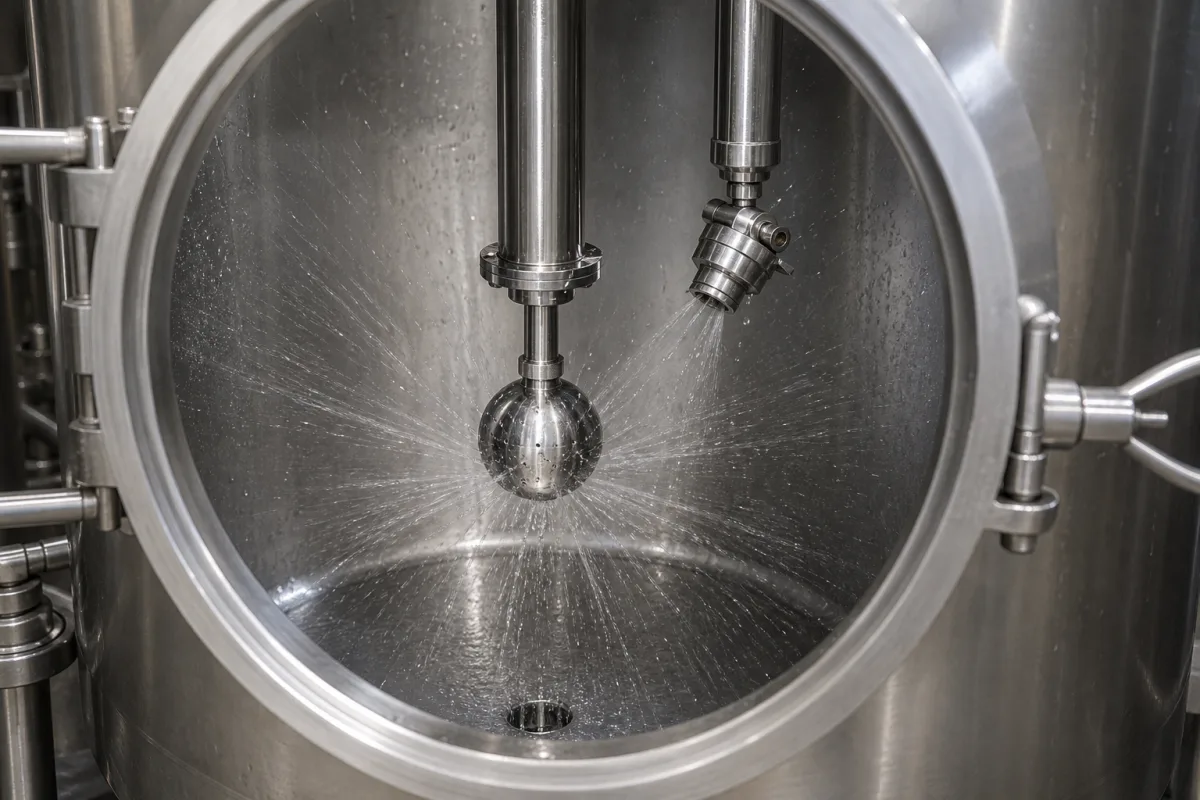
Hydraulic cleaning components that distribute cleaning fluids within vessels and pipelines during CIP processes.
Product Specifications

Technical details and manufacturing context for Spray Balls/Nozzles

Definition
Spray balls and nozzles are critical components of Cleaning-in-Place (CIP) systems designed to deliver cleaning solutions, sanitizers, and rinse water to all interior surfaces of tanks, vessels, and pipelines. They create specific spray patterns (full coverage, rotating, or fixed) to ensure complete surface contact and effective removal of soil, residues, and microorganisms without requiring disassembly of equipment.
Working Principle
High-pressure cleaning fluid is pumped through the CIP system into the spray ball/nozzle assembly. The fluid exits through precisely engineered orifices or rotating arms, creating controlled spray patterns that cover the entire interior surface area. The mechanical action of the fluid impact, combined with chemical cleaning agents, removes contaminants through a combination of impingement force, chemical reaction, and thermal effects.
Common Materials
Stainless Steel 316L, Stainless Steel 304, PTFE (Polytetrafluoroethylene), Food-grade plastics
Technical Parameters
  • Orifice diameter and spray pattern coverage diameter (mm) Customizable
Components / BOM
  • Spray Head/Body
    Main housing that distributes fluid and contains orifices
    Material: Stainless Steel
  • Orifice Plates/Nozzles
    Precision openings that create specific spray patterns
    Material: Stainless Steel or PTFE
  • Mounting Flange/Connection
    Interface for installation to tank or pipeline
    Material: Stainless Steel
  • Bearings/Rotation Mechanism
    Enables rotational movement for rotating spray balls (if applicable)
    Material: Stainless Steel with food-grade lubricants
Engineering Reasoning
2.0-6.0 bar (29-87 psi) at 15-60°C fluid temperature
8.0 bar (116 psi) internal pressure or 0.5 mm orifice erosion
Design Rationale: Cavitation-induced erosion when local pressure drops below fluid vapor pressure (0.023 bar at 20°C for water), causing implosive bubble collapse with microjet impacts exceeding 1000 MPa
Risk Mitigation (FMEA)
Trigger Particulate contamination exceeding 50 μm in cleaning fluid
Mode: Orifice abrasion and flow pattern distortion
Strategy: Install 10 μm absolute filtration with differential pressure monitoring at 0.5 bar threshold
Trigger Chloride concentration exceeding 25 ppm in 316L stainless steel systems
Mode: Stress corrosion cracking at weld heat-affected zones
Strategy: Replace with duplex 2205 stainless steel (PREN >35) for chloride environments

Industry Taxonomies & Aliases

Commonly used trade names and technical identifiers for Spray Balls/Nozzles.

Applied To / Applications

This component is essential for the following industrial systems and equipment:

Industrial Ecosystem & Supply Chain DNA

Complementary Systems
Downstream Applications
Specialized Tooling

Application Fit & Sizing Matrix

Operational Limits
pressure: Up to 10 bar (standard), up to 16 bar for high-pressure designs
flow rate: 5-100 L/min per nozzle, depending on orifice size and pressure
temperature: -20°C to 150°C (standard), up to 200°C with special materials
slurry concentration: Up to 15% solids by weight for standard designs, special designs for higher concentrations
Media Compatibility
✓ Aqueous cleaning solutions (CIP chemicals) ✓ Food-grade sanitizers and detergents ✓ Pharmaceutical-grade cleaning agents
Unsuitable: Highly corrosive acids (e.g., concentrated sulfuric acid) without specialized material selection
Sizing Data Required
  • Vessel/tank diameter and geometry
  • Required cleaning coverage pattern and overlap
  • Available pump pressure and flow rate

Reliability & Engineering Risk Analysis

Failure Mode & Root Cause
Clogging/Blockage
Cause: Accumulation of mineral deposits, product residues, or foreign particles due to inadequate filtration, improper cleaning cycles, or water quality issues.
Abrasive Wear/Erosion
Cause: High-velocity impact of abrasive particles in the fluid stream, leading to material loss and altered spray patterns, often exacerbated by poor filtration or aggressive cleaning chemicals.
Maintenance Indicators
  • Irregular or uneven spray patterns observed during cleaning cycles
  • Audible changes such as whistling, hissing, or reduced flow noise indicating partial blockage or pressure issues
Engineering Tips
  • Implement regular inspection and cleaning schedules using appropriate descaling agents and verify spray coverage with test plates
  • Install and maintain proper inline filtration (e.g., 100-micron filters) and ensure water quality meets manufacturer specifications to prevent particle ingress

Compliance & Manufacturing Standards

Reference Standards
ISO 2852:2007 (Stainless steel tube fittings for the food industry) ASME BPE-2019 (Bioprocessing equipment standards for spray devices) DIN 11864-1 (Fittings in stainless steel - Spray balls)
Manufacturing Precision
  • Bore diameter: +/-0.02mm
  • Spray angle deviation: +/-2 degrees
Quality Inspection
  • Flow rate and coverage pattern verification test
  • Material composition verification via PMI (Positive Material Identification)

Factories Producing Spray Balls/Nozzles

Verified manufacturers with capability to produce this product in China

✓ 93% Supplier Capability Match Found

P Procurement Specialist from Germany Jan 03, 2026
★★★★★
"As a professional in the Food Manufacturing sector, I confirm this Spray Balls/Nozzles meets all ISO standards."
Technical Specifications Verified
T Technical Director from Brazil Dec 31, 2025
★★★★★
"Standard OEM quality for Food Manufacturing applications. The Spray Balls/Nozzles arrived with full certification."
Technical Specifications Verified
P Project Engineer from Canada Dec 28, 2025
★★★★★
"Great transparency on the Spray Balls/Nozzles components. Essential for our Food Manufacturing supply chain."
Technical Specifications Verified
Verification Protocol

“Feedback is collected from verified sourcing managers during RFQ (Request for Quote) and factory evaluation processes on CNFX. These reports represent historical performance data and technical audit summaries from our B2B manufacturing network.”

6 sourcing managers are analyzing this specification now. Last inquiry for Spray Balls/Nozzles from Turkey (56m ago).

Supply Chain Compatible Machinery & Devices

Intelligent Food Grade Metal Detector

Automated metal contamination detection system for food processing lines.

Explore Specs →
Automated Food Packaging Integrity Tester

Automated system for non-destructive testing of food package seals and integrity.

Explore Specs →
Automated Food Moisture Analyzer

Automated system for precise moisture content measurement in food products

Explore Specs →
Automated Food Color Consistency Analyzer

Automated inline system for real-time color measurement and consistency control in food processing.

Explore Specs →

Frequently Asked Questions

What's the difference between 304 and 316L stainless steel for spray balls?

316L stainless steel offers superior corrosion resistance, especially against chlorides and acids common in food processing, making it ideal for harsh CIP environments. 304 is suitable for less aggressive applications.

How do spray balls improve CIP efficiency in food manufacturing?

Spray balls ensure complete coverage and consistent fluid distribution during cleaning cycles, reducing chemical and water usage while maintaining strict hygiene standards required in food processing.

Can spray balls handle high-temperature CIP processes?

Yes, our stainless steel and PTFE spray balls are engineered to withstand high-temperature cleaning cycles up to 150°C (302°F) and aggressive cleaning chemicals used in food manufacturing CIP systems.

Can I contact factories directly on CNFX?

CNFX is an open directory, not a transaction platform. Each factory profile provides direct contact information and production details to help you initiate direct inquiries with Chinese suppliers.

Get Quote for Spray Balls/Nozzles

Request technical pricing, lead times, or customized specifications for Spray Balls/Nozzles directly from verified manufacturing units.

Your business information is encrypted and only shared with verified Spray Balls/Nozzles suppliers.

Thank you! Your message has been sent. We'll respond within 1–3 business days.

Need to Manufacture Spray Balls/Nozzles?

Connect with verified factories specializing in this product category

Add Your Factory Contact Us
Previous Product
Spray Ball Head
Next Product
Stainless Steel Washing Tank