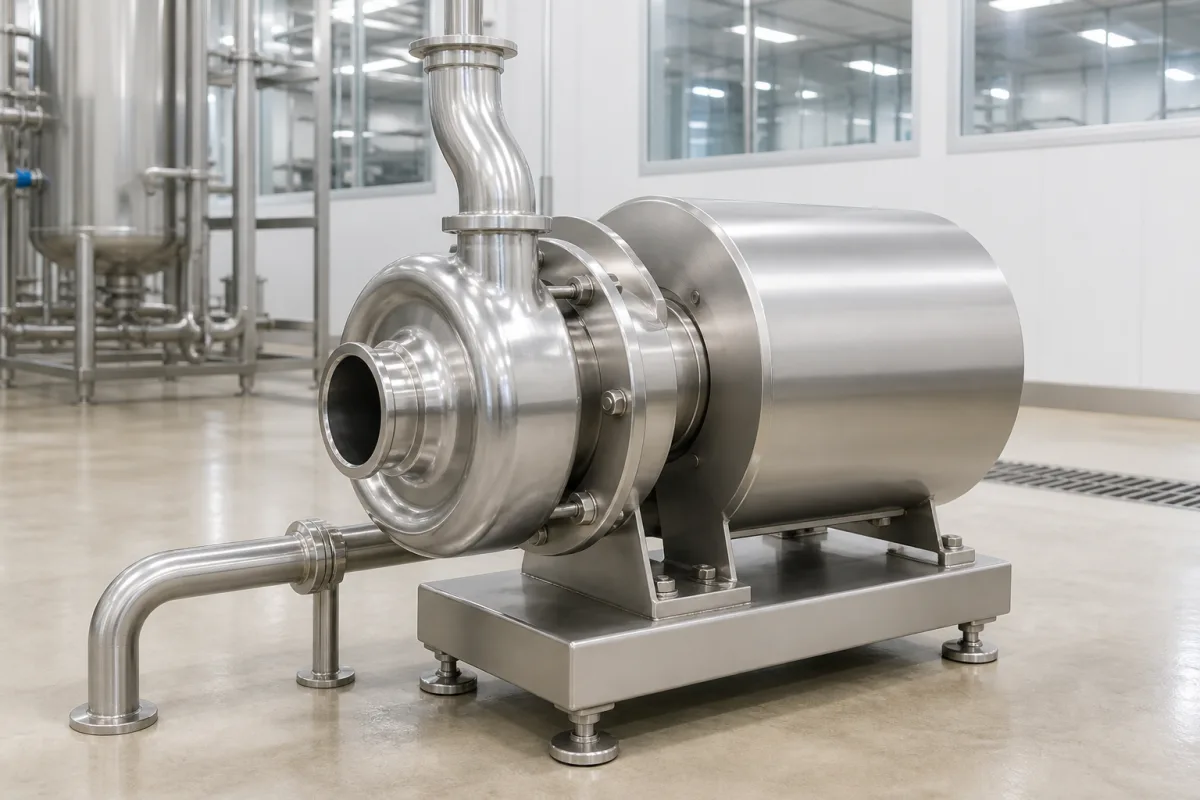
Water circulation pump for hot-water blanchers (blanch-water recirculation pump)
Hot blanch-water recirculation pumps · suction margin with water at 85–95 °C, one pump and heater per temperature zone, hygienic centrifugal pump ratings and seal flushing
A blancher's water circulation pump draws hot water from the blanching trough or tank, sends it through a heater and returns it to the product as jets or flow, so that the water stays at the set temperature and the product keeps moving. Because the water it handles is close to boiling and in contact with food, its selection turns on three things: how much suction margin is left at the pump inlet at the blanching temperature, which temperature zone of the blancher it serves, and whether the pump's materials, seals and temperature ratings suit hot food-contact water.
Centrifugal pumps that recirculate hot blanching water in water blanchers, cooker-coolers and blanch-water tanks, with their heaters, return jets and seal-flush supplies. The blanching machine itself is covered on the Rotary fruit and vegetable blanching drum page. Pumps that circulate cleaning and rinse solutions in CIP circuits, building heating and domestic hot-water circulators, and steam-only blanchers are outside this page.
CNFX editorial research · Sources checked October 12, 2026 · 3 sources
Keep near-boiling blanch water from flashing at the pump inlet
The hotter the blanch water, the less pressure is left above its vapour pressure at the pump inlet. NIST's saturation data for water give a vapour pressure of 47.4 kPa at 80 °C, 57.9 kPa at 85 °C, 70.2 kPa at 90 °C, 84.6 kPa at 95 °C and 101.4 kPa at 100 °C, with liquid density falling from 971.8 to 958.4 kg/m³ over the same range. [1]
Editorial calculation: for an open trough at standard atmospheric pressure (101.325 kPa, an assumption for a plant near sea level), the pressure head above vapour pressure is (101.325 − 84.608) kPa ÷ (961.88 kg/m³ × 9.81 m/s²) ≈ 1.8 m at 95 °C, (101.325 − 57.867) ÷ (968.59 × 9.81) ≈ 4.6 m at 85 °C, and (101.325 − 19.946) ÷ (983.16 × 9.81) ≈ 8.4 m at 60 °C. Static head from the water level above the pump inlet adds to these figures and inlet pipe losses subtract from them; the result must exceed the NPSH the pump requires at its duty point. [1]
Editorial note: at 95 °C there is little margin to spend on a long or narrow suction line, so ask the supplier for the pump's NPSH-required curve and give them the water level, pipe run and fittings between trough outlet and pump inlet.
Give the supplier the blanching temperature of each zone, the water flow each zone needs, the trough water level relative to the pump inlet, suction and discharge pipe sizes and lengths, the heater's pressure drop, the jets or nozzles fed, starch or solids load in the water, CIP conditions, and the electrical supply.
02
Give each blancher temperature zone its own pump and heater
Rosenqvists Food Technologies' patent application EP2298092 for a potato-slice blancher divides a single water bath into recirculation zones in which water is drawn from an outlet, pumped back to an inlet and injected into the trough again; it states that for controllability each zone uses a separate pumping and heating system. [2]
In that design the temperature falls in the machine direction, from about 85 °C in the upstream segment to about 55 °C downstream, and the applicant reports a gradient of about 85 °C to about 60 °C as well adapted to blanching potato slices. Water jets across the conveying direction create turbulence that keeps the slices from sticking together, and fresh water is added as the sugar content of the water rises. [2]
Editorial note: a zoned blancher therefore needs one pump per zone, each sized for its own temperature, so the suction margin in the section above differs from zone to zone; state the temperature of each zone in the enquiry rather than one figure for the machine.
03
Read a hygienic pump's temperature, pressure and seal-flush limits for hot water
Alfa Laval's leaflet for its LKH hygienic centrifugal pump, a stainless pump with a motor shroud and adjustable legs designed for cleaning in place, lists 13 sizes covering capacities up to 500 m³/h and differential pressures up to 11 bar at 50 Hz, product-wetted steel in 1.4404 (316L), EPDM elastomers, a carbon rotary and silicon-carbide stationary seal face, and a temperature range of –10 °C to +140 °C with EPDM. [3]
The same leaflet sets limits that matter for hot water duty: maximum inlet pressure of 10 bar for sizes LKH-10 to -70 and 5 bar for LKH-85 to -90; a flushed shaft seal whose flush media may be at most 70 °C, at an inlet water pressure of at most 1 bar and a consumption of 0.25–0.5 l/min; and a double mechanical seal option. Motors run from 0.75 to 110 kW, IP55, insulation class F. [3]
Editorial calculation: a flush of 0.25–0.5 l/min is 15–30 litres per hour, or 360–720 litres per 24-hour day for each flushed pump. [3] Editorial note: because the flush water limit (70 °C) is lower than blanch-water temperatures, ask whether the supplier recommends a single, flushed or double seal for your zone temperature.
04
Duty data for a blancher circulation pump order
Values shown are from the LKH leaflet as a reference for a hygienic pump of this kind; give your own duty for each zone.
Send zone temperatures, flows and suction layout together
Paste it into your enquiry below or into an email to a maker, then replace every bracket.
Blancher: [type; product; number of zones]
Zones: [temperature and flow for each]
Suction: [water level above pump inlet; pipe size and length]
Discharge: [heater; jets or nozzles; pressure]
Water: [starch or solids; sugar build-up]
Pump: [material; seal type; flush supply]
Cleaning: [CIP temperature and chemicals]
Power: [voltage; frequency; speed control]
Explore company information and manufacturing capabilities, then discuss the scope of your project with a relevant supplier.
Share this page
Compiled and source-reviewed by the CNFX editorial team.
Each manufacturer above links to the page on that company's own website where the product is listed, with the date we checked it. How we source and review
· Page last updated 13 October 2026
Buyer questions
Why does a blancher pump need more care at 95 °C than at 60 °C?
Water's vapour pressure is 84.6 kPa at 95 °C against 19.9 kPa at 60 °C (NIST), so far less suction margin is left above boiling at the pump inlet. [1]
Does a zoned blancher need a circulation pump for each zone?
In Rosenqvists' EP2298092 blancher each recirculation zone, from about 85 °C down to about 55 °C, has its own pump and heater. [2]
What temperature can a hygienic centrifugal pump handle?
Alfa Laval lists –10 to +140 °C with EPDM for its LKH pump, with flush media for a flushed seal limited to 70 °C. [3]
Sources and what still needs a direct check
Sources checked 2026-10-12. NIST's Chemistry WebBook gives water's saturation properties; Rosenqvists Food Technologies' patent application describes a zoned blancher; Alfa Laval describes its own hygienic pump.