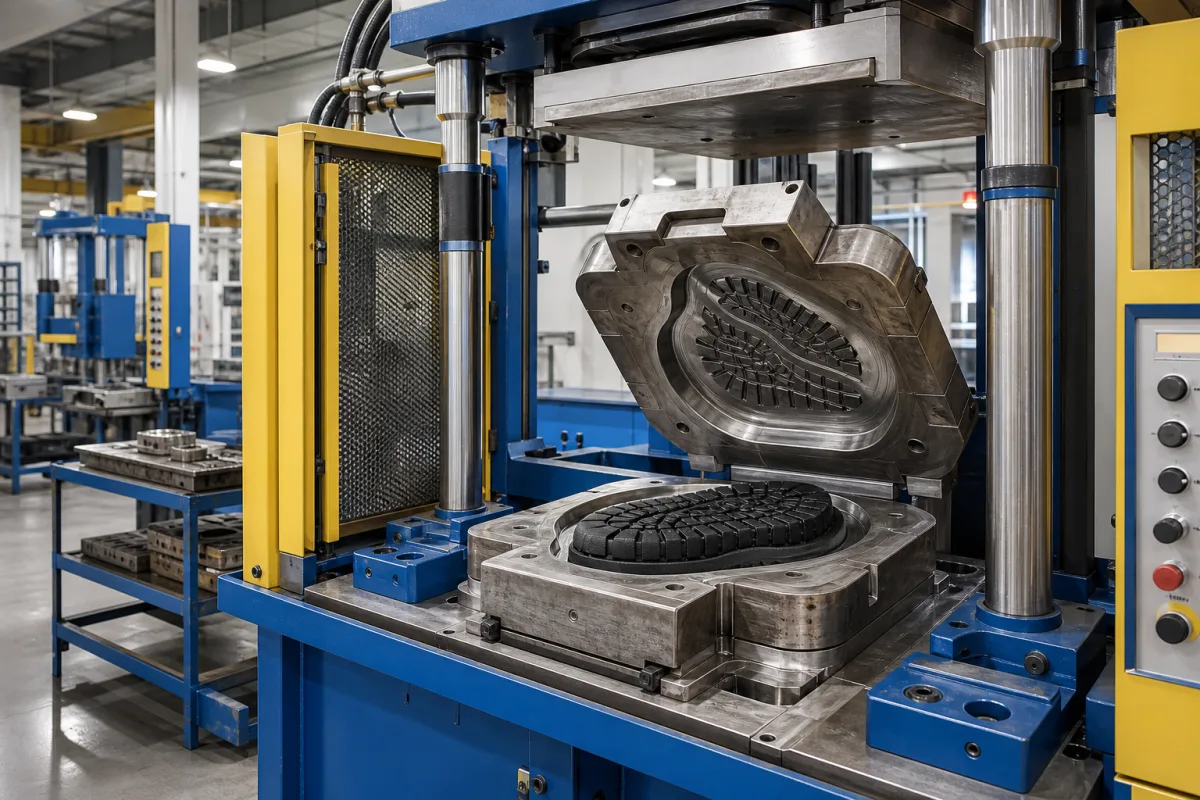
Hydraulic hot presses that vulcanise rubber outsoles in heated moulds, and sole-attaching presses that bond soles to lasted uppers · Heating temperature and time, pressure, number of stations, cycle time, temperature control points, mould handling, safety light curtains, and for attaching presses pad pressure and cylinder arrangement
A hydraulic outsole hot press shapes and vulcanises rubber in a heated mould. A sole-attaching press instead bonds a separately made sole to a lasted upper. Select the moulding or attaching process first, then specify the compound or adhesive conditions, mould handling and delivered machine configuration.
Hydraulic hot presses for moulding and vulcanising rubber outsoles in footwear production, and sole-attaching (sole pressing) presses that bond cemented soles to lasted uppers. Injection moulding machines for PU, PVC or TPR soles (see injection molding machine), upper lasting machines (see industrial footwear upper stretching machine) and complete shoe assembly lines are outside this page.
CNFX editorial research · Sources checked October 18, 2026 · 4 sources
Set the vulcanising temperature, time and pressure
Delta's application pack for twin-cylinder rubber hot presses describes the press as heating and pressing rubber into outsoles, with heating temperature, heating time and pressure as the three key process conditions; the best mould-opening point is derived from each material's vulcanisation curve to optimise elasticity and abrasion resistance. Its process runs from cutting colour chips, loading and closing the mould, a plasticisation (induction) stage in which multi-colour rubbers must be combined, vulcanisation at fixed temperature under maintained pressure, then opening, demoulding and trimming. [1]
The pack states that an outsole hot press takes about 2 to 3 minutes to complete the process, that the hydraulic system must hold pressure for a long enough time, and that adding stations raises utilisation. [1]
Editorial calculation: assuming Delta’s approximate 2–3 minute example represents a complete independent station cycle including loading, curing, opening and unloading, repeated without interruption for a 60-minute hour, the theoretical count is 60 ÷ 3 to 60 ÷ 2 = 20–30 cycles/hour. This excludes downtime, rejected cycles and shared-equipment constraints. It is not manufacturer-published output or measured running data; it gives no pairs/hour without the mould cavity and accepted-part count. [1]
Give the supplier the sole compound and its cure curve, mould size and number of cavities, required temperature, time and pressure, number of stations and moulds, mould handling (rolling or sliding in and out), temperature zones, hydraulic or hybrid drive, safety guarding, control system and data needs, and utilities available.
02
Plan stations, temperature control, safety and sole attaching
Delta’s application pack describes configurable 2–8 station lines and 30–60+ temperature-control points viewed through an HMI. Its illustrated architecture shows eight safety light curtains. The point count is not temperature uniformity, and the illustrated curtain count is not a guarding requirement for every press configuration. [1]
US patent 4,363,148 describes a sole-attaching press with a small positioning cylinder and a separate working-force mechanism linked through a locking arrangement. Its illustrated embodiment uses a pneumatically operated diaphragm cylinder and a lever to apply working force after positioning; the inflatable pad in the prior-art discussion is a separate design. This patent does not establish the installed mechanism of the Tenghong machines. [2]
Tenghong lists independent adjustment of vertical and side-wall pressing, a main-cylinder pre-fill arrangement, balancing arms on identified models, and PLC/pressure-sensing options. Its TH-730B capsule example uses an oil-expanded bladder and lists pressure up to 30 kg/cm² as printed. Confirm the force-unit convention and the measurement location; the capsule value is not established as hydraulic pump-line pressure. [3]
03
Read a cure curve before setting the press timer
Marković and co-authors’ 2026 boot-tread-compound study measured cure characteristics to ASTM D2084 using an oscillating-disc rheometer at 160 °C. It describes 300 × 300 mm laboratory rubber plates vulcanised in an electrically heated hydraulic press at 160 °C under about 4 MPa. Those specimen and laboratory conditions do not define a production outsole press cycle. [4]
The study reports scorch time ts2 and optimum cure time tc90, and defines its cure rate index as CRI = 1/(tc90 − ts2). Its Table 1 values are reproduced below. At 5 phr NBR it reports the shortest tc90 and highest ΔM of the listed blends; the authors treat ΔM as an indirect cross-link-density indicator. [4]
The text after Table 1 describes the scorch times at 5 and 15 phr NBR as slower than the control, while Table 1 reports ts2 = 0.83 and 0.93 min respectively versus 0.94 min for the control. Retain the tabulated values and ask the authors to reconcile that wording before using it as a processing conclusion. [4]
Editorial calculation: assuming the study’s approximate 4 MPa means uniform pressure acting over the entire 300 × 300 mm specimen face, the assumed area is 0.09 m² and force is 4 × 10⁶ Pa × 0.09 m² = 360 kN. This is a hypothetical force balance, not a manufacturer rating or measured press force. The paper’s approximate pressure statement does not by itself establish hydraulic-line pressure or the force needed for a different mould. [4]
Obtain the actual compound’s rheometer curve and validate the production mould’s heating, thickness, pressure and demoulding sequence. The laboratory tc90 values and Delta’s approximate 2–3 minute application example have different bases; neither alone sets an accepted production cycle. [4][1]
04
Connect heated moulds, pressure holding and station controls
1 company lists this product among what they make. Company figures are quoted from each
company's own website; every card states where the relationship came from.
Guangdong Tenghong Machinery Technology Co., Ltd.
TBC
Lists sole-attaching and pressing machines, including identified capsule, balancing-arm and PLC configurations.
Explore company information and manufacturing capabilities, then discuss the scope of your project with a relevant supplier.
Share this page
Compiled and source-reviewed by the CNFX editorial team.
Each manufacturer above links to the page on that company's own website where the product is listed, with the date we checked it. How we source and review
· Page last updated 13 October 2026
Buyer questions
What controls the quality of a vulcanised rubber outsole?
Heating temperature, heating time and pressure, with mould opening set from the compound's vulcanisation curve. [1]
How long does an outsole hot-press cycle take?
Delta’s application example takes about 2–3 minutes and describes configurable 2–8 station lines. Validate the actual compound, mould heating and handling sequence before adopting a production cycle. [1]
How does a sole-attaching press apply pressure?
The cited patent positions the presser with a small cylinder, then applies separate working force through a locking arrangement; its illustrated force cylinder is pneumatic. Tenghong’s separate TH-730B capsule offering lists up to 30 kg/cm² as printed. Confirm the selected machine’s mechanism and pressure basis. [2][3]
What temperature and pressure are used to vulcanise boot-tread rubber?
The study reports laboratory plates cured at 160 °C under about 4 MPa, and rheometer tc90 values of 1.86–2.13 min at 160 °C. These are specimen and rheometer conditions, not a production outsole cycle or hydraulic pump-line specification. [4]
Sources and what still needs a direct check
Sources checked 2026-10-18. Sources are an automation maker's outsole hot-press application pack, a patent describing a sole-attaching press, one maker's product page and a peer-reviewed study of boot-tread rubber cure data; none is an endorsement.