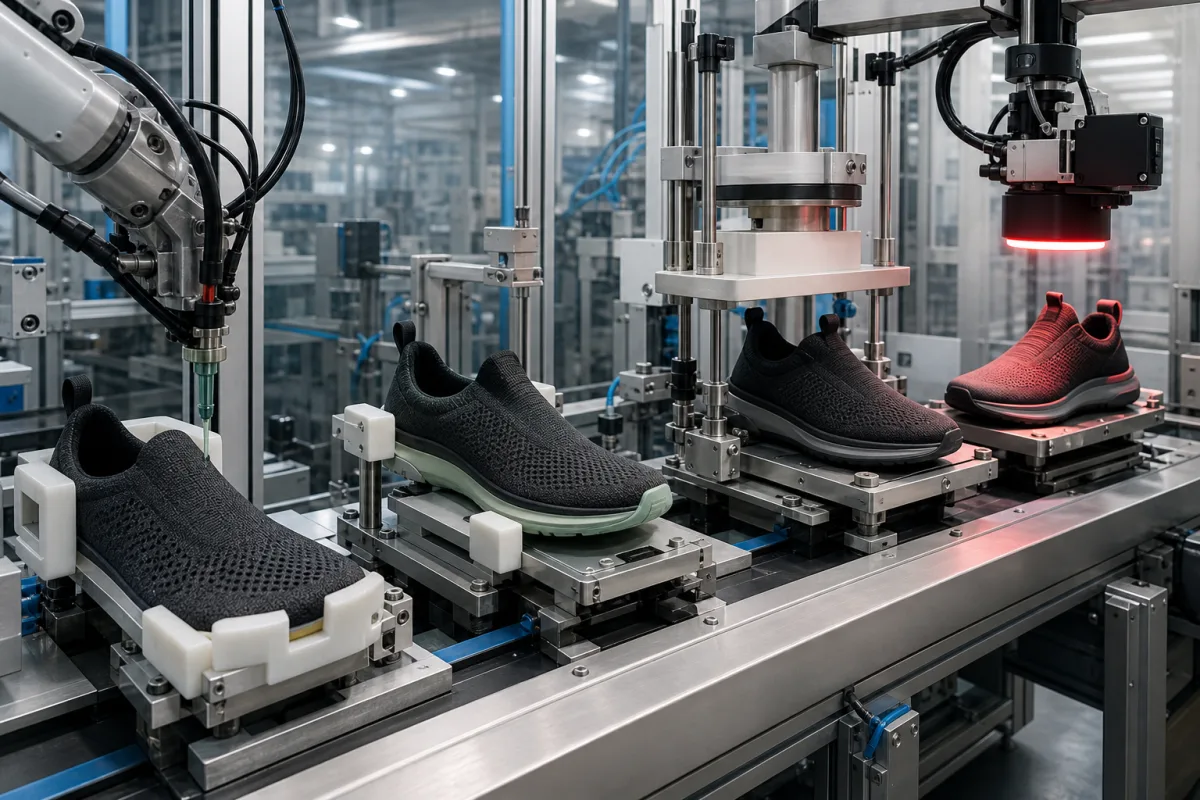
Automated sole-attaching line for cemented shoes: robotic roughing, cement spraying, hot-cure and sole pressing
The cemented-sole stretch of a shoe line, from lasted upper to pressed shoe · robot-tended roughing and cementing, scanned spray paths per sole variant, hot-cure and press timing, and how operators share the cell with robots
On a cemented shoe the sole is held by one adhesive joint between the lasted upper and the outsole. On a cemented-construction line that joint is made in a fixed order — rough the bonding margin, spray primer and cement on upper and sole, condition or cure the cement, lay the sole on the upper and press. Automating it means a robot must find the bonding line on every size and model, the cement must be at the right state when the parts meet, and the operators who load and lay soles must be able to work beside the robots. The sections below follow that order using published cell data, a sole-spraying case study and patent bonding trials.
Automated lines and cells that attach outsoles to lasted uppers by cementing: roughing, primer and cement application on upper and sole, contour scanning, conditioning or hot-cure, sole laying and pressing, with the pallet transfer between them. Multi-station pallet assembly lines for general products are covered on the Automated assembly line on workpiece pallets page, and dedicated single-function assembly machines on the Automatic O-ring assembly page. Outsole vulcanising presses and the pad pressure of individual sole-attaching presses are covered on the Footwear sole moulding press (outsole hot press) page, and pulling-over and toe lasting on the Industrial footwear upper stretching machine page; direct-injection sole moulding, stitching and upper knitting are outside this page.
CNFX editorial research · Sources checked October 12, 2026 · 4 sources
Upper and sole route through a cemented bottoming line
DESMA's description of its amir®c lines gives the station order. Soles and uppers are loaded by hand; a camera checks the position of the upper on the last while the sole contours are scanned; a production recipe loaded by RFID or barcode supplies the contour data to the following stations. [1]
DESMA ties the absence of reprogramming between models to two conditions: scanning each sole in process, and lasting each upper onto a highly precise last. [1] A buyer therefore needs to know whether the existing last stock meets the line maker's accuracy requirement before counting on model changes without retooling.
Station
What happens there
Loading
Soles and uppers inserted manually; upper already on a last [1]
Position check and scan
Camera checks upper on last; sole contours scanned automatically [1]
Recipe
Loaded by RFID or barcode; software supplies contour lines for later stations [1]
Roughing
Robot roughens the upper along a defined tooling path; DESMA lists bottom, sidewall and laser roughing [1]
Primer and cement
Spray robot traces outer contours of sole and upper and applies water- or solvent-based primer and/or cement; spraying or brushing, moving either the tool or the last [1]
Conditioning
Soles and uppers pass through conditioning elements [1]
Bottoming
Cell assists the operator in sole laying and manages flow up to final pressing [1]
02
A robot-tended roughing and cementing cell: two machines, two robots, 750 pairs a day
Atom MB's RAMS cell, described in PubliTec's Assemblaggio, keeps the roughing and cementing machines as the working elements and gives the robots the tending. Shoes are loaded by hand on 3D-printed supports onto a pallet transfer line; one robot moves each shoe into a CD10 roughing machine, which pre-roughs and fine-roughs one pair at a time on a double station, then onto a rotary clamping table; the second robot loads a CD3 cementing machine and returns the shoe to the pallet for sole joining. [2]
Atom's chief innovation officer says the gripper was designed to handle different sizes, heights and geometries without damaging the shoe and to work with ordinary lasts rather than special ones. [2]
Editorial calculation: 750 pairs a day is 1,500 shoes. Over an assumed 16 production hours that is about 47 pairs, or 94 shoes, an hour per cell; ask the line maker for its own shift basis, since the article states the daily figure only.
Item
Published value
Output
750 pairs per day per cell; two twin cells give 1,500 pairs [2]
Robots
Two six-axis Mitsubishi Electric RV-13FRL with safety option, 13 kg payload [2]
Roughing machine
Atom CD10, double station, pre-roughing and fine roughing [2]
No fences; two laser scanners per robot; entering the outer zone slows the robot to a certified 250 mm/s, closer approach stops it, restart is automatic when the operator leaves [2]
Control
Safety PLC and both robot CPUs on one rack, CC-Link IE Field bus [2]
03
Spray path generated from a 3D scan of each sole variant
In the International Federation of Robotics case study of a Wipro installation, soles arrive on a conveyor and are scanned on the move by a Photoneo 3D camera; Wipro's software turns the point cloud into a glue path, converts it to robot coordinates and a Nordson dispensing system sprays the sole. The point is that no robot teaching is needed for a new sole variant. [3]
The case study reports quality improved by over 40%, consistency improved by over 75% and labour cost in manufacturing reduced by 50%, against a starting point of manual gluing with excess fills, under fills and glue sprayed outside the sole. [3] These are integrator-reported results without a stated measurement method; ask what was counted as a defect before and after.
DESMA likewise says its sole cell applies exactly the required amount of primer or cement and can run standalone or inside a line. [1]
Ask for the scan time and spray time per sole at your largest size, the minimum edge distance the path keeps from the bonding line, and how the system handles a sole whose scan fails.
04
Hot-cure temperature, spotting window and press time before the bond holds
Emhart's US patent 4,846,919 on attaching soles with a moisture-curing hot-melt adhesive shows how tightly the cure and press steps are linked. The claimed method hot-cures the adhesive on the upper for about 30 to 120 seconds at about 100 to 110 °C and below 30% relative humidity, then presses upper and sole together immediately afterwards. [4]
The trials used leather uppers and leather or thermoplastic rubber soles. [4] For knitted or synthetic uppers, ask the adhesive and line supplier for the cure window and press time validated on those materials, and for green-strength peel results taken at the moment the shoe leaves the press, since in Example 2 doubling the press time more than doubled the early peel strength. [4]
Editorial calculation: in Example 2, going from 15 to 30 seconds of pressing raised the 15-second peel value from 13 to 31 N/cm, a factor of about 2.4; on a press handling one pair per cycle, that extra 15 seconds is the price of the higher green strength. [4]
Parameter (Emhart patent)
Value
Hot-cure temperature
Above the adhesive's crystalline melting point; 70–120 °C named as the usual range, 100–110 °C preferred [4]
Hot-cure time
10 seconds to 5 minutes, preferably 30–120 seconds [4]
Chamber humidity
10–70% RH, preferably below 30%; with leathers a 60 °C dew point should not be exceeded to avoid water staining [4]
Time to spotting and pressing
Soles spotted in under 60 seconds and pressing in under 90 seconds after the upper leaves the hot-cure (preferred) [4]
Peel 13 N/cm at 15 s after pressing, 19 N/cm at 30 s [4]
Example 2: pressed 30 s
Peel 31 N/cm at 15 s after pressing, 46 N/cm at 30 s; 120 N/cm after 5 days at 23 °C/50% RH (material failure) [4]
Example 1: two-zone cure 90 / 110 °C, 3.5 min, pressed 12 s
Peel 14 N/cm at 15 s; 163 N/cm after 5 days (material failure) [4]
05
Data for a sole-attaching line enquiry
Paste it into your enquiry below or into an email to a maker, then replace every bracket.
Shoes: [models; size range; upper material; sole material]
Output: [pairs per shift; shift length; number of models per day]
Stations: [roughing type; primer and cement application; scanning; conditioning or hot-cure; sole laying; press]
Adhesive: [water-based, solvent-based or hot-melt; cure temperature and time; press time]
Lasts: [last type and accuracy; quantity per size]
Transfer: [pallets or carriers; manual load and unload points]
Safety: [guarding concept; zones and speeds near operators]
Explore company information and manufacturing capabilities, then discuss the scope of your project with a relevant supplier.
Share this page
Compiled and source-reviewed by the CNFX editorial team.
Each manufacturer above links to the page on that company's own website where the product is listed, with the date we checked it. How we source and review
· Page last updated 13 October 2026
Buyer questions
How many pairs does a robotic cementing cell produce?
Atom's RAMS cell with two six-axis robots, a CD10 roughing and a CD3 cementing machine processes 750 pairs a day; two twin cells give 1,500. [2]
Does a new sole model need robot reprogramming?
In the IFR/Wipro case, each sole is scanned on the move and the glue path is generated from the point cloud, so no teaching is needed; DESMA scans each sole and loads a recipe by RFID or barcode. [3][1]
How soon after curing must the sole be pressed?
Emhart's patent prefers spotting within 60 seconds and pressing within 90 seconds of the hot-cure, which runs 30–120 seconds at 100–110 °C in its claims. [4]
Can operators work inside a robotic cementing cell?
In Atom's cell, laser scanners slow the robot to 250 mm/s when an operator enters the outer zone and stop it on closer approach, without fences. [2]
Sources and what still needs a direct check
Sources checked 2026-10-12. Line sequence from DESMA's amir®c page; cell data from PubliTec's report on Atom MB's RAMS cell; scanned sole spraying from an International Federation of Robotics case study of a Wipro installation; cure and press parameters from Emhart's US patent 4,846,919.