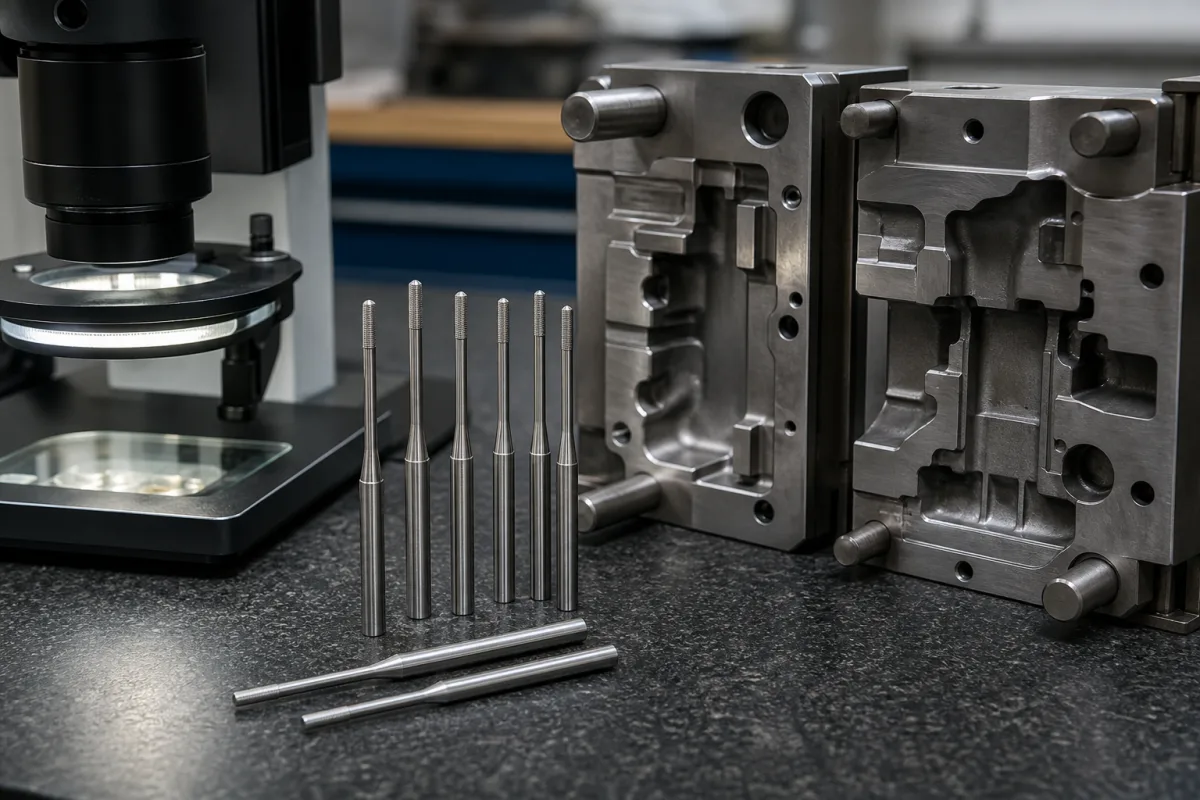
Vent pins and vent plugs for permanent metal moulds · Crescent and flat-sided vent rods, threaded annular vent plugs, gaps narrow enough that surface tension keeps metal out, mould coating and cleaning, and die-casting vent passages
A casting mould vent pin lets the air in a metal mould escape as molten metal fills the cavity, so that trapped air does not leave voids or misruns, while keeping the metal itself out of the vent. In permanent moulds it is a rod or plug fitted in a bore through the mould wall, leaving a very narrow gap at the cavity surface. Ask three things first: which mould, metal and casting process the vent is for, what vent type and gap it uses, and how it is fixed, dressed to the cavity and maintained through coating and cleaning.
Vent pins, vent rods and vent plugs fitted in permanent (gravity and low-pressure) metal moulds, with comparison to vent passages and vent valves in die-casting dies. Ejector pins (see precision casting mold ejector pin), vent plugs for rubber and plastic moulds, and core box vents for sand cores are outside this page except where compared.
CNFX editorial research · Sources checked October 12, 2026 · 4 sources
US patent 4,026,512 (Static mold vent, 1977) explains that metal-forming moulds must have vents to let air escape as molten metal flows in, located so that air pockets are not trapped and do not cause imperfections in the castings. It describes the two prior vents it identifies for permanent moulds: an elongate cylindrical rod, smaller than its drilled bore and with a bent inner end, pressed into the bore so that it leaves a crescent-shaped air passage at the cavity; and a rod press-fitted in the bore with a longitudinal flat on one side, leaving a passage of segmental section. In both, the gap is small enough that molten metal, by its surface tension, does not readily enter and plug the bore, and the outer end of the rod projects as a handle for fitting and removal. [1]
The patent's own vent is a threaded plug screwed into a threaded outer portion of the bore, with a cylindrical inner portion projecting through the inner bore to form a narrow annular air passage opening at the cavity surface, an air bleed through the plug to the outside, and a tool socket at the rear. It aims to give a larger-diameter annular opening with greater total cross-section but a narrower gap than the prior vents of comparable flow. [1]
For die casting, US patent 4,489,771 (Gas-venting arrangement incorporated with a mold, 1984) describes a thin, wide vent passage formed by a shallow groove at the parting face, leading to a vent valve closed by the metal itself, and notes that the specific gravity of air is about 1/2000 that of molten aluminium. [2]
Editorial note: ask the supplier for the vent gap at the cavity face and how it was chosen for your metal and mould temperature, and for the number and locations of vents on the casting drawing.
Give the supplier the casting process (gravity or low-pressure permanent mould, die casting), alloy and pouring temperature, mould material and wall thickness, vent locations and count, vent type (bent rod, flat-sided rod, threaded annular plug), bore and gap dimensions, fit and retention method, whether inner ends must be dressed to the cavity shape, mould coating practice, cleaning interval, and replacement and spares needs.
02
Plan fixing, dressing, coating and cleaning
US 4,026,512 states that with the prior vents “there is a tendency for the rods to work and shift longitudinally in the bores, during use of the molds”, and reports that dressing their inner ends to match the cavity shape is difficult because the rods can rotate and shift while being worked. Permanent moulds are periodically cleaned and painted with a coating that acts as release agent and insulation, applied in varying thickness to control where and how fast the metal chills; the vent ends must be painted too. Paint runs into the vent bores, so rods must be removed, cleaned and accurately re-oriented, and mis-oriented rods leave teats, dimples or similar marks on castings. It adds that these prior vents give limited, restricted venting. [1]
Editorial note: ask how the vent is retained against shifting, how its cavity end is dressed and painted, and how it is cleaned without changing the gap, and include spare vents and a cleaning procedure in the order.
03
Consider sintered vent plugs and size their pores
Dongguan Boyi Precision's sintered vent page describes vents made by sintering powder metal into plugs with straight, parallel micro-pores that let air and gas out of the mould while blocking the metal. It recommends pores of 0.3 mm for larger low-pressure and gravity die-cast parts and 0.5 mm for smaller parts (its summary list assigns 0.5 mm to gravity die-casting and 0.3 mm to low-pressure die-casting or vacuum casting), a 0.3–0.4 mm range for low-pressure or vacuum casting, and 0.2 mm pores for plastic injection moulds. It offers 304 stainless steel, black-coated steel and magnetic versions with outside diameters of 4–30 mm. [3]
The listed tolerances are ±0.02 mm on outside diameter and ±0.2 mm on height. The maker lists water pumps, manifolds, oil pumps, alternator housings and door locks among die-cast applications. [3] A press-fitted plug of this kind faces the same issues of fixing, dressing to the cavity and cleaning described for rod vents. [1]
Editorial calculation: for BY101003, 148 pores × π × (0.15 mm)² ≈ 10.5 mm² of open area on a 79.2 mm² face, about 13%; for BY101005, 121 × π × (0.25 mm)² ≈ 23.8 mm², about 30%. Larger pores vent more area but are more likely to let metal enter.
Tokyo Sintered Metal's European patent application EP 0 071 324 A1 (filed 7 April 1982, published 9 February 1983) explains how vent elements with straight, axial pores of near-uniform diameter can be made for metal casting, die casting and rubber and plastic moulding: wire is wound spirally around a lower-melting core rod, the wound rods are bundled in a tube, and heating melts the core so that it infiltrates between the windings and leaves one pore where each core rod was. Its worked examples give the pore size and porosity achieved: 0.11 mm pores at 7% porosity (SUS 316 winding wire of 0.1 mm, sintered at 1,250 °C for 60 minutes), 0.15 mm pores at 25% (0.07 mm winding wire), and 0.47 mm pores at 32% and 36% porosity in 13 mm and 15 mm diameter elements made at 1,200 °C. It describes drilling, laser or spark-eroding pores as limited in element thickness and costly for large pore counts. [4]
Editorial calculation: the patent's 0.11–0.47 mm pores bracket the 0.3 mm and 0.5 mm pores Boyi lists for low-pressure and gravity casting, while porosity ranged from 7% to 36% with the winding and core geometry, so ask the vent supplier for both the pore diameter and the open-area percentage, since two vents with the same pore size can vent very different gas volumes. [4][3]
Model (Boyi)
Outside diameter
Height
Pore diameter
Pore number
BY041003
4.04 mm
10 mm
0.3 mm
24
BY081003
8.04 mm
10 mm
0.3 mm
109
BY101003
10.04 mm
10 mm
0.3 mm
148
BY201003
20.04 mm
10 mm
0.3 mm
481
BY041005
4.04 mm
10 mm
0.5 mm
16
BY101005
10.04 mm
10 mm
0.5 mm
121
State the casting process (gravity, low-pressure, vacuum), alloy, vent location and bore size, and ask for pore diameter, open area, material and the press-fit tolerance.
04
Bent and flat-sided rods, threaded annular plugs, parting-line passages and vent valves
The first three rows are permanent-mould vents from US 4,026,512 and the next two are die-casting vents from US 4,489,771; the coating row applies to all of them, because mould paint runs into vent bores. [1][2]
Pin diameter, vent gap, material and hardness, and sintered pore size for a vent order
The vent-gap row has no published figure for any alloy — the patents state only that the gap must be narrow enough for surface tension to keep metal out — so ask for the gap the supplier chose for your metal and mould temperature. [1]
1 company lists this product among what they make. Company figures are quoted from each
company's own website; every card states where the relationship came from.
Dongguan Boyi Precision Industry Limited
Manufacturing site to be confirmed for the order
Lists stainless, black and magnetic sintered vents for gravity, low-pressure and vacuum casting moulds.
Explore company information and manufacturing capabilities, then discuss the scope of your project with a relevant supplier.
Share this page
Compiled and source-reviewed by the CNFX editorial team.
Each manufacturer above links to the page on that company's own website where the product is listed, with the date we checked it. How we source and review
· Page last updated 13 October 2026
Buyer questions
How does a mould vent pin keep metal out?
The gap it leaves at the cavity is narrow enough that molten metal's surface tension stops it entering the bore (US 4,026,512). [1]
What permanent-mould vent types are there?
A bent rod leaving a crescent gap, a flat-sided rod leaving a segment-shaped passage, or a threaded plug forming an annular gap. [1]
Why do vent pins need care during mould coating?
Mould paint runs into vent bores, so rods must be removed, cleaned and re-oriented, or castings get teats or dimples (US 4,026,512). [1]
What pore size suits a sintered vent in an aluminium permanent mould?
One maker recommends 0.3–0.4 mm for low-pressure or vacuum casting and 0.5 mm for smaller gravity-cast parts, with 0.2 mm reserved for plastic injection moulds. [3]
How are straight-pore sintered mould vents made?
Tokyo Sintered Metal's EP 0 071 324 A1 winds wire around a low-melting core rod, bundles the rods in a tube and heats them so the core melts into the windings, leaving pores of 0.11 to 0.47 mm at 7% to 36% porosity in its examples. [4]
Sources and what still needs a direct check
Sources checked 2026-10-12. The US sources are patents (1977 and 1984) describing mould venting in their own terms, and Tokyo Sintered Metal's European application (1983) describes how straight-pore vent elements are made; none gives vent gap values for specific alloys. Dongguan Boyi Precision's page lists its own sintered vents.