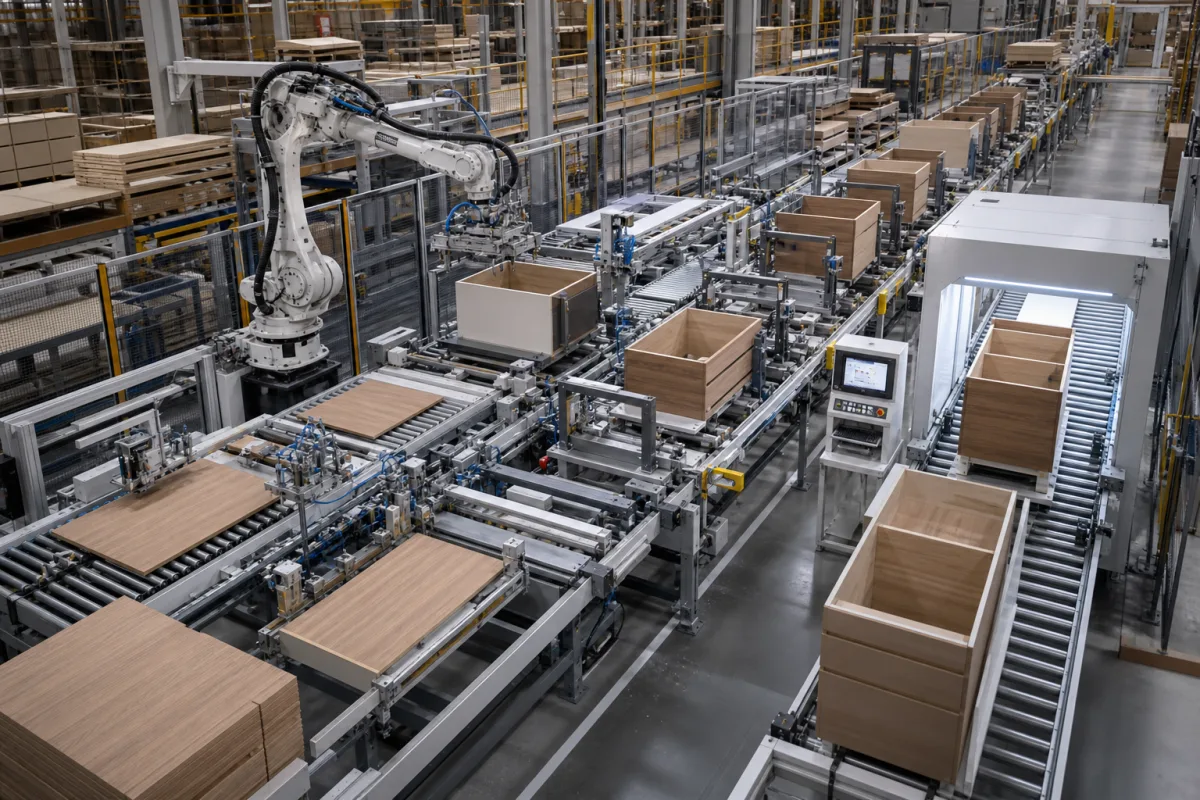
Furniture assembly line for panel cabinets: case clamp and packing stations
Panel furniture final assembly · case clamp pressing of cabinet carcasses, throughfeed versus stationary, carton folding and sealing for flat-pack
A furniture assembly line for panel cabinets is the conveyor-linked final stage of a panel furniture factory: machined and edged panels are either joined into cabinet carcasses and pressed square in a case clamp, or packed flat into cartons for self-assembly. Ask three things first: what carcass sizes and press forces the case clamp covers, whether carcasses are pressed in a stationary clamp or a throughfeed clamp linked to conveyors, and how fast the packing station folds and seals cartons for your largest panel.
Final assembly and packing stations for panel (case-good) furniture: stationary and throughfeed case clamps for cabinet carcasses, their infeed and outfeed conveyors, and carton folding and sealing lines for flat-pack panels. Panel cutting, edge banding and CNC drilling lines upstream, upholstered and solid-wood chair assembly, and robotic or O-ring assembly cells for other products (see the Automatic O-ring assembly page) are outside this page.
CNFX editorial research · Sources checked October 12, 2026 · 4 sources
Size the case clamp for your carcasses: stationary or throughfeed
HOMAG's case clamp brochure states that the pressing force is conveyed to the cabinet according to the material properties so that cabinets are tightly pressed and square. Its stationary CABTEQ S-200 and S-250 clamps take carcasses 150–2,500 mm long (3,000 mm option on the S-250) and 150–1,400 mm high, apply up to 12–18 kN vertically and horizontally, close at 50 mm/s rapid and 25 mm/s slow, and weigh about 2.2 t. [1]
The throughfeed CABTEQ T-250 is built for a linked line: HOMAG's product page lists carcasses 250–2,500 mm long, 120–800 mm deep and 220–1,320 mm high, up to 30 kN vertical and 15 kN horizontal pressure, transport at 12–40 m/min, 500 mm working height, 6 bar operating pressure and a weight of 6.0 t. [2] Sensors scan carcass length and height on entry to position the top and side pressure elements, and a 4-axis nailing unit fixes the rear panel from a magazine of 10,000 staples that reloads while carcasses move. [1]
HOMAG quotes a bathroom furniture maker using the T-250 for rear panels of 3 mm and 16 mm and for pressing tall and base cabinets on one line. [1] Editorial calculation: at 12 m/min a 2,500 mm carcass needs 2.5 ÷ 12 × 60 = 12.5 s to travel its own length; at 40 m/min it needs 3.75 s. Pressing and stapling time come on top; ask the supplier for a timed cycle on your largest cabinet.
Give the supplier carcass length, depth and height ranges, panel material and thickness, rear-panel thickness and fixing (staples, screws, glue), joint type (dowels, fittings), daily output, stationary or throughfeed operation, conveyor heights at entry and exit, and the packing method downstream.
02
Balance the packing station against the line output
For flat-pack furniture the assembly stage ends at a carton line. Fortran's automatic box folding machine forms cartons 400–2,800 mm long, 320–900 mm wide and 40–250 mm high at 5–7 boxes a minute from 2.5–6 mm corrugated board, with a 9,760 × 3,550 × 2,500 mm footprint, about 3,700 kg weight and 4.5 kW excluding the gluing unit. [3]
Its automatic box closing machine seals cartons 300–2,900 mm long and 200–1,200 mm wide at 4–8 cycles a minute; the carton bottom is glued first, panels and padding are placed in, and the machine measures the width and height of each carton before hot-melt sealing the long side and both short sides, reaching up to 8 packages a minute in batch mode. [4]
Editorial calculation: 5–7 folded cartons a minute is 300–420 an hour, and 8 sealed packages a minute is 480 an hour, so on these two published rates the folding station sets the pace of the carton line. Check both rates against your upstream output in parts per carton, and ask whether one packing line can serve the panel mix you produce.
03
Compare the published stations
Item
Stationary case clamp (HOMAG S-250)
Throughfeed case clamp (HOMAG T-250)
Carton line (Fortran folding + closing)
Workpiece
Carcass 150–2,500 (3,000) mm long, 150–1,400 mm high [1]
Carcass 250–2,500 mm long, 120–800 mm deep, 220–1,320 mm high [2]
Carton up to 2,800 mm (folding) and 2,900 mm (closing) long [3][4]
Touch operation; sizes measured by sensors. [1][4]
Software link to order data.
05
Press air, transport speed, carton rate and station weights for a cabinet line
Power supply, noise level, hall temperature, humidity and ingress protection are not stated in the reviewed sources; request them together with the layout drawing for the full line.
Field
What it means and published values
Ask the supplier for
Line Length (m)
Fortran folding machine alone is 9,760 mm long. [3]
Layout drawing for the full line.
Production Rate (units/hour)
Carton folding 5–7/min; sealing up to 8/min. [3][4]
Timed rate on your products.
Workstation Count (stations)
Five sections in each Fortran packing machine. [4]
1 company lists this product among what they make. Company figures are quoted from each
company's own website; every card states where the relationship came from.
Guangdong Fortran Machinery Co.,Ltd
Manufacturing site to be confirmed for the order
Lists furniture production line conveyors, carton folding and closing machines and packaging lines for panel furniture.
Explore company information and manufacturing capabilities, then discuss the scope of your project with a relevant supplier.
Share this page
Compiled and source-reviewed by the CNFX editorial team.
Each manufacturer above links to the page on that company's own website where the product is listed, with the date we checked it. How we source and review
· Page last updated 13 October 2026
Buyer questions
What does a case clamp do on a furniture line?
HOMAG describes case clamps as pressing assembled cabinets with force matched to the material so they are tight and square; its throughfeed T-250 also staples the rear panel. [1]
How much force does a cabinet case clamp apply?
HOMAG lists 12–18 kN for its stationary S-200 and S-250 and up to 30 kN vertical and 15 kN horizontal for the throughfeed T-250. [1][2]
How fast can flat-pack furniture be boxed?
Fortran lists 5–7 cartons a minute for its folding machine and up to 8 packages a minute for its closing machine. [3][4]
Sources and what still needs a direct check
Sources checked 2026-10-12. HOMAG is a maker of panel furniture machinery describing its own case clamps; Fortran is a listed supplier describing its own packing machines. Values are maker statements.