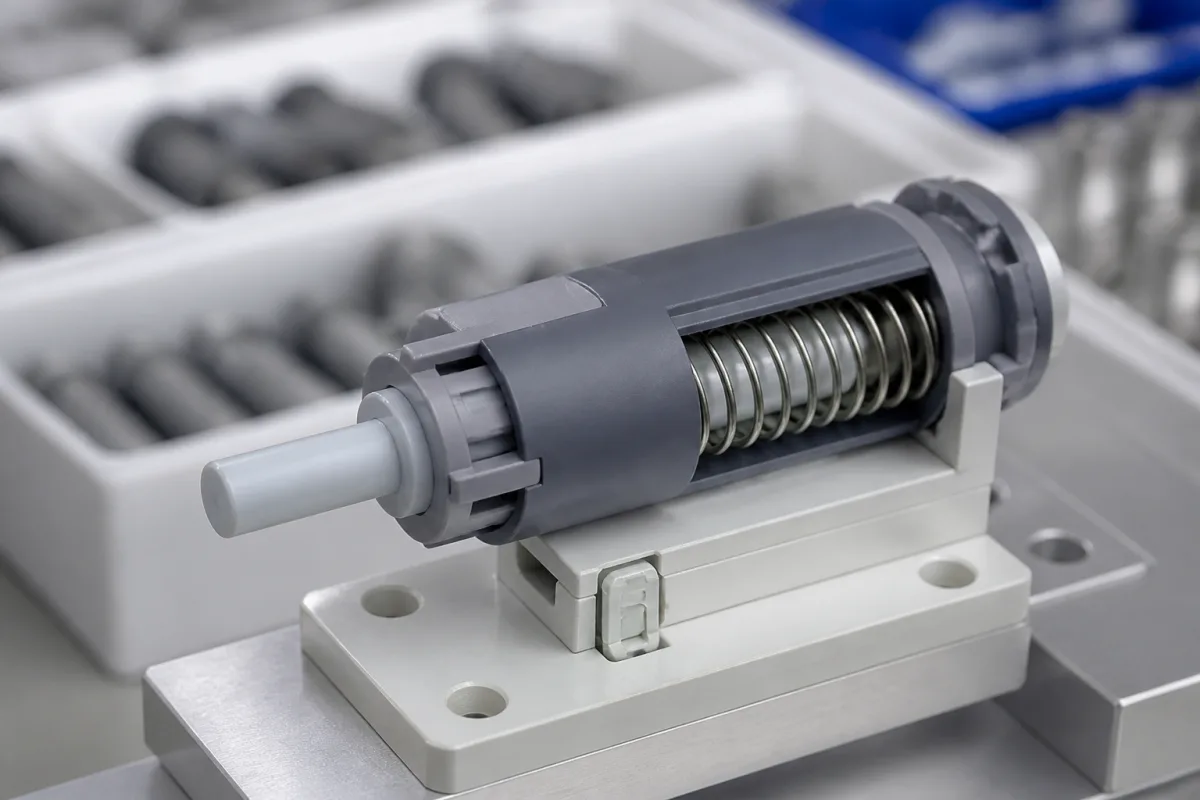
Furniture fluid dampers · Damping force, stroke and free-run, characteristic curve, return spring, load and cycle rating
A soft-close damper is a small piston-and-cylinder unit filled with silicone oil or air that a closing drawer strikes in its last few centimetres, slowing it so it closes quietly. Ask three things first: what damping force the damper gives at what test speed and over what stroke, what force curve and free-run it has, and what drawer load and cycle life the damper and slide are rated for together.
Linear fluid dampers for drawers and similar furniture fronts, supplied alone or built into soft-close slides. Rotary dampers, door closers for buildings, gas springs and push-to-open mechanisms are outside this page.
CNFX editorial research · Sources checked October 12, 2026 · 5 sources
Zimmer Group's Lungo fluid damper, 6.3 mm in diameter and 77.9 mm long, lists a damping force of 15 N (±2 N) at 33 mm/s over a 30 mm stroke, with a linear-constant curve after 9 mm of free-run and no spring return. Its Estremo damper, 10 mm in diameter, lists 150 N (±50 N) or 45 N (±5 N) at 50 mm/s over 30 mm, with spring return and no free-run. [1][2]
Zimmer explains that a piston moves in a closed housing while food-safe silicone oil flows through small channels, the oil's viscosity and the channel cross-section creating the friction that slows the motion; force can follow linear-rising, linear-constant, inclining, S-line or declining curves; dampers without reset need a coupler and are pulled out by hand, while integrated reset extends the rod automatically; and valve discs keep resistance low during opening. A 'smooth' version reduced opening force by about 30% in its self-closing sliding-door example. [1] A Julius Blum patent on furniture dampers likewise describes a piston struck by the drawer front during closing, damped by the flow resistance of a fluid, preferably silicone oil, with air also possible. [4]
Editorial calculation: a 30 kg gross drawer closing at 0.3 m/s carries ½ × 30 × 0.3² = 1.35 J; a constant 45 N over 30 mm absorbs 45 × 0.03 = 1.35 J, while 15 N over the 21 mm after a 9 mm free-run absorbs only about 0.32 J. Damping force varies with speed, so treat this as a first check and test on the drawer. Drawer mass and speed are assumed examples. [1][2]
Give the supplier the drawer's gross mass and closing speed, available stroke and mounting space, required force curve and free-run, whether a spring return is needed, operating temperature range, required cycle life, slide type and mounting, and noise or closing-time targets.
02
Match the slide's load and cycle rating
Accuride Europe defines a slide's load rating as the maximum gross load a pair supports for a stated number of cycles, so the drawer's own mass must be included; a cycle is one complete open and close on dedicated test machines. Its tested cycles range from 50,000–80,000 for the furniture market to 2,000–10,000 for industrial and electronic markets, and all its products get a static load test at full extension that "will typically be at least twice that of the dynamic load test". Accuride notes there are no standard tests for slides in isolation. [3]
The linked supplier states an operating range of –45 °C to +50 °C for its hydraulic dampers and says "most products last over 50,000 uses (100,000 uses for premium models)". [5]
Editorial calculation: at 20 openings and closings a day, 50,000 cycles last about 2,500 days, nearly 7 years; a busy kitchen drawer at 60 a day reaches 50,000 in about 2.3 years. Usage rates are assumed examples. [3][5]
03
Compare what suppliers offer
Suppliers linked to this page list soft-close dampers; each card links to the page reviewed.
The listing reviewed offers hydraulic plastic dampers for drawers, doors and hinges, with custom sizes and pressure; ask for force at a stated speed, stroke and cycle test results for the exact model.
04
Trace the damper components
This is a functional reference built from the sources cited; it is not one maker's specification.
Fill the specification fields with values for your parts
A soft-close damper quotation needs values for your drawers. The table explains each field, gives published values where a reviewed source states them, and says what to obtain from the supplier.
Field
What it means and published values
Ask the supplier for
Damping force (N)
Examples 15 N at 33 mm/s; 45 or 150 N at 50 mm/s. [1][2]
Explore company information and manufacturing capabilities, then discuss the scope of your project with a relevant supplier.
Share this page
Compiled and source-reviewed by the CNFX editorial team.
Published product pages show what a company offers, not tested performance. Confirm the legal seller, factory and scope for your order. How we source and review
· Page last updated 13 October 2026
Buyer questions
How strong is a soft-close drawer damper?
Zimmer's examples range from 15 N at 33 mm/s to 150 N at 50 mm/s over a 30 mm stroke. [1][2]
What fluid is in a soft-close damper?
Zimmer uses food-safe silicone oil; a Blum patent names silicone oil as preferred, with air also possible. [1][4]
How many cycles should drawer slides last?
Accuride gives 50,000–80,000 cycles for the furniture market. [3]
Does the load rating include the drawer?
Yes; Accuride's rating is a gross load including the drawer's mass. [3]
Sources and what still needs a direct check
Sources checked 2026-10-12. Zimmer Group is a damper maker publishing its own data sheets; Accuride is a slide maker explaining its ratings; the Blum patent describes a furniture damper design; Hongfeng Zhiyang is the linked supplier stating its own figures.