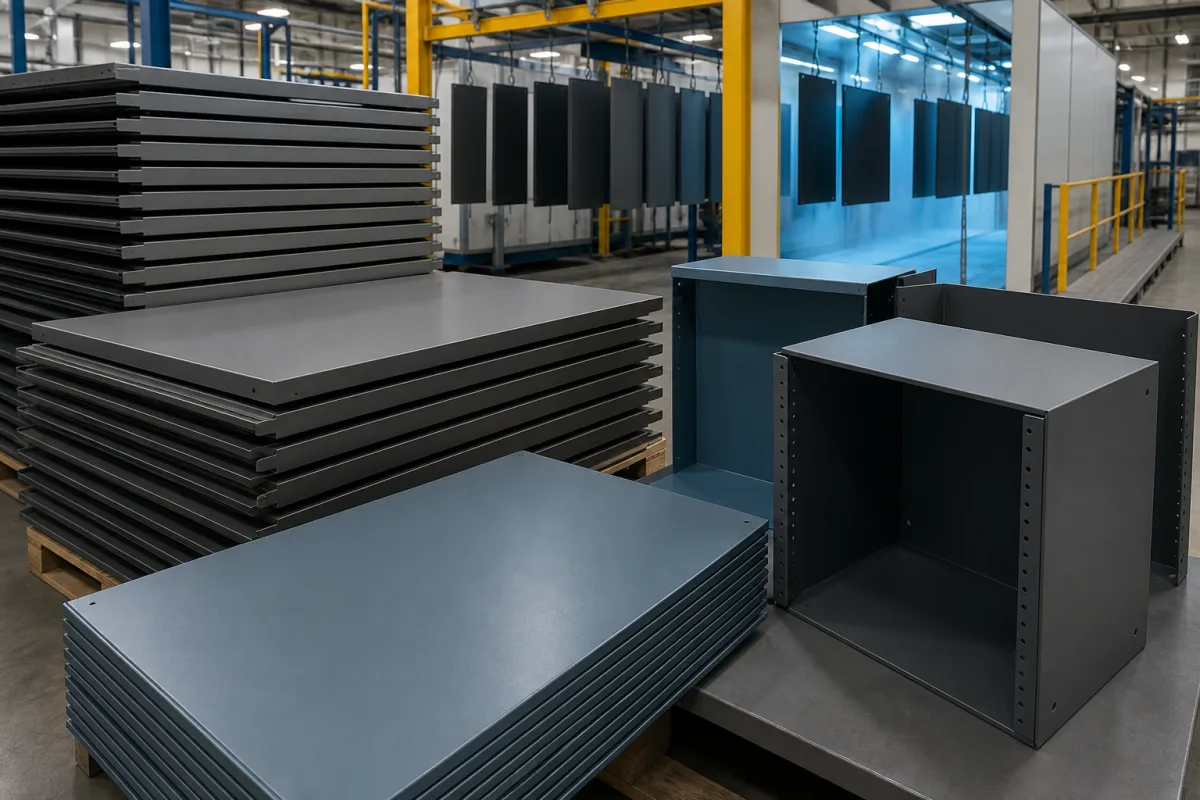
Powder-coated steel sheet and panels · Substrate specification, coating thickness measurement, pencil hardness, impact, T-bend, gloss and salt-spray testing written into the order
Powder-coated steel sheet is cold-rolled or galvanized steel finished with a dry thermosetting powder that is electrostatically applied and heat-cured. Settle three things before ordering: the substrate specification and grade, the coating system and film thickness, and the test methods and pass values for hardness, impact, bend, gloss and corrosion that the coated sheet must meet.
Steel sheet, blanks and fabricated flat panels finished with powder coating. Coil-coated (pre-painted) steel, liquid-painted parts, powder coatings sold as materials, and coated aluminium are outside this page; pre-painted galvanized coil has its own page.
CNFX editorial research · Sources checked October 11, 2026 · 8 sources
ASTM A1008 covers cold-rolled carbon steel sheet in coils and cut lengths in commercial, drawing, deep-drawing, extra-deep-drawing, structural and high-strength low-alloy designations. ASTM A653 covers hot-dip zinc-coated (galvanized) and zinc-iron alloy-coated (galvannealed) steel sheet in similar designations. [1][2]
ASTM D7091 is the practice for measuring dry film thickness of coatings with magnetic and eddy-current gauges on ferrous and non-ferrous metals. It sets three steps — calibration, verification and adjustment of the gauge — and the methods for taking readings. [3]
Editorial note: state on the order which substrate specification and designation apply, the coating thickness range with the D7091 measurement method, and whether thickness limits apply to every reading or to the average, so the coater and inspector measure the same way. [1][2][3]
Give the supplier the substrate specification and designation (and zinc coating mass for galvanized), sheet thickness and size, pretreatment, powder type and colour, film thickness range and how it is measured, gloss, pencil hardness, impact, T-bend, salt-spray hours and acceptance criteria, packing and protection, and quantity.
02
Write the coating tests into the order
ASTM D3363 determines film hardness of an organic coating on metal by pencil leads of known hardness, and notes that precision is best when the parties agree on a set of referee pencils. ASTM D2794 rapidly deforms the coating and substrate by impact and evaluates the effect; it says that because of poor reproducibility numerical values should be limited to one laboratory and that ranking improves interlaboratory agreement. [4][5]
ASTM D4145 tests the flexibility and adhesion of coatings on metal that is bent when fabricated into building panels or other products. ASTM D523 measures specular gloss by comparing reflectance with a black glass standard; its results correlate with visual shininess at corresponding angles. [6][7]
ASTM B117 covers the apparatus, procedure and conditions to create and maintain a salt spray (fog) environment. It cautions that corrosion performance in this environment may not predict field performance and that reproducibility depends on specimens, evaluation criteria and control of variables, so replicates should be included. [8]
Editorial note: give each test a pass value and a method reference, for example a minimum pencil hardness to D3363, a T-bend rating to D4145, and salt-spray hours to B117 with the evaluation criteria, rather than a general quality claim. [4][6][8]
03
Test reports and the substrate mill certificate to ask any coater for
Ask any supplier for test reports naming the ASTM methods used and the substrate mill certificate. [3][2]
04
Substrate, zinc coating, powder film, hardness, impact and bend, and gloss
Each layer is bought or checked to its own standard: the steel to A1008 or A653, the film thickness to D7091, and hardness, impact, bend and gloss to separate ASTM methods. [1][2][3]
Film thickness, pencil hardness, impact, T-bend, gloss and salt-spray hours for a coated-sheet order
The methods here say how to test, not what result to accept, so every row needs your own pass value; B117 itself warns that salt-spray hours may not predict field corrosion. [8]
Explore company information and manufacturing capabilities, then discuss the scope of your project with a relevant supplier.
Share this page
Compiled and source-reviewed by the CNFX editorial team.
Each manufacturer above links to the page on that company's own website where the product is listed, with the date we checked it. How we source and review
· Page last updated 13 October 2026
Buyer questions
How is powder coating thickness measured?
ASTM D7091 covers magnetic and eddy-current dry film thickness gauges, with calibration, verification and adjustment steps. [3]
How is coating hardness tested?
ASTM D3363 uses pencil leads of known hardness. [4]
Does salt spray hours predict real corrosion life?
ASTM B117 warns that results may not predict field performance. [8]
Which standard covers galvanized steel sheet?
ASTM A653 covers hot-dip galvanized and galvannealed sheet. [2]
Sources and what still needs a direct check
Sources checked 2026-10-11. ASTM summary pages for the substrate specifications and coating test methods.