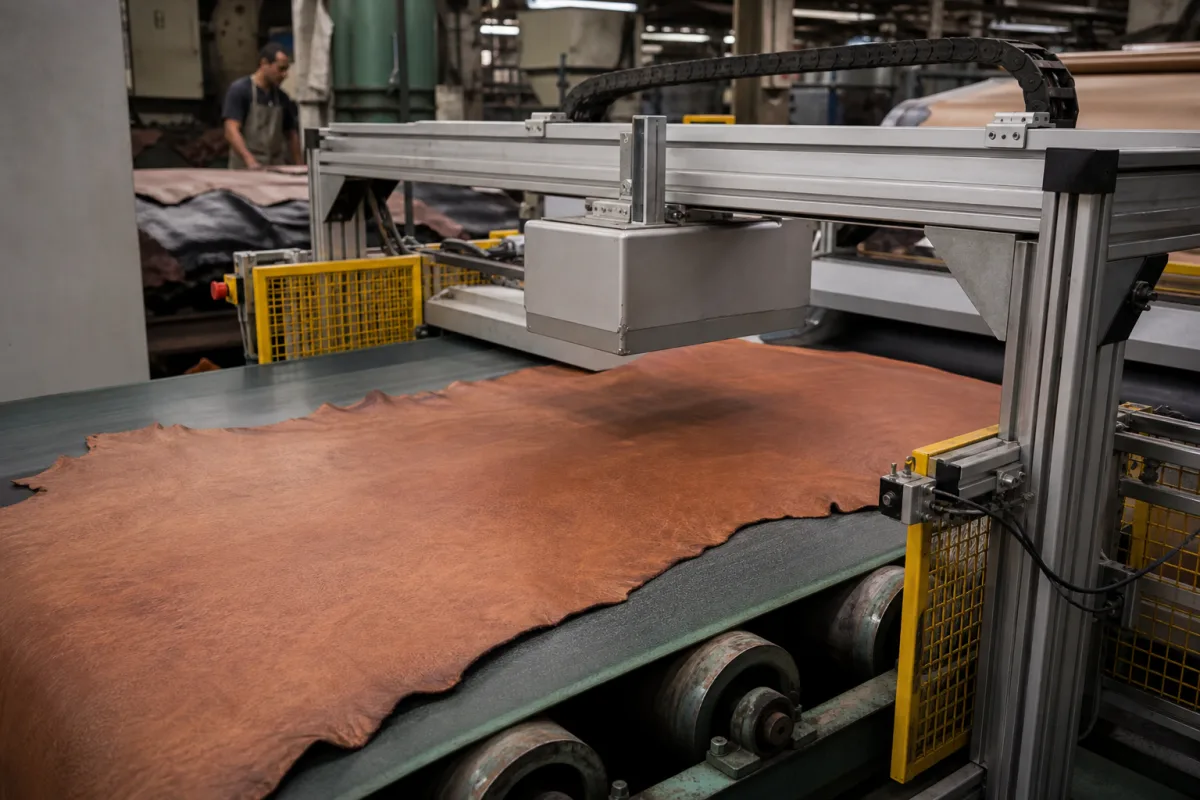
Leather moisture analyzer for hides and crust on tannery lines
Tannery moisture control · Oven reference for leather, crust moisture targets, non-contact heads over the conveyor and stack-contact meters
A leather moisture analyzer tells a tannery how much water is left in hides and crust leather after setting out, drying or conditioning, so that staking, buffing and finishing start from a known state. Leather is not wood: its readings depend on tanning, fat and density, it is thin, and it moves through the plant on conveyors and toggles. That shapes both the reference method and the hardware.
Instruments that measure the water content of hides, wet-blue, crust and finished leather in tanneries: non-contact heads mounted over conveyors, and portable meters pressed onto a stack of leather, together with the oven method used to calibrate them. Wood moisture meters are covered on the Wood moisture meter (moisture content analyzer) page, and Bluetooth handheld meters for lumber on the Portable digital wood moisture analyzer with Bluetooth page; halogen loss-on-drying balances on the Food moisture analyzer page; hide defect scanners on the Leather hide defect mapping system page. Spray finishing lines with their drying tunnels are covered on the Leather spray finishing line page; conditioning machines are outside this page.
CNFX editorial research · Sources checked October 12, 2026 · 4 sources
Volatile matter by oven drying: the reference that leather readings are calibrated to
ASTM D3790 determines volatile matter (moisture) in all types of leather by oven drying, and ASTM uses its result as the leather's moisture content when putting all other chemical tests on a moisture-free basis. The standard warns that protein fibre and chromium tanning salts may retain moisture while tannins and oils may oxidise, both giving negative errors, and that the amount released varies with grinding, sample weight, drying temperature and time, container shape and oven type (gravity or mechanical convection). [1]
For that reason ASTM calls the result "a purely arbitrary value for the moisture content" and requires the method to be followed exactly for laboratories to agree. A meter calibrated against one laboratory's oven procedure carries that procedure with it, so the calibration record should name the method used. [1]
Product standards turn the reference into a target. Kenya's draft standard DKS 675:2024 for chromed crust bovine leather sets moisture content at 10–12% m/m, tested by ISO 4684, alongside at least 2.5% chromium oxide on dry leather and a shrinkage temperature of at least 100 °C. [2]
Editorial calculation: if the 10–12% figure is a share of the leather's as-received mass, it equals about 11.1–13.6% on an oven-dry basis (10/90 and 12/88), the basis wood meters use. A meter set up on one basis and a specification written on the other differ by more than one percentage point at this level. [2]
State the leather type (wet-blue, crust, finished), the tannage, the thickness range, the stage where moisture is checked, the target band, and which oven method the readings must agree with.
02
A non-contact head over the conveyor or a meter pressed onto a 10 mm stack
In-line measurement keeps the sensor off the leather. Ital Control Meters describes its IR3000 infrared moisture meter as using the absorption of infrared by water to measure without contact, aimed at the product from 10–40 cm away, on moving solids, with ranges programmable from dry to 100% water and readings in real time; the company also offers SWR microwave sensors. [4]
Portable leather meters work on a stack instead. The humimeter LM6 sold by Checkline is placed on the leather and reads 3–65% water content at 0.1% resolution with automatic temperature compensation, measuring to a depth of 5 mm and needing a sample at least 10 mm thick; hides can be stacked to reach that thickness. It operates at −10 to 50 °C and logs up to 10,000 readings. [3]
Editorial calculation: with crust leather of an assumed 1.2 mm thickness, reaching the 10 mm minimum takes 10 / 1.2 ≈ 8.3, so nine hides in the stack, and the reading represents that stack rather than one hide. On a drying line this makes the portable meter a check on batches, while a head over the conveyor reads each hide as it passes. [3]
Neither instrument removes the calibration question: the IR3000's range is set per product, and the LM6 reading has to be compared with oven results for the leather types in use. Ask suppliers which leathers their calibration covers and against which oven procedure it was made. [4][1]
For a line head, state the belt width, conveyor speed, mounting height available and the signal or fieldbus the line control expects; for a portable meter, the leather types to be calibrated and the data export needed.
03
What to send for a leather moisture analyzer
Paste it into your enquiry below or into an email to a maker, then replace every bracket.
Leather: [type; tannage; thickness range; density or temper]
Stage: [after setting out, drying, conditioning or before finishing]
Target: [moisture band; wet or dry basis; reference oven method]
Mounting: [line head over conveyor or portable meter]
Line data: [belt width; speed; mounting height; output signal]
Records: [data logging and export needed]
Explore company information and manufacturing capabilities, then discuss the scope of your project with a relevant supplier.
Share this page
Compiled and source-reviewed by the CNFX editorial team.
Each manufacturer above links to the page on that company's own website where the product is listed, with the date we checked it. How we source and review
· Page last updated 13 October 2026
Buyer questions
What is the reference method for leather moisture?
Oven drying to determine volatile matter, as in ASTM D3790 (or ISO 4684); ASTM notes the result depends on grinding, sample weight, temperature and time, container and oven type. [1][2]
What moisture should crust leather have?
One example: Kenya's draft DKS 675:2024 for chromed crust bovine leather specifies 10–12% m/m. [2]
Why does a portable leather meter need a stack of hides?
The humimeter LM6 needs a sample at least 10 mm thick and measures to 5 mm depth, so thin hides are stacked. [3]
How far can a non-contact infrared head be from the leather?
Ital Control Meters gives 10–40 cm for its IR3000. [4]
Sources and what still needs a direct check
Sources checked 2026-10-12. ASTM D3790 is the oven method; the Kenyan figure is from a draft national specification notified to the WTO. The LM6 and IR3000 data are from a distributor product page and a trade-press item on the maker's instrument.