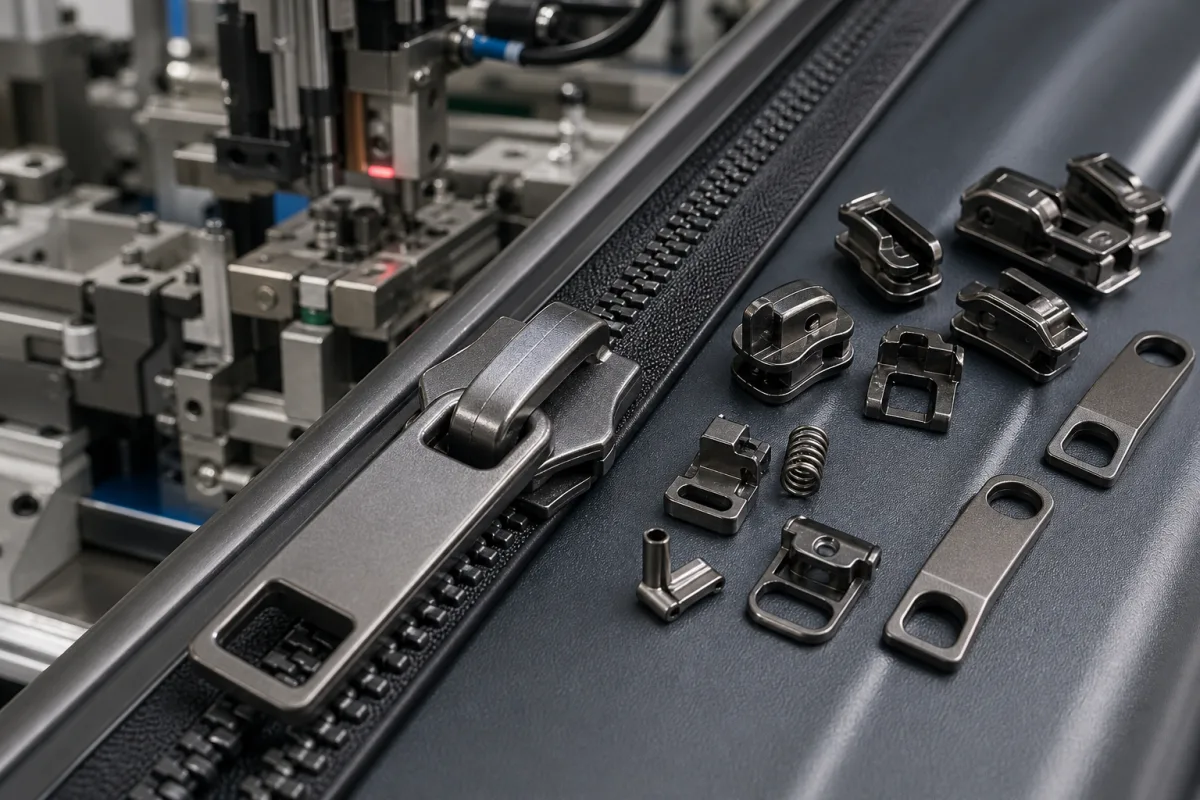
Zipper sliders for luggage and bags · Slider and pull strength tests, lock holding strength, stops and separable units, operability and sticking, and what to test on receipt
A zipper slider is the part that runs along the chain, meshing or separating the teeth, with a pull tab and, on locking types, a lock that holds its position. Fix three things before ordering: the chain type and size the slider must fit, the strength tests (pull-off, twist, lock holding and compression) and their pass values, and the operability checks and finish the bag maker will apply on receipt.
Zipper sliders, pulls and locking sliders supplied for luggage, handbags and cases, alone or with the zipper chain. Complete luggage, TSA-type combination locks, buckles and zipper tape sold without sliders are outside this page.
CNFX editorial research · Sources checked October 12, 2026 · 5 sources
ASTM D2061 covers determination of the strengths of zippers and zipper parts, with the restrictions of each method stated in its scope. Its methods are holding strength of separable units, holding strength of the slider lock, holding strength of stops, resistance to angular pull-off of the slider pull, resistance to cushioned compression of sliders, resistance to pull-off of the slider pull, resistance to twist of pull and slider, strength of chains and elements, and torsional resistance of the slider pull for removal of components. [1]
The standard notes that, with the related methods in D2062 and D2059, these are a collection of proven test methods that can aid evaluation without detailed zipper knowledge, but that they do not cover every zipper property. [1]
Editorial note: D2061 gives the test procedures, not the pass values; write a minimum value for each test that matters for a bag — for example pull-off of the slider pull, slider-lock holding strength and cushioned compression of the slider — into the purchase specification. [1]
YKK Americas publishes the zipper strength tests it runs, stated as based on JIS S3015 and ASTM D2061: chain crosswise strength per 2.5 cm, top stop and bottom stop holding strength, separating unit crosswise strength, slider lock strength and slider tab pull-off strength. Its tensile testing machine conditions are a tensile speed of 300 mm/min and a clamp width of 25 mm; slider tab pull-off is tested at a 90° angle and also at 45°, at 100 mm/min, with force applied to the puller and the bottom of the slider body. For slider lock strength, the lock is engaged in the middle of the chain and each side of the chain is pulled outwards in opposite directions. [4]
YKK also separates sliders by locking function: an auto-lock slider holds its position until the tab is pulled, so it stays put if the tape is forced apart or the application puts tension on the zipper, while a pin-lock slider locks when pins on the puller are pushed down into the zipper elements. YKK lists auto-lock sliders for garments, outerwear and furniture and pin-lock sliders for bedding, upholstery, clothing and purses. [5]
Give the supplier the chain type and size, slider type (auto-lock, non-lock, double-pull, reversible), pull design, material and finish, the D2061 tests and minimum values, the D2062 operability checks, colour and plating matching, sampling plan, packing and quantity.
02
Set operability and sticking checks
ASTM D2062 covers procedures for opening and closing of zippers, separator functioning and sticking of zippers at stops, including slider sticking on the bottom stop. It states that the methods are considered satisfactory for acceptance testing of commercial zipper shipments because they have been used extensively in the trade, even though between-laboratory precision is quite large in some cases. [2]
D2062 also advises that where two or more laboratories report results that differ by a practically significant amount, comparative tests should be run to check for statistical bias between them. [2]
Editorial note: agree with the supplier which laboratory's results are binding, and run comparative tests on a reference lot before the first shipment. [2]
03
Use published minimums for slider force and lock strength
The US federal commercial item description A-A-55634A (Zippers, fasteners, slide interlocking, 2004), used for military and other federal items, classifies zippers into ten sizes in six groups by closed chain width (0.125 to 0.500 in across sizes 1 to 10) and sets Table V performance requirements by size. Sliders may have automatic, pin, semi-automatic pin or cam locks, and the maker's name or ID must be imprinted on the slider body or pull. [3]
The same table lists crosswise chain breaking strength, for example 130 lb minimum for size 5–7 brass or nickel individual-element chain and 175 lb for continuous-element (coil) chain. Slider pulls are short (below 7/8 in) or long (7/8 in or longer), padlock, chain or stirrup, and the document states that like-size fasteners and sliders from different manufacturers are not to be interchanged. [3] Test methods for these properties are in ASTM D2061 and D2062. [1][2]
Editorial calculation: 7.0 lb ≈ 31 N and 10.0 lb ≈ 44 N lock strength; a 500 lb cushioned compression load ≈ 2.2 kN; 0.125–0.500 in ≈ 3.2–12.7 mm chain width.
Slider requirement (A-A-55634A Table V)
Size 1–2
3–4
5–7
8
9
10
Slider lock strength, lb min.
3.0
3.0
7.0
7.0
7.0
10.0
Operating force, metal IEF, lb max.
1.5
1.5
2.5
3.5
3.5
4.5
Operating force, coil (CEF), lb max.
2.0
2.0
2.0
2.5
2.5
3.5
Operating force after salt spray, metal IEF, lb max.
3.0
3.0
5.0
7.0
7.0
9.0
Cushioned compression load applied to slider, lb
100
100
200
500
500
500
Holding strength of stops, metal IEF, lb min.
15
15
25
35
50
50
State the zipper size and chain type, and ask the supplier for slider lock strength, operating force (before and after salt spray) and cushioned compression results against your chosen minimums.
04
Who lists luggage sliders, and which reports to ask for
Ask any supplier for D2061 and D2062 test reports on sliders matched to your chain. [1][2]
05
Body, pull tab, lock and stops: which test each part faces
Lock type, pull force and chain-size match for a bag slider
Only slider lock strength, lock type and test conditions carry published values here, from the federal CID and YKK; cycle life, hardness and dimensional fit come from the slider maker for your chain size.
Explore company information and manufacturing capabilities, then discuss the scope of your project with a relevant supplier.
Share this page
Compiled and source-reviewed by the CNFX editorial team.
Each manufacturer above links to the page on that company's own website where the product is listed, with the date we checked it. How we source and review
· Page last updated 13 October 2026
Buyer questions
Which standard covers zipper slider strength?
ASTM D2061, including slider-lock holding strength and pull-off, angular pull-off and twist resistance of the slider pull. [1]
Which standard covers zipper operation?
ASTM D2062 covers opening and closing, separator functioning and sticking at stops. [2]
Does ASTM D2061 set pass values?
It sets the test methods; the reviewed summary gives no pass values, so buyers set them in the specification. [1]
Are zipper operability tests used for shipment acceptance?
ASTM D2062 says they are considered satisfactory for acceptance testing of commercial shipments. [2]
How strong must a zipper slider lock be?
US federal item description A-A-55634A sets a minimum slider lock strength of 3.0 lb for sizes 1–4, 7.0 lb for sizes 5–9 and 10.0 lb for size 10. [3]
At what speed are zipper slider strength tests run?
YKK Americas states that its zipper strength tests, based on JIS S3015 and ASTM D2061, use a tensile speed of 300 mm/min with a 25 mm clamp width, and that slider tab pull-off is tested at 90° and 45° at 100 mm/min. [4]
Sources and what still needs a direct check
Sources checked 2026-10-12. ASTM D2061 and D2062 summary pages define zipper strength and operability tests.