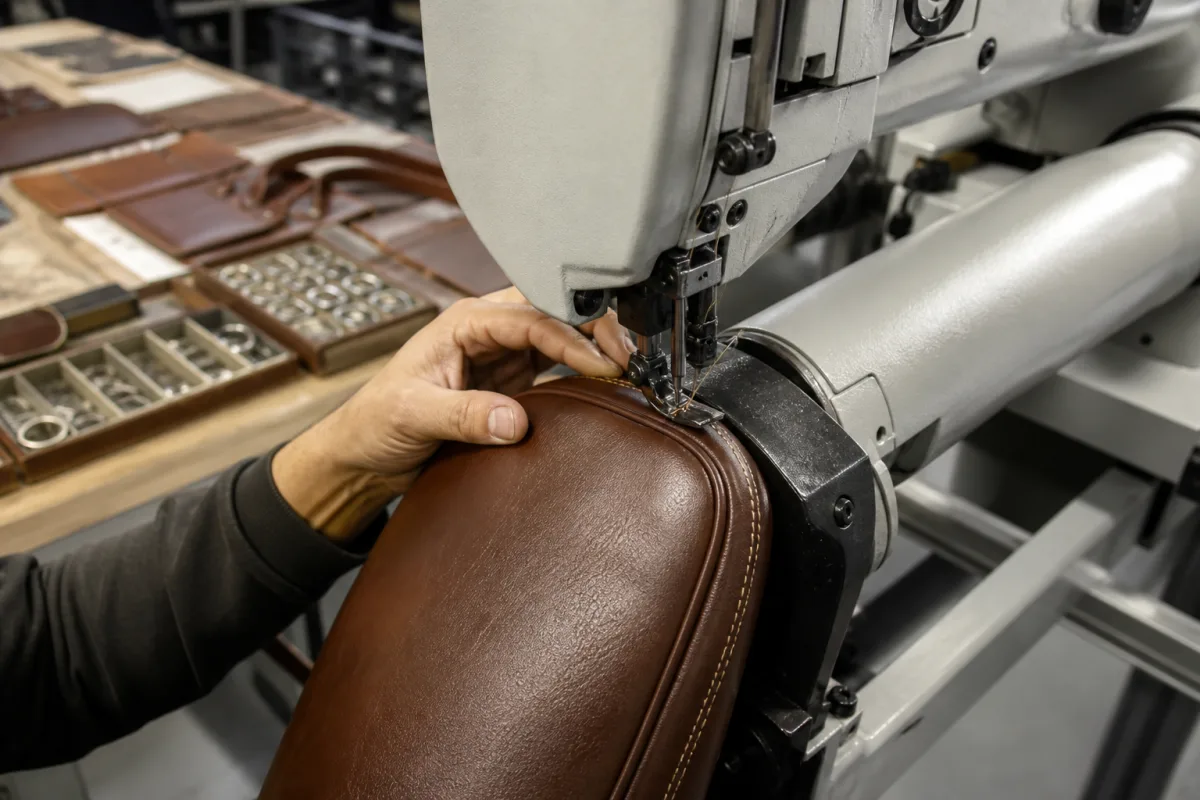
Leather sewing · Needle cutting points, thread size and needle size, stitch density, cylinder and post beds
An industrial leather stitching machine is a heavy-duty lockstitch sewing machine, in flatbed, cylinder-bed or post-bed form, built to sew leather for bags, luggage, saddlery and upholstery. Ask three things first: which needle system and cutting point suit your leather and seam look, what thread and needle sizes the machine must handle, and which bed shape and feed fit the parts you sew.
Industrial sewing machines for leather goods, including flatbed, cylinder-bed and post-bed lockstitch machines with compound feed. Leather cutting, skiving and splitting machines, shoe-lasting machines and household machines are outside this page.
CNFX editorial research · Sources checked October 12, 2026 · 4 sources
Pick the needle cutting point for the seam you want
Groz-Beckert's leather needle points, as described on its distributor College Sewing's product pages for system 134 needles, cut the leather rather than push it aside. The narrow cross point 'S' (also N CR) makes a lenticular incision along the seam direction for a very straight seam, suitable for all leather types including footwear, bags with coarse ornamental seams, belts and car seats. [1]
The reverse twist point 'LR' (R TW) makes a lenticular incision at 45° to the seam direction, giving a decorative seam inclined slightly to the left, and is described as the best needle for decorative seams. [2] The triangular point 'D' (TRI) makes a triangular incision and a straight seam, suits hard, dry leather, heavy footwear and upholstery, and has the strongest cutting effect of the points, almost to the needle's full diameter. [3]
Editorial note: the needle system (for example 134 / 135×8) is set by the machine, so confirm which systems and point styles the machine maker approves before ordering needles.
Give the supplier the products and leather types and thicknesses, number of layers, seam types (straight, decorative, edge), thread sizes, needle system, bed type (flat, cylinder, post), feed type, stitch length range, presser foot lift, speed, motor and power supply.
02
Match thread size, needle size and stitch density
Coats states that thread size determines needle size, and that its leather-garment recommendations vary with leather weight and grade. For leather jackets it lists 301 lockstitch seams at 12–14 stitches per 3 cm with Tex 45 Gral thread and Nm 90–100 needles (Tex 40 Epic also with Nm 90–100), and buttonholes and button sewing with Tex 60 thread and Nm 100–110 needles. [4]
Editorial calculation: 12–14 stitches per 3 cm is a stitch length of about 2.1–2.5 mm (30 mm ÷ 14 to 30 mm ÷ 12). Coats notes that thread, needle and stitch rating vary with the weight and grade of leather, so ask the thread supplier for a recommendation for your leather. [4]
03
Flatbed, cylinder-bed and post-bed machines on the listed sites
Listings include heavy-duty flatbed, cylinder-bed and post-bed leather sewing machines for bags, shoes and upholstery.
04
Needle, hook, feed and bed on a leather lockstitch machine
Speed, presser-foot lift and needle range for your leather goods
Needle size and stitch length are the only fields with published values here, both from Coats' leather-jacket guide; for bags, belts or upholstery ask for the thread and needle pairing on your own leather.
Explore company information and manufacturing capabilities, then discuss the scope of your project with a relevant supplier.
Share this page
Compiled and source-reviewed by the CNFX editorial team.
Each manufacturer above links to the page on that company's own website where the product is listed, with the date we checked it. How we source and review
· Page last updated 13 October 2026
Buyer questions
Which needle point is best for leather?
Groz-Beckert's S point gives a straight seam, LR a decorative 45° seam and D the strongest cut for hard, dry leather. [1][2][3]
What thread and needle sizes are used for leather?
Coats lists Tex 45 thread with Nm 90–100 needles for leather-jacket lockstitch seams, and Tex 60 with Nm 100–110 for buttonholes. [4]
What stitch density suits leather seams?
Coats lists 12–14 stitches per 3 cm for leather-jacket lockstitch seams, about 2.1–2.5 mm per stitch. [4]
Sources and what still needs a direct check
Sources checked 2026-10-12. Needle point descriptions are Groz-Beckert's, published by its UK distributor College Sewing; Coats is a thread maker giving illustrative recommendations that vary with leather weight and grade.