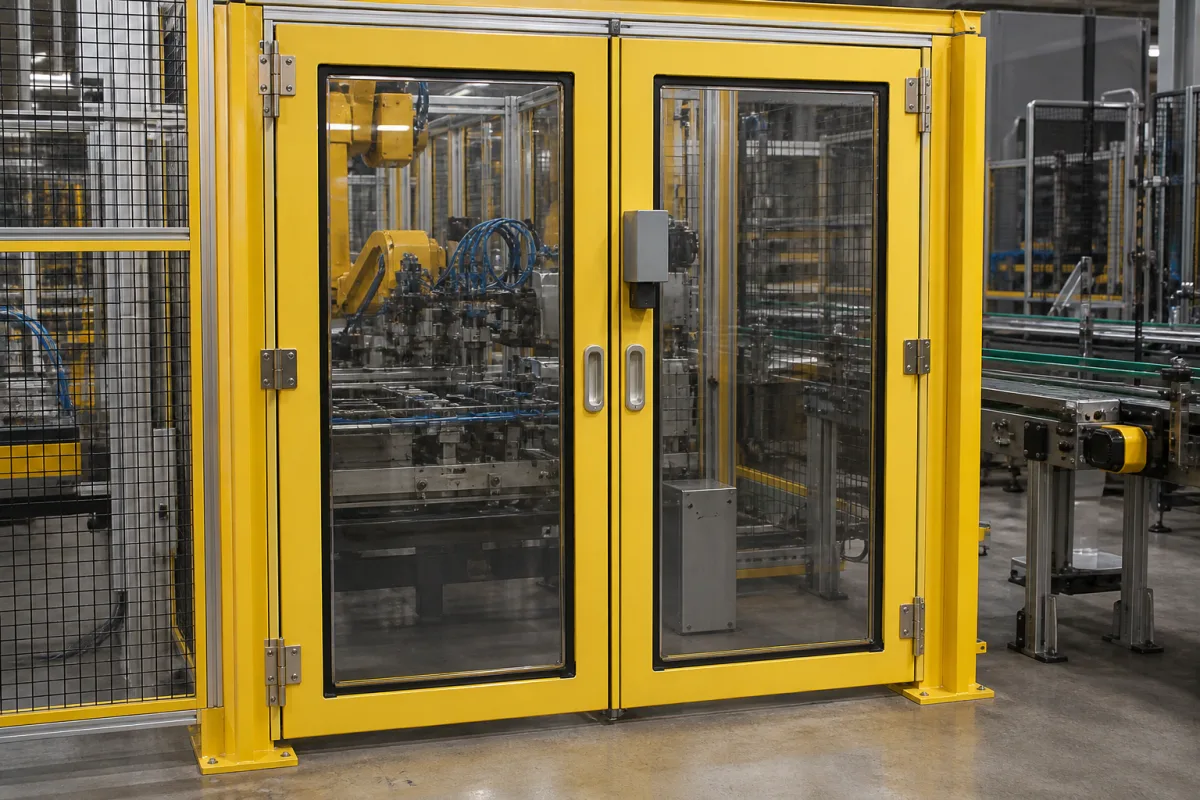
Hinged access door for machine guarding (single and double leaf, with interlock, guard locking and escape release)
Hinged access doors in machine and robot-cell guarding · single or double leaf, opening width, guard-locking holding force, escape release from inside, door-stop wear on the lock
The access door is the part of a guard that people open every shift, so it carries the interlock that stops the machine and, where the hazard runs on after stopping, a lock that keeps the door shut until it is safe. Order it by the opening the job needs (single or double leaf), the infill that lets operators see in, the holding force of the guard-locking device, how someone trapped inside gets out, and what absorbs the door's swing so the lock does not.
Hinged single and double access doors in perimeter guarding for machines, robot cells and automated lines, with their infill panels, hinges, handles, interlocking devices, guard locking and escape releases. Fencing layout, guard heights, mesh openings and safety distances for whole cells are covered on the Machine and robot cell safety guarding page. Sliding and powered doors, roller doors, HVAC duct access doors and access panels in buildings are outside this page.
CNFX editorial research · Sources checked October 12, 2026 · 4 sources
Single or double leaf: opening width, panel heights and infill
Troax builds its single and double hinged doors from the same mesh, polycarbonate or steel-sheet panels as its fence, in standard panel heights of 2,050 mm or 1,250 mm and up to six widths, with special widths to suit. The single door gives an opening of about 500 to 1,500 mm and the double door about 1,000 to 3,000 mm. [1][2]
The double door suits a cell where a pallet, fixture or lift truck must pass; the single door is for people. Troax supplies the single door pre-assembled with lock and safety switch from the factory or as separate panels, posts and door kit, and the double door as separate parts for assembly on site. [1][2]
Lock options listed are magnetic, Euro cylinder, Safe Escape Lock and Safe Lock, plus a panic bar on the single door, each with or without a safety switch chosen from the risk assessment. Troax states that its single hinged door, fitted with a Safe Lock, has been tested to withstand an impact of 1,600 joules. [1] The polycarbonate (ST PC) panel is offered where full visibility into the cell is needed. [2]
State the clear opening needed for people and for any equipment, the infill per leaf, and the impact energy the risk assessment calls for (for example a part or tool thrown by a robot).
02
Guard locking on a hinged door: holding force, spring or solenoid locking, coding
Guard locking holds the door shut rather than only detecting that it is open. Euchner's MGB2 locking set for hinged doors states a locking force FZh of 2,000 N; it locks by spring force and releases when voltage is applied to the solenoid (closed-circuit current principle), and reaches PL e, Category 4 for control of guard locking, with PFHd of 2.95 × 10⁻⁹ and a 20-year mission time. [3]
Editorial calculation: Schmersal's maximum holding force is 2,550 ÷ 1,950 ≈ 1.31 times the FZh value it states to EN ISO 14119, so compare devices on FZh, not on the larger figure. [4]
Schmersal describes the AZM190 as slim and suited to hinged doors, aluminium profiles and fencing; its actuating head can be repositioned in four 90° steps, and it has a manual release worked with a triangular key. The same data sheet lists “sliding safety guard” in its application note, so confirm the hinged-door mounting with the maker. [4] The MGB2 can switch on guard-lock monitoring, so its safe outputs switch on only when the door is locked rather than just closed. [3]
Latching force 20 N; actuating speed max. 0.3 m/s; IP65/IP67; −25 to +55 °C [4]
Ask for FZh to EN ISO 14119, whether locking is by spring or by solenoid, and what happens to the lock on power loss.
03
Escape release from inside the cell and keeping the lock from acting as a door stop
A person shut inside a locked cell needs a way out without tools. Euchner's escape release unlocks the guard locking manually in an emergency, and its inner door handle lets the person leave the danger zone; the standard version is designed for door profiles up to 40 mm. [3] Troax offers a Safe Escape Lock that can be equipped with a non-contact safety switch. [1]
Swinging the door against the lock wears it. Euchner rates the MGB2 for a total mechanical life of 1 × 10⁶ operations, but only 0.2 × 10⁶ when the device is used as a door stop with 1 J impact energy and 0.1 × 10⁶ with 2 J. [3] Editorial calculation: at 2 J per closure the rated life falls to 10% of the total; a door closed 100 times a day reaches 100,000 operations in about 1,000 days, about 2.7 years at that rate. A separate mechanical door stop keeps the lock at its full rating.
The MGB2 also has a ready delay of 5 s and a switching frequency of 0.25 Hz. [3] Editorial calculation: 0.25 Hz is at most one switching every 4 s, which is no limit for a manned door but matters if the door is opened and closed by an automatic cycle.
Specify the door profile depth for the escape release, which side the hinge is on, and a door stop or damper separate from the lock.
04
Details for an access door quote
Paste it into your enquiry below or into an email to a maker, then replace every bracket.
Door: [single or double leaf; clear opening width and height; hinge side]
Infill: [mesh; polycarbonate; steel sheet; per leaf]
Guard system: [post size; existing fence make]
Interlock: [safety switch type; guard locking yes/no; spring- or solenoid-locked]
Holding force: [FZh required]
Escape: [escape release; panic bar; door profile depth]
Safety rating: [PL / Category from the risk assessment]
Impact: [impact energy to resist]
Environment: [ambient temperature; washdown; IP rating]
Explore company information and manufacturing capabilities, then discuss the scope of your project with a relevant supplier.
Share this page
Compiled and source-reviewed by the CNFX editorial team.
Each manufacturer above links to the page on that company's own website where the product is listed, with the date we checked it. How we source and review
· Page last updated 13 October 2026
Buyer questions
How wide can a machine guard access door be?
Troax gives about 500 to 1,500 mm of opening for its single hinged door and about 1,000 to 3,000 mm for its double hinged door. [1][2]
What holding force does a guard-locking switch on a hinged door need?
It must hold the forces expected on the guard; published figures include FZh 2,000 N for Euchner's MGB2 and FZh 1,950 N for Schmersal's AZM190. [3][4]
Can the door lock be used as the door stop?
Euchner rates the MGB2 for 1 × 10⁶ operations in total but only 0.1 × 10⁶ when it acts as a door stop with 2 J impact energy. [3]
Sources and what still needs a direct check
Sources checked 2026-10-12. Troax, Euchner and Schmersal publish these figures for their own guarding doors and door interlocks; the impact and holding-force values are the makers' stated test or rating values.