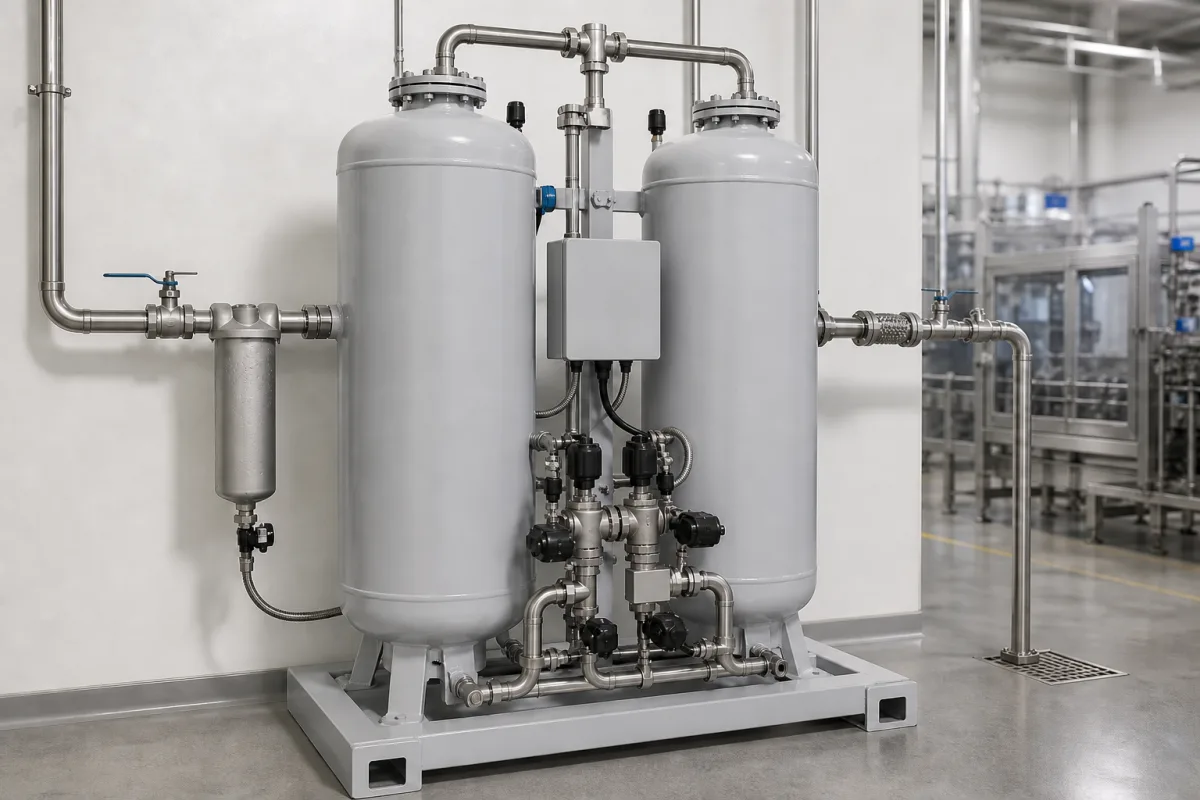
Desiccant compressed air dryers · Heatless vs heated purge vs blower regeneration, purge loss, pressure drop, dew-point switching
A desiccant compressed air dryer removes water vapour by passing compressed air through a tower of adsorbent (activated alumina or molecular sieve) while a second tower regenerates, giving pressure dew points well below freezing, as in the twin-tower dryer pictured with its prefilter and valves. Ask three things first: how the dryer regenerates and how much compressed air or energy that takes, what pressure drop it adds, and what pressure dew point it holds at your flow, pressure and inlet temperature.
Twin-tower regenerative desiccant (adsorption) dryers for compressed air: heatless, heated purge and heated blower purge types, with pre- and after-filters. Refrigerated dryers, membrane dryers, vehicle air brake dryers and compressors themselves (see air compressors) are outside this page.
CNFX editorial research · Sources checked October 12, 2026 · 4 sources
Choose the regeneration type by purge loss and running cost
Atlas Copco explains that regenerative desiccant dryers hold adsorbent in two towers: compressed air dries in one while the other regenerates by depressurising and passing dried purge air through the bed. Heatless dryers use only compressed air as purge, and Atlas Copco puts their average purge air consumption at about 16–20% of rated flow capacity; heated types reduce purge air, and heated blower purge dryers use ambient air from a blower over an external heater. Over 10 years it puts the heated blower purge dryer's total cost of ownership about 40% below the heatless type, because purge losses make up about 80% of a heatless dryer's TCO. [1]
Atlas Copco suggests heatless dryers suit low running hours or backup duty, and on balance ranks heated blower purge with zero-purge cooling first on economy; its BD+ range guarantees a pressure dew point of −40 °C and can reach −70 °C. [1] Denair's externally heated purge desiccant dryers list pressure dew points from −20 to −70 °C, activated alumina or molecular sieve desiccant, automatic control with alarms and noise of 72 dB(A) or less. [2]
The heatless principle goes back to Charles W. Skarstrom's US patent 2,944,627 (filed 1958-02-12, published 1960-07-12; original assignee listed as Exxon Research and Engineering). One bed adsorbs at feed pressure while the other is opened to a lower pressure and back-washed in counterflow by part of the dried product, so desorption "may be accomplished without addition of heat from an outside source". In its drying example, air with about 4,000 ppm moisture was fed at about 40 psig, a cycle timer switched the two adsorbers at three-minute intervals, and the dried product flow was about 1.0 standard cubic foot per minute; for drying the patent prefers a cycle time of about one to five minutes, and names activated alumina for removing water vapour and carbon dioxide together. [3]
Editorial calculation: a heatless dryer rated at 300 l/s that purges 16–20% of its rating uses about 48–60 l/s of compressed air for regeneration, which the compressors must produce on top of the plant's demand.
Give the supplier the compressed air flow (normal and peak), working pressure, inlet temperature and ambient, required pressure dew point, oil and particle limits (pre- and after-filtration), running hours, available power and whether purge air, heat or a blower may be used, and the space and noise limits.
02
Check pressure drop and dew-point dependent switching
Atlas Copco stresses that a dryer's internal pressure drop raises the compressor discharge pressure and energy cost, and in extreme cases output loss through the dryer can reach 20%; it advises choosing desiccant dryers with a very low pressure drop and cites a figure below 0.2 bar. Dew-point dependent switching uses a dew-point sensor to delay tower changeover until the bed is loaded, extending cycle time, which it says can generate energy savings of up to 90%. [1]
Atlas Copco notes regeneration cycles are based on time, dew point or both, and that for installations needing a negative dew point adsorption dryers are regarded as the only valuable solution. [1] Editorial note: ask for the dryer's pressure drop and dew point at your actual flow, inlet temperature and pressure, not only at the rating conditions.
03
Compare dryer types by dew point and energy per 100 cfm
The US Department of Energy's sourcebook Improving Compressed Air System Performance compares dryer types on dew point and energy, including the pressure drop through the dryer. Single-tower deliquescent dryers suppress the pressure dew point by 15–50 °F below the inlet temperature and need about 0.2 kW per 100 cfm, excluding replacement desiccant. Refrigerant dryers give a pressure dew point of 35–39 °F, with a pressure drop of 3–5 psid, and need about 0.79 kW per 100 cfm. Twin-tower desiccant dryers are rated at a pressure dew point of −40 °F; a pressure-swing type uses purge air of 10–18% of its rating, heated types use less purge but add heater energy, and the approximate requirement is 2.0–3.0 kW per 100 cfm. The sourcebook notes that dryer ratings use the 'three 100s' inlet conditions (100 psig, 100 °F inlet air, 100 °F ambient), that higher inlet temperature or lower pressure reduces rated capacity, that cutting saturated air temperature by 20 °F roughly halves its moisture content, and that drying beyond the needed dew point wastes energy. [4]
Editorial calculation: a dryer rated at 300 l/s handles about 636 cfm, so a twin-tower desiccant dryer would need about 13–19 kW against about 5 kW for a refrigerant dryer at the same flow; −40 °F equals −40 °C, and 35–39 °F is about 2–4 °C. If your end use only needs a dew point a few degrees above freezing, the desiccant dryer's extra 8–14 kW buys nothing; specify the dew point the process needs and ask for flow correction factors at your inlet temperature and pressure. [4][1]
Denair's heated purge listing and what to ask any dryer supplier
Denair is the one supplier linked here; its card points to its externally heated purge dryer page.
Ask any supplier for the dryer type, rated flow and its reference conditions, pressure dew point, purge or heater power, pressure drop, desiccant type and change interval, control and alarms, and filter grades supplied.
05
Towers, desiccant, heater or blower, valves and filters
The heater or blower row is the one that changes with the regeneration type chosen above.
Time or dew-point switching; a cycle timer in the original heatless patent. [1][3]
Control mode and alarms.
Pre- and after-filters
Protect desiccant; catch dust.
Filter grades.
06
Flow, dew point, purge and pressure drop at your inlet conditions
Rated flow only means something with its inlet conditions attached; the DOE sourcebook notes that higher inlet temperature or lower pressure reduces rated capacity. [4]
Explore company information and manufacturing capabilities, then discuss the scope of your project with a relevant supplier.
Share this page
Compiled and source-reviewed by the CNFX editorial team.
Each manufacturer above links to the page on that company's own website where the product is listed, with the date we checked it. How we source and review
· Page last updated 13 October 2026
Buyer questions
How much compressed air does a heatless dryer use?
Atlas Copco puts the average purge air consumption of a heatless dryer at about 16–20% of its rated flow capacity. [1]
Is a heated blower dryer worth the extra cost?
Atlas Copco estimates about 40% lower 10-year total cost of ownership than a heatless dryer, whose purge losses it puts at about 80% of TCO. [1]
What dew point can a desiccant dryer reach?
Atlas Copco's BD+ range guarantees −40 °C and can reach −70 °C; Denair lists −20 to −70 °C for its heated purge dryers. [1][2]
How does a heatless dryer regenerate without a heater?
Skarstrom's US patent 2,944,627 depressurises the loaded bed and back-washes it in counterflow with part of the dried air; its drying example switched towers every three minutes at about 40 psig. [3]
How much energy does a desiccant air dryer use compared with a refrigerant dryer?
The US DOE compressed air sourcebook gives about 2.0–3.0 kW per 100 cfm for twin-tower desiccant dryers (−40 °F dew point) against about 0.79 kW per 100 cfm for refrigerant dryers (35–39 °F). [4]
Sources and what still needs a direct check
Sources checked 2026-10-12. Atlas Copco and Denair are compressed air equipment makers; their pages describe dryer types and their own products. Skarstrom's 1958 patent (US 2,944,627) sets out the pressure-swing cycle behind heatless dryers.