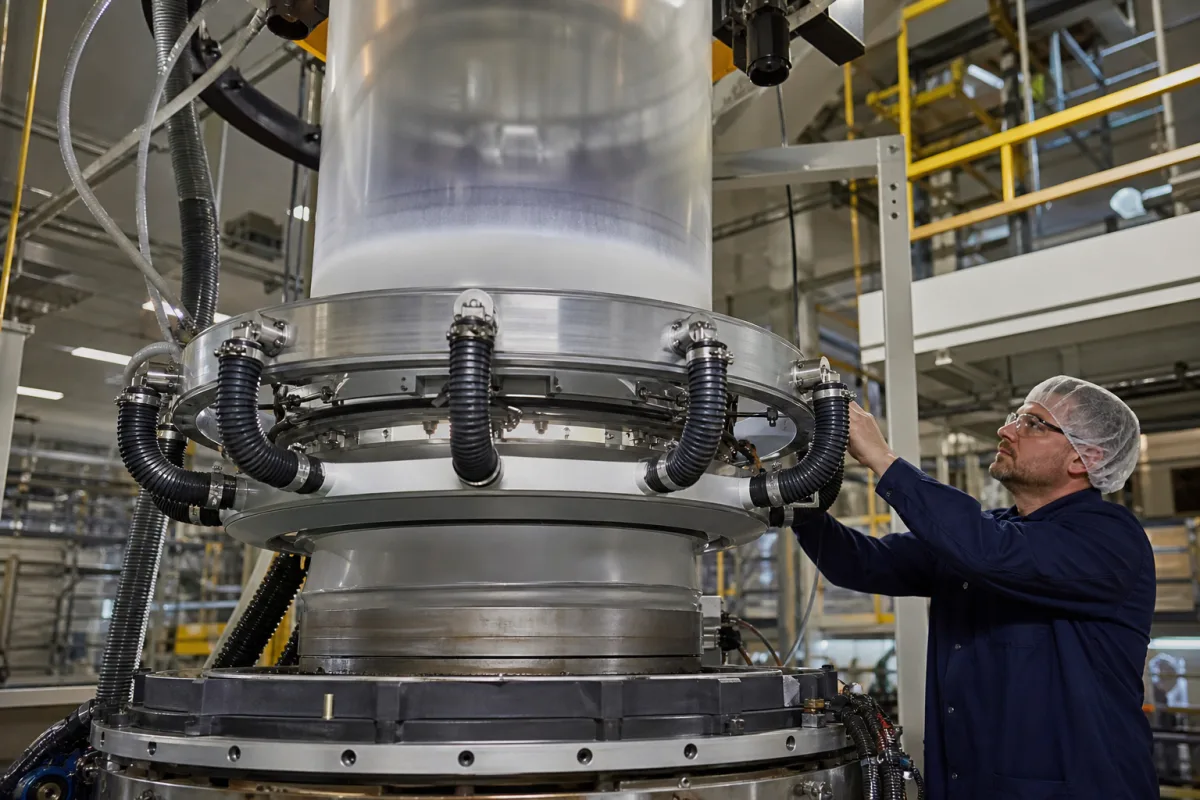
Air ring for blown film: the dual-lip external cooling ring, its venturi bubble lock, the inlet plenum and segmented gauge-control actuators
External cooling ring of a blown film die · lower and upper lip, venturi bubble lock, multi-inlet plenum, iris, segmented auto-gauge actuators and lip changeover
An air ring is the annular cooling device bolted on top of a blown film die. Chilled air from a blower enters its plenum, leaves through one or more annular lips and runs up the outside of the hot film tube, cooling it and, through the low pressure it creates, holding the bubble against a forming cone. How much air the lips can deliver before the bubble goes unstable sets how fast a die can run, and how evenly the air reaches the bubble shows up in the film gauge around its circumference.
External cooling air rings mounted on blown film dies: single-lip, dual-lip, elevated and triple-lip rings, their plenums and air inlets, lips and forming cones, irises and stacks above the lips, rotating versions for oscillating dies, and air rings with circumferential actuators for automatic gauge control. Complete blown film lines, with extruders, die sizing, blow-up ratio, internal bubble cooling, haul-off and winders, are covered on the Plastic film blowing machine (blown film line) page; spiral mandrel dies, lip gaps and die output ratings are on the Annular dies (blown film dies) page. Blowers, chillers and cast film chill rolls are outside this page.
CNFX editorial research · Sources checked October 13, 2026 · 4 sources
Lower lip, intermediate lip and the venturi lock that sets the stability limit
In a dual-flow air ring the air leaves through two annular outlets, one low near the die and one higher up. Gloucester Engineering's patent describes the failure that limits the lower stream: as its speed rises, the pressure between the conical lip and the soft film drops until the film touches the lip and chokes the flow, then is pushed away again, and this repeating attraction and repulsion gives poor cooling and variable gauge. [1]
The patent puts maximum rates for well adjusted prior dual-flow rings at about 13 lb per inch of die circumference per hour on low density polyethylene and its blends. Its own ring adds a ramp on the inside of the intermediate lip that makes the lower air path converge rapidly, raising the static pressure locally so that the bubble cannot expand too fast; the upper stream then meets the film at a grazing angle. [1]
Davis-Standard's blown film article puts the choice between ring types this way: elevated and triple-lip rings let fast, stable polyolefin structures run at very high outputs but are harder to adjust across large blow-up ratio ranges or for films such as barrier structures with PA and EVOH; a dual-lip ring gives up some output for flexibility, through the share of air sent to the lower lip, the expansion angle up to the upper lip, and control of the main air flow that forms the bubble lock. [4] D.R. Joseph's patent lists the configurations as single lip, dual lip, elevated dual lip and elevated triple lip. [3]
Tell the supplier the resins and structures to run, the die diameter, the blow-up ratio range including any low blow-up work, the film thickness range, and the chilled-air temperature and flow available at the ring inlet.
02
Output per inch of die circumference in the Gloucester trials
The patent's examples used one 10 in single-layer die fed by an 80 mm, 24:1 L/D grooved extruder, layflat of 42 in (blow-up ratio about 2.7), the iris about 1 in from the tube and the blower set to the highest flow the bubble would tolerate. [1]
Editorial calculation: a 10 in die has a circumference of about 31.4 in, so 13 lb/h per inch corresponds to about 408 lb/h (185 kg/h) and Example A's 22.6 lb/h per inch to about 710 lb/h (322 kg/h) on the same die size. The prior-ring figure and the examples come from the same patent applicant and were not run side by side, so treat the ratio as the applicant's claim rather than a measured comparison. [1]
Plenum air in the examples ran from 44 to 72 °F. The patent says chilled air is not required for its ring but is advantageous to production rate. [1] Davis-Standard adds that the blower and chiller must supply enough cool air, that long, bent or uninsulated ducting can cut performance, and that measuring the temperature and flow of the chilled air at the ring inlet is wise. [4]
Feeding the plenum: four to eight ducts from a manifold, or one inlet
Davis-Standard describes the usual way air reaches the ring: a manifold splits the supply into four to eight equal-length ducts feeding inlets spaced around the ring entry, which then spreads the flow with contouring or baffles. These steps add pressure loss and cut the maximum airflow. A single inlet removes the manifold and its losses but makes even airflow around the circumference harder to achieve. [4]
Gloucester's patent shows a tangential side-entry inlet and notes that radial or bottom entry can also be used. For dies that rotate, its ring turns the inner lips with the die while the inlet stays still, using two PTFE strips in grooves as combined rotary bearings and seals; for a fixed die these can be left out. [1]
Above the lips, the same patent fits a stack and an adjustable iris and states that setting the iris gap to the bubble at about twice the minimum gap between the stack and the bubble was found useful. [1]
Ask for the number and position of inlets, the pressure drop across the ring at the rated airflow, and whether the ring has to rotate with the die.
04
Segmented actuators around the ring for automatic gauge control
Macro Engineering's patent describes an air ring with a series of individually operated actuators around its circumference. Each one changes the cooling air locally so that the film at that point runs nearer to or further from the ring body: closer means more stretch and thinner film, further means less stretch and thicker film. [2]
In one version electrically heated bimetallic strips bend into a passage between ring and die to throttle air at their location; in another, flaps are moved by actuators that the patent says may be linear actuators, solenoids, stepping motors, positioning motors or torque motors. The patent reviews earlier approaches, including manually adjusted deflector blades, which it says gave too little gauge control and were hard to adjust. [2]
D.R. Joseph's patent separates general cooling of the whole tube from location-specific cooling or heating used to even out thickness, and notes that both depend on narrow air annuli that collect oils, paraffins, melted plastic and grease unevenly; such deposits, or a damaged venturi surface, cause local instability and thickness variation. [3]
For an auto-gauge ring, ask for the number of control zones, the actuator type, the gauge scanner it works with, and how the zones are cleaned.
05
Lip and forming-cone changes without lifting the ring
D.R. Joseph's patent says air rings weigh from 100 lb up to thousands of pounds depending on diameter, and that the fasteners holding lips and bubble-diameter parts can only be reached by lifting the ring off the die, so a lower lip change can take hours or a whole day. It proposes a forming-cone assembly keyed into the main body and fastened from above, lifted out vertically without removing other parts. [3]
The patent singles out low blow-up ratio work, a tube only slightly larger than the die exit, as the hardest configuration for air ring cooling, needing a ring configured for it; it says some customers buy a second air ring for it or swap components. [3] Editorial note: if a line will switch between low and normal blow-up ratios, ask whether the lip set can be changed from above and how long the change takes.
06
What an air ring maker needs to quote
Paste it into your enquiry below or into an email to a maker, then replace every bracket.
Die: [diameter; rotating or fixed; mounting]
Film: [resins and structures; thickness; blow-up ratio range]
Output: [target kg/h or lb/h per inch of die]
Ring type: [single, dual, elevated or triple lip]
Air: [blower; chiller; air temperature and flow at the inlet; duct length]
Inlets: [number; tangential, radial or bottom]
Gauge control: [manual or automatic; zones; scanner]
Service: [lip change from above; cleaning access]
Explore company information and manufacturing capabilities, then discuss the scope of your project with a relevant supplier.
Share this page
Compiled and source-reviewed by the CNFX editorial team.
Each manufacturer above links to the page on that company's own website where the product is listed, with the date we checked it. How we source and review
· Page last updated 13 October 2026
Buyer questions
What limits the output of a dual-lip air ring?
Gloucester Engineering's patent describes the bubble being drawn onto the lower lip as air speed rises, choking the flow and making the bubble unstable; it gives about 13 lb/h per inch of die circumference for earlier dual-flow rings on LDPE. [1]
Why is an air ring fed by more than one hose?
Davis-Standard says a manifold splits the supply into four to eight equal-length ducts feeding inlets around the ring; a single inlet cuts pressure loss but makes even airflow harder. [4]
How does an air ring control film thickness?
Macro Engineering's patent uses individually operated actuators around the ring to change the air locally, moving the film nearer to the ring (thinner) or further from it (thicker). [2]
Dual-lip or triple-lip?
Davis-Standard says elevated and triple-lip rings suit very high outputs on stable polyolefin films, while a dual-lip ring offers flexibility for different films and blow-up ratios. [4]
Sources and what still needs a direct check
Sources checked 2026-10-13. Three European patent publications on air rings (Gloucester Engineering's dual-flow ring with trial outputs, Macro Engineering's segmented gauge actuators and D.R. Joseph's lift-out forming cone) and a Davis-Standard engineering article on choosing an air ring.