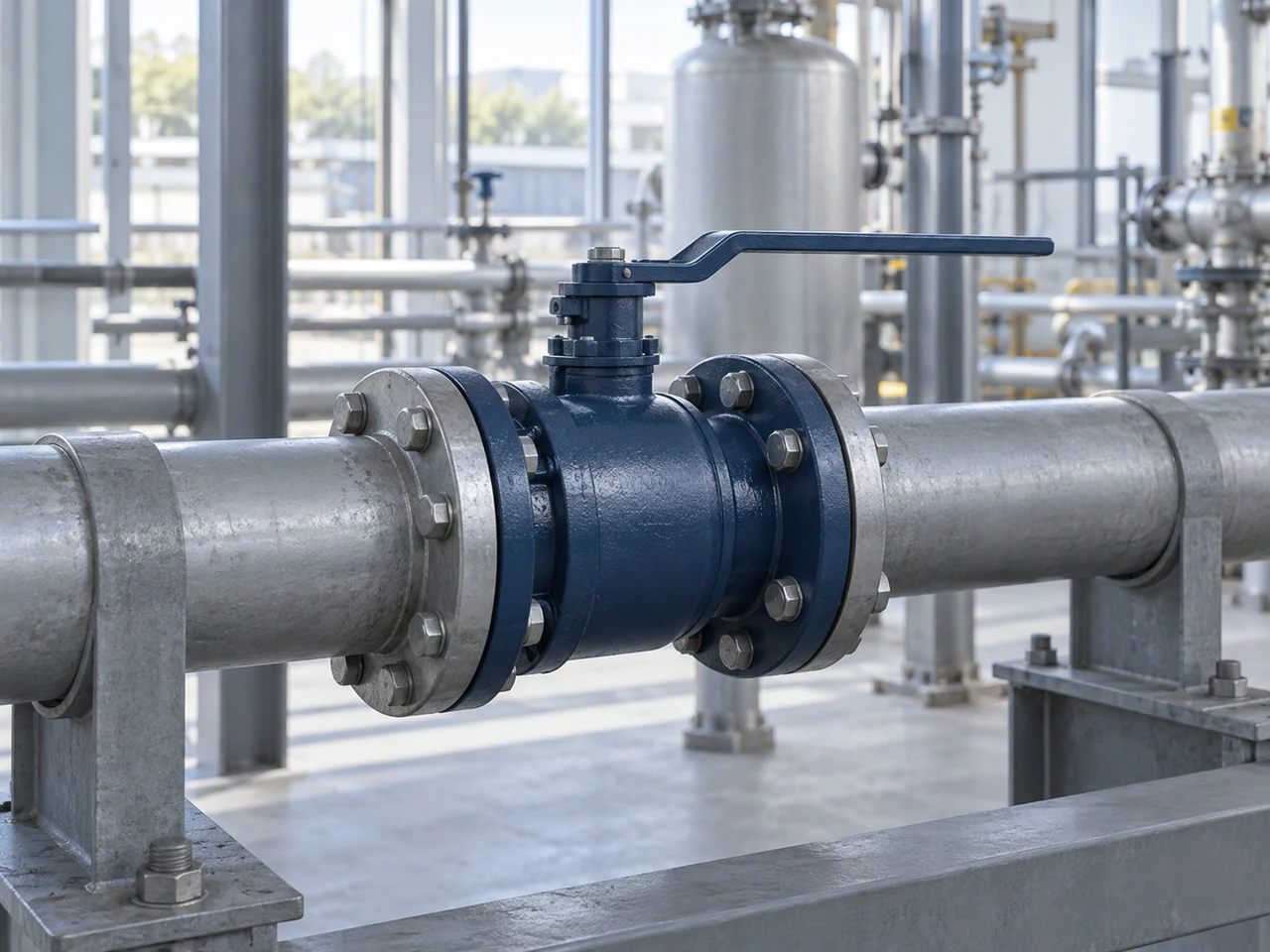
Specify what the valve must isolate, where trapped pressure can go, and which dimensions must fit. The nominal pipe size answers only one of those questions.
Industrial metal ball valves for line isolation. Neway’s published designs provide the component and dimensional examples below; each example retains its own material, size and operating conditions.
CNFX editorial research · Sources checked October 10, 2026 · 7 sources
Choose how the ball is supported and how the cavity relieves
The stem turns a bored ball through a quarter-turn. Aligning the bore with the pipe opens the passage; turning it across the line closes it against the seats. In a floating design the ball can move slightly toward the downstream seat under line pressure. A trunnion design supports the ball and uses moving seats to establish the seal. Neway’s sectional drawings show these different load paths. [1][2]
Arrangement in Neway’s trunnion catalogue
Response to cavity pressure
Selection consequence
Self-relieving seats · SPE
When cavity pressure overcomes the opposing seat forces, the seat can move away from the ball and relieve toward the pipeline.
Identify the permitted relief destination and pressures on both sides of the closed valve. [2]
Double-piston seats · DPE
Cavity pressure can energize the seat seal rather than open a relief path.
Neway calls for automatic cavity relief unless otherwise agreed. Ask for the actual relief arrangement, not just a DIB-1 label. [2]
One SPE seat and one DPE seat
The catalogue describes cavity relief through the SPE side.
The seat orientation becomes part of the purchase specification and installation drawing. This is its DIB-2 option. [2]
These are the manufacturer’s illustrated arrangements, not a guarantee attached to every “trunnion” listing. A DBB description also needs the selected seat configuration and test basis. Do not infer a safe maintenance isolation procedure from the product name. [2]
02
Inspect a real component schedule, not just “steel and PTFE”
This functional BOM follows the Neway BA reduced-port valve, catalogue pp. 12–13, using the carbon-steel, non-sour material column. Numbers below are drawing positions, not quantities. It is a named reference assembly; a different series, sour-service build or supplier needs its own controlled BOM. [1]
Component · drawing position
Function in the assembly
Material in this BA column
Body and body insert · 1, 2
Enclose the ball and seats; the insert closes the body opening.
ASTM A216 WCB for both.
Ball · 3
Rotates the flow passage and contacts the seats.
ASTM A182 F6a.
Seats · 6
Provide the sealing contact around the ball.
PTFE.
Stem · 7; thrust washer · 11
Transmit handle rotation and support the stem at its bearing interface.
Stem: ASTM A182 F6a; washer: PTFE.
Gland flange · 5; gland · 8
Load the stem-packing assembly.
Flange: ASTM A216 WCB; gland: ASTM A276 304L.
Body gasket · 9; stem packing · 10
Seal different leak paths: the body joint and stem exit.
Flexible graphite gasket; graphite packing.
Gland screws · 12
Secure the gland-flange assembly shown in the drawing.
ASTM A193 B7.
Anti-static device · 13
Provides the conductive path described between the internal valve parts and body.
The table says stainless steel without a specific grade.
Handle, stops and retaining hardware · 4, 14–16, 18–23
Operate, limit and retain the manual mechanism.
Carbon steel in this column except position 15, which is listed as stainless steel.
Optional O-ring · 17
An additional seal shown around the body-insert area.
Viton A in this column; optional does not mean supplied on every valve.
The same catalogue gives a different stainless-steel build: CF8M body/insert and F316 ball/stem. Do not assemble a material declaration by taking preferred entries from different columns. Where a certificate or exact compound is required, put the selected positions and materials into the order. [1]
03
A higher pressure class can change the space the valve occupies
Both examples below are the BA reduced-port NPS 2 × 1½ (DN 50 × 40) entry on catalogue p. 14. The flow bore d remains 38 mm, while the flange-to-flange dimension L and listed weight change. The pressure-class number alone does not establish interchangeability. [1]
Compare columns side by side. On a narrow screen, scroll the table horizontally.
BA catalogue entry
Bore d
Length L
Weight
Class 150
38 mm
178 mm
8.7 kg
Class 300
38 mm
216 mm
11.0 kg
Check the complete mating arrangement
The Class 300 entry is 38 mm longer in this comparison. Record the existing face-to-face space, flange standard/class, facing, bolt pattern, gasket and support arrangement. These two catalogue rows are not a substitute for the approved connection drawing. [1]
Nominal size does not settle flow capacity
Neway’s separate engineering table lists Cv 423 for its 2-inch full-bore Class 150 entry and Cv 133 for the 2 × 1½-inch reduced-bore entry. Those are flow coefficients from the catalogue, not promised operating flows and not two BA configurations. Ask for flow data tied to the quoted model and check it against the actual fluid and permitted pressure drop. [1]
04
Approve the complete pressure–temperature duty and the actual test
Neway plots seat-material pressure–temperature limits separately from body-class curves. A body rating does not establish the suitability of its seats, packing and other seals at the proposed duty. Obtain the complete selected valve’s written limits, including conditions during operation. [1]
Item on the valve schedule
Evidence to require
Why it matters
Process and upset duty
Fluid composition, solids, normal/design pressure and temperature, differential pressure in each direction, and any trapped-liquid condition.
A family’s widest catalogue temperature and pressure ranges do not prove those extremes are available together.
Body, ball, seats and seals
The selected material column or itemized BOM, with corrosion/service suitability accepted for the stated fluid.
The BA PTFE seat example does not authorize substituting PEEK, RPTFE or an elastomer without reviewing the complete build. [1]
Pressure designation and ends
Specify the applicable PN or Class designation and the exact end-connection drawing.
ISO 17292 lists several classes and PN designations within its scope. That list is not a conversion table equating PN16–40 with Class150–600. [3]
Shell and closure acceptance
Agreed test standard/edition, medium, pressure, duration, leakage criterion and test record for the supplied valve.
ISO 5208 addresses pressure-boundary and closure testing. Its public abstract does not provide the paid acceptance tables. [5]
Control-valve leakage terminology
If a control-valve leakage class is specified, name its standard and test conditions explicitly.
FCI’s own explanation addresses control-valve seat tightness under defined tests. It does not support relabelling an isolation valve’s leakage as a percentage under “ISO 5208 Class VI”. [6]
Fire or emissions evidence
If required, request the applicable test/certificate and its coverage of the quoted construction.
A catalogue feature description or an API/ISO number alone is not verified evidence for the particular valve being purchased.
Only the public ISO scope pages were read for this guide. Detailed test values, certification coverage and project acceptance remain contractual checks; no universal leakage percentage is asserted here.
05
An actuator that bolts on still needs a torque review
ISO 5211:2026 covers the mounting flange and drive connection of part-turn actuators, including reference interface torque values. It does not specify the pipe ends or establish the operating torque of your selected valve in your process. [4]
Keep the torque-table conditions attached to the number
Neway’s floating-valve table gives 40 N·m for its 2-inch Class 150 reference. The note uses ambient temperature and RPTFE seats for that class. This cannot simply be assigned to the PTFE BA material example above. Fluid and trim changes require a fresh selection. [1]
Use the catalogue factor as a starting calculation
Applying Neway’s stated reference factor of 1.3–1.5 to 40 N·m gives 52–60 N·m. This arithmetic illustrates its actuator-selection note; it is not an approved actuator rating for a specific installation. Ask the supplier to match the required valve torque through the stroke to the actuator output at the minimum available supply, including the required failure action. [1]
Identify manual, pneumatic or electric operation; state the required fail position and whether the valve must move against full differential pressure.
Request the mounting drawing, coupling and support details alongside the valve/actuator selection. ISO 5211’s scope excludes the intermediate support’s attachment to the valve itself. [4]
Obtain the agreed operating time and feedback arrangement for the selected package. An actuator-family speed claim does not establish the installed valve’s switching time.
06
Specify the repair route before the line layout is fixed
The BA drawing has a removable body insert; Vihung separately offers fully welded trunnion valves. These are different constructions with different access questions. Ask what can be replaced on the installed model and what requires valve removal. Neither catalogue is the service procedure for a different supplier’s valve. [1][7]
Order the seat, body-gasket and stem-packing kits against the exact valve identity and material schedule. Include a controlled drawing so a generic “PTFE kit” cannot conceal missing or different seals. [1]
For cavity-relieving designs, have the supplier identify the relief direction and any external relief equipment on the approved assembly/P&ID. The plant isolation plan must account for the actual arrangement. [2]
Obtain the manufacturer’s installation and maintenance instructions, safe isolation requirements, fastener settings and post-service test criteria before work is planned. No model-specific Neway maintenance manual was verified in this review.
Record external leakage, loss of shutoff and changes in operating effort against the approved service criteria. Set inspection and spare-parts planning with the equipment owner rather than adopting an unsourced universal replacement interval.
Neway describes emergency sealant fittings on certain trunnion configurations. Their presence is not permission to inject sealant or dismantle a pressurized assembly; obtain the selected manufacturer’s procedure and the site’s isolation authorization. [2]
07
Copy the industrial isolation-valve enquiry
Paste it into your enquiry below or into an email to a maker, then replace every bracket.
Line / valve tag and isolation duty [ ]
Fluid composition, solids and any special service [ ]
Normal / design pressure and temperature; differential pressure in both directions [ ]
Trapped-cavity condition; required seat arrangement and relief destination [ ]
Nominal pipe size, required bore and flow / permitted pressure loss [ ]
Pressure designation; end standard, facing, mating drawing and face-to-face space [ ]
Body, ball, stem, seats, packing and other seal materials [ ]
Manual or actuator; minimum supply; failure position; operating time and feedback [ ]
Required valve torque and complete actuator selection / mounting drawing [ ]
Agreed shell and closure test standard, conditions and acceptance record [ ]
Required material traceability, fire / emissions evidence and its exact coverage [ ]
Installed dimensions / mass, removal clearance, maintenance instructions and spare kits [ ]
These existing supplier records cover industrial line valves, actuator packages and sanitary tube assemblies. Read the specific offering before sending the same specification to every company.
Neway Valve (Suzhou) Co., Ltd.
Suzhou New District — published company contact address
Publishes floating and trunnion industrial ball-valve catalogues. The BA parts and dimensional examples above come from its floating-valve catalogue; request the specific series, seat arrangement and controlled order drawing. Published family features do not establish certificate coverage for a quoted valve.
Describes fully welded trunnion ball valves with full/reduced bores and self-relieving seats, plus optional DIB arrangements. Ask for the quoted seat configuration and cavity-relief drawing. Website approval lists were not independently verified.
Lists pneumatic floating, trunnion, metal-seated, soft-seated and V-port ball-valve arrangements. Treat the valve and actuator as a selected package: the page gives inconsistent switching-time claims, so obtain an agreed cycle time and torque selection for the actual duty.
Export entity described as Hefei AFC; plant unverified
Lists industrial ball valves, including DBB and segmented designs. Its homepage distinguishes the AFC group from Hefei AFC International Trade, described as the export company. Establish the legal seller, actual manufacturer and selected valve model before placing an order.
Publishes industrial floating and trunnion valves, including flanged, socket-weld and threaded listings; the catalogue also contains multiway and polymer designs. Match the individual entry to the line specification. Its broad category standards list is not a verified compliance record for every listed valve.
China — exact production site unverified in this review
KAYSEN’s KS-BV02 listing concerns a three-piece sanitary ball valve. Its title, connection field and description mix welded and clamp-end wording; request a single agreed end drawing and pressure–temperature rating. This is a sanitary-tube enquiry, not evidence of the BA industrial design above.
Publishes a sanitary three-piece valve with PTFE seats, several seal options and clamp, weld or threaded ends. Specify the actual end family and seal set. The offered sanitary assembly is a different procurement scope from a flanged industrial isolation valve.
Publishes a three-piece clamp sanitary valve with 304/316L options and several seal materials. Its page describes on/off operation, but does not provide a complete pressure–temperature selection. General FDA, GMP and other certification wording on the page is not a verified certificate for the valve.
Lists three-piece clamp, tank-bottom, two-way and three-way sanitary ball-valve configurations. Its catalogue distinguishes encapsulated and non-encapsulated seat descriptions. Select the actual construction and cleaning duty; do not transfer specifications between those entries.
Offers sanitary three-piece and non-retention ball valves. The three-piece pressure figures are not mapped to size and end configuration; resolve that before comparing bids. Its Wenzhou company description and incomplete Hong Kong contact address also leave the production-site identity unresolved.
Zengcheng, Guangzhou — current website contact address
The legacy domain redirects to an ALLTO-branded site with a current ball-valve category, including a Q347F worm-wheel fixed-ball listing, one-piece and three-way valves. Request the selected model’s dimensional drawing, seat design and rated duty before comparing it with the catalogue examples above.
Explore company information and manufacturing capabilities, then discuss the scope of your project with a relevant supplier.
Share this page
Compiled and source-reviewed by the CNFX editorial team.
Published product information supports the scope stated on each card; it does not by itself verify a factory, certificate or the conformity of a quoted assembly. How we source and review
· Page last updated 10 October 2026
Buyer questions
Does a reduced-port NPS 2 valve have a 2-inch flow bore?
Not in the BA example reviewed here. The NPS 2 × 1½ entry has a 38 mm bore in both Class 150 and Class 300. Use the bore dimension and flow data for the selected model rather than treating the pipe designation as the opening diameter. [1]
Does a DPE seat release trapped cavity pressure automatically?
Neway’s described DPE arrangement does not provide the SPE self-relieving path. Its catalogue requires automatic cavity relief unless otherwise agreed. The approved valve arrangement must resolve where excess cavity pressure will go. [2]
Can the 40 N·m catalogue entry size the actuator for any 2-inch valve?
No. That entry belongs to Neway’s stated ambient-temperature and RPTFE-seat reference conditions. The actual model, trim, fluid, differential pressure and actuator supply must be included in the supplier’s selection. [1]
Is ISO 5211 an end-connection standard for the pipework?
It defines the part-turn actuator attachment interface. The pipe connection and its pressure rating need their own specified standard and drawing. The current public entry reviewed is ISO 5211:2026. [4]
Sources and what still needs a direct check
Sources checked 2026-10-10. Standards bodies and regulations define the requirements; manufacturer pages show published ranges for those models only. CNFX does not certify products or suppliers.
The numerical examples are catalogue references, not an approved pressure–temperature envelope or interchangeable order specification.
Exact certificates, manufacturing sites, delivered-lot conformity and a model-specific maintenance procedure have not been independently verified.
Supplier pages do not settle all configuration choices: KAYSEN mixes welded/clamp wording; BCST gives inconsistent switching-time claims; Deyi leaves pressure mapping and production-site identity unresolved.
ISO sources here are public abstracts. Full test clauses and the selected valve’s acceptance criteria must be checked in the procurement specification.
Buyer enquiry
Request manufacturing insight
for Ball Valve
Ask for use case, specification boundaries, supplier type, and RFQ preparation
information for this product.
Where it goes
Straight to the CNFX editorial desk, and to the manufacturer if this product is
linked to a claimed profile. Nothing is broadcast to a supplier list.
Your details stay here
We do not sell or rent enquiry data, and we do not add you to a mailing list.
Used only to answer this request.
No commission, no middleman
CNFX is a directory. We take no cut of any order and never negotiate on a
supplier's behalf.
What to include
Share your product specifications, quantity, destination and target delivery date.
Need to Manufacture Ball Valve?
Compare manufacturer profiles with relevant product and process capability.