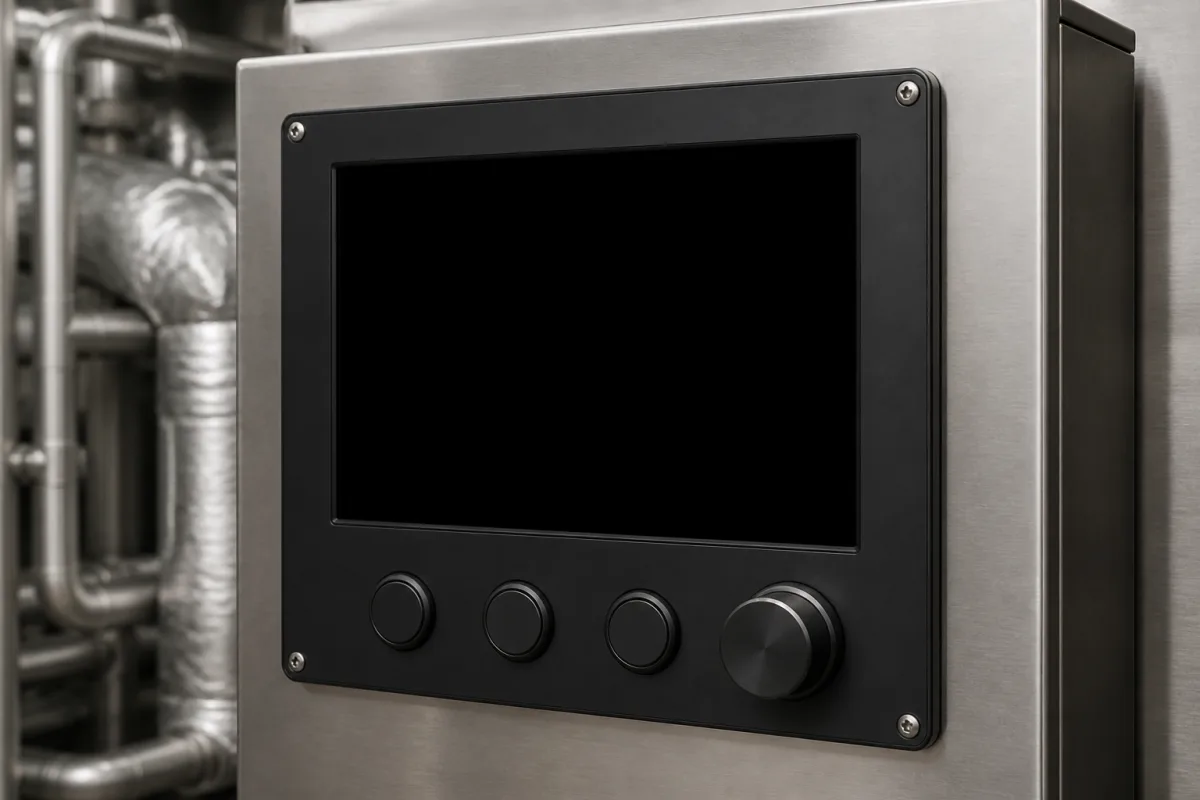
Display and push-and-turn knob interface for temperature equipment (non-touch display with rotary encoder and keys)
Non-touch operator interface · push-and-turn encoder knob with detents and push switch, high-luminance display, rotational life and temperature range
On a knob-operated machine the operator turns a detented encoder to change a setpoint, presses it to confirm, and reads the value on a display beside it. This interface is a small assembly of three parts: the display, the rotary encoder with its push switch, and a few keys behind a bezel. The decisions that matter are how the knob feels and how long it lasts, whether the display can be read in the room it sits in, and whether every part survives the temperature at the front of the machine.
Front-panel operator interfaces built from a non-touch display, a push-and-turn rotary encoder and keys, used to set and read temperatures and other process values on equipment. Touch layers and touch displays are covered on the HMI touchscreen page; serial smart display modules on the Smart display module page; complete temperature controllers on the Temperature controller page; HVAC room display units on the User interface for HVAC thermostats page; stainless washdown HMIs and machine-side operator stations on their own pages. Motion-feedback encoders are separate products.
CNFX editorial research · Sources checked October 12, 2026 · 3 sources
Encoder knob: detent count, pulses per turn, and rotational and push-switch life
The knob is the part an operator wears out. Between the mechanical and optical encoders below, rated life differs by a factor of about 33.
Bourns specifies contact bounce of 2.0 ms maximum at 15 RPM, a maximum operating speed of 60 RPM, detent torque of 30 to 90 gf-cm, and a switch actuation force of 610 ± 306 gf, and advises noise-reduction filters in the circuit. [1] Grayhill offers multiple torque profiles and sealed options, and describes the pushbutton as giving scroll-and-click operation in one control. [2]
Editorial calculation: a 24-pulse encoder gives one count every 360/24 = 15°, and 32 detents give one step every 11.25°, the angle Grayhill lists as its finest throw option. The optical part's rated rotational life is about 33 times the mechanical part's (1,000,000 / 30,000), and its push-switch rating 150 times (3,000,000 / 20,000).
State how often the setpoint is changed per shift, whether operators wear gloves, the detent count and torque wanted, and the switch life required, so the supplier can pick a mechanical or optical encoder.
02
A display that can be read without touch: luminance, viewing direction and interface
Newhaven sells its 2.4-inch sunlight-readable TFT without a touchscreen, for bright places where touch is not required. [3]
Editorial note: a 6:00 viewing direction means the panel is optimised for a viewer looking from below the screen's centre line; mount the display at a height and tilt that matches where the operator stands, and ask for the contrast curve in the data sheet.
Give the ambient light at the machine, the reading distance, the mounting height and angle, and the characters or graphics to be shown.
03
Matching the temperature range of display, encoder and keys at the machine front
The interface works only within the narrowest range of its parts.
Editorial calculation: combining the published operating ranges, Newhaven's display (−20 to +70 °C) [3], Bourns' encoder (−30 to +70 °C) [1] and Grayhill's encoder (−40 to +85 °C) [2], an assembly built from any of these encoders and that display is limited to −20 to +70 °C by the display.
Bourns rates the PEC11R at IP40. [1] Editorial note: IP40 does not cover water, so where the front panel is wiped or splashed, ask how the knob shaft and keys are sealed at the bezel, or choose a sealed encoder option such as those Grayhill offers. [2]
State the front-panel temperature next to heated zones, cleaning method, and required ingress rating of the finished interface.
04
Data for a display-and-knob interface
Paste it into your enquiry below or into an email to a maker, then replace every bracket.
Use: [equipment; values to set and read; changes per shift]
Encoder: [mechanical or optical; detents; pulses per turn; push switch; life]
Display: [size; resolution; luminance; viewing direction; interface]
Keys: [number; function]
Environment: [front-panel temperature; cleaning; ingress rating]
Mounting: [panel cut-out; bezel; height and angle]
Explore company information and manufacturing capabilities, then discuss the scope of your project with a relevant supplier.
Share this page
Compiled and source-reviewed by the CNFX editorial team.
Each manufacturer above links to the page on that company's own website where the product is listed, with the date we checked it. How we source and review
· Page last updated 13 October 2026
Buyer questions
How long does a rotary encoder knob last?
Bourns rates its mechanical PEC11R at 30,000 rotational cycles minimum and 20,000 switch cycles; Grayhill rates its optical 62A-D-V at over one million rotational cycles and 3 million pushbutton actuations. [1][2]
How bright should a non-touch display be for a bright room?
Newhaven's 2.4-inch sunlight-readable TFT without touch is rated at 1,000 nits. [3]
What detent counts are available?
Bourns lists 12, 18 or 24 detents or none; Grayhill lists 12, 16, 20, 24 or 32 detents or non-detent. [1][2]
Sources and what still needs a direct check
Sources checked 2026-10-12. Bourns and Grayhill publish ratings for their own rotary encoders; Newhaven Display publishes ratings for its own TFT display.