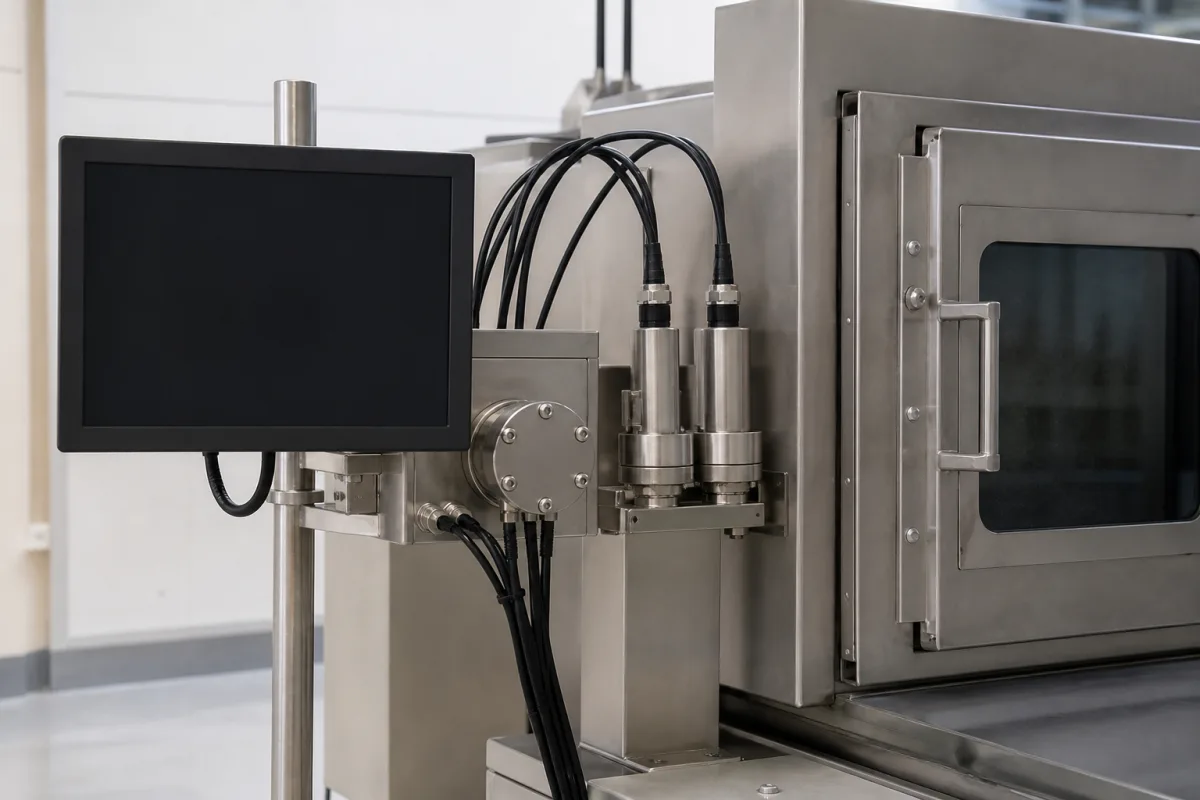
Dose monitoring system for gamma sterilisation: routine dosimeters, readers, calibration traceability and dosimeter placement in each production run
How the absorbed dose in a gamma-irradiated load is measured and recorded · dosimeter classes from about 5 % uncertainty for routine to 1 % for primary standards, PMMA, alanine and radiochromic systems and their ranges, where dosimeter sets go in a production run, and the dose-rate effect NIST found in alanine above 5 kGy
A gamma irradiator sets the dose through source activity and the time product spends in the cell; the dose actually absorbed is known only from dosimeters that travel with the product. The dose monitoring system is that chain: dosimeters of a known class, the reader that measures them, a calibration traceable to a national laboratory, and a rule for where dosimeter sets go and how often, so that every production run can be certified.
Dose measurement and monitoring for gamma (cobalt-60) radiation processing and sterilisation: routine dosimeters such as dyed and clear PMMA, alanine with EPR readout and radiochromic films, their spectrophotometric or EPR readers, calibration and traceability through reference and transfer dosimeters, and the placement of dosimeter sets in production runs. The irradiator itself, with its cell, source rack, conveyor, cobalt-60 supply and throughput, is covered on the Gamma sterilization processing line page; dosimetry of medical linear accelerators and radiotherapy planning on the Medical linear accelerator and Treatment planning stations pages.
CNFX editorial research · Sources checked October 12, 2026 · 3 sources
Four classes of dosimeter: from about 5 % for routine use to 1 % for primary standards
The IAEA's Technical Reports Series No. 409, Dosimetry for Food Irradiation, arranges dosimeters into a calibration chain: [1]
Transfer dosimeters carry dose information from a national or accredited laboratory to the irradiation facility. The calibration of a routine system must be traceable to a national laboratory, carried out on each new batch of dosimeters, and done under irradiation conditions as close as possible to those of the process, or else verified under them; performance should be audited at regular intervals, for example through the IAEA's International Dose Assurance Service. [1]
In the United States that traceability runs through NIST, which operates a postal alanine transfer service with an expanded uncertainty of less than 2 % (k = 2), using commercially made alanine pellets read by EPR, and keeps check standards irradiated to 1, 10 and 50 kGy. [3]
Ask which class each dosimeter in the system belongs to, how the routine batch is calibrated and at what dose rate, and which laboratory the calibration traces to.
02
Routine dosimeters for a sterilising dose: Red and Amber Perspex, alanine and radiochromic film
TRS-409 lists usable ranges for routine systems, and STERIS's Harwell Dosimeters line gives the functional ranges of the products it makes: [1][2]
Clear PMMA forms a broad absorption band at 250–400 nm with greatest sensitivity at 304–320 nm, and is read at 314 nm where temperature and humidity effects are smaller; TRS-409 warns that commercial clear PMMA sheet containing a UV absorber cannot be used. Dyed PMMA darkens on irradiation, is supplied in sealed pouches and is read at a wavelength set by the dye. Radiochromic films respond alike to electrons and photons and have a small temperature dependence in solid form, but must be kept from UV or fluorescent light, some from humidity changes, and their optical surfaces must not be touched or scratched. [1]
STERIS offers alanine both as loose pellets and as a tape-tab that places the pellet in a barcoded film package for traceability. [2] Editorial note: a 25 kGy sterilisation dose sits inside the ranges of Red Perspex, Amber Perspex and alanine; a product whose maximum acceptable dose is above 30 kGy needs the Red Perspex or alanine range for the high-dose position.
Give the minimum and maximum doses to be verified, the reader the plant already uses, and how long dosimeters wait between irradiation and reading.
03
Where dosimeter sets go in a run, and a 1–2 % dose-rate effect in alanine above 20 kGy
TRS-409 calls for routine dosimetry of every production run so that the operator can certify the dose, as ASTM E1204 and E1431 require, and sets out placement by operating mode: [1]
More frequent placement means less product rejected if an operational failure occurs, and dosimetry data may also be needed after mechanical failures and operational anomalies. [1]
Calibration conditions matter for alanine above about 5 kGy. NIST found that dosimeters irradiated at 1.001 Gy/s and at 5.052 Gy/s respond equally below 5 kGy, but not above; over 1995 to 2007, dosimeters given 20–30 kGy by gamma sources of 1.4 Gy/s or less read 1 % to 2 % lower than the 1 kGy comparison. NIST also notes the alanine EPR signal is linear with dose only up to about 4 kGy. [3] Editorial calculation: 25 kGy takes about 6.9 h at 1.001 Gy/s and about 1.4 h at 5.052 Gy/s.
Operating mode
Dosimeter sets
Radionuclide irradiator, continuous (shuffle-dwell, loads cannot be removed singly)
At least one process load with a dosimeter set in the chamber at all times, plus a set on the first and last load of the run [1]
One set at the start of a run; in long runs also near the middle and at the end [1]
State the operating mode, the number and position of dosimeter sets per run, the dose rate at the routine monitoring position, and the records the plant must hand over with each run.
04
What to send when specifying a dose monitoring system
Paste it into your enquiry below or into an email to a maker, then replace every bracket.
Process: [gamma / electron; continuous or batch; dose rate at monitoring position]
Doses: [minimum sterilising dose; maximum acceptable dose; routine monitoring position]
Dosimeters: [PMMA type / alanine / radiochromic film; batch size; storage]
Reader: [spectrophotometer wavelength / EPR spectrometer; calibration checks]
Traceability: [calibration laboratory; transfer dosimeters; audit service]
Records: [per-run dose certificate; data system; retention]
Explore company information and manufacturing capabilities, then discuss the scope of your project with a relevant supplier.
Share this page
Compiled and source-reviewed by the CNFX editorial team.
Each manufacturer above links to the page on that company's own website where the product is listed, with the date we checked it. How we source and review
· Page last updated 13 October 2026
Buyer questions
How accurate are routine dosimeters for radiation sterilisation?
IAEA TRS-409 gives about 5 % uncertainty (k = 1) for routine dosimeters such as PMMA and radiochromic film, against 2–3 % for reference standards. [1]
What dose range does Red Perspex cover?
STERIS gives a functional range of 5–50 kGy for Harwell Red Perspex 4034 and 1–30 kGy for Amber Perspex 3042. [2]
How many dosimeters go in a gamma production run?
In continuous operation TRS-409 asks for a dosimeter set always in the chamber plus sets on the first and last loads; in batch operation, one set per load. [1]
Does dose rate affect alanine dosimeters?
NIST found responses 1–2 % lower for 20–30 kGy given at 1.4 Gy/s or less, with the effect significant above 5 kGy. [3]
Sources and what still needs a direct check
Sources checked 2026-10-12. Dosimeter classes, routine systems and placement come from IAEA Technical Reports Series No. 409; product ranges from STERIS's Harwell Dosimeters page; transfer uncertainty and the alanine dose-rate effect from a 2008 NIST Journal of Research paper.