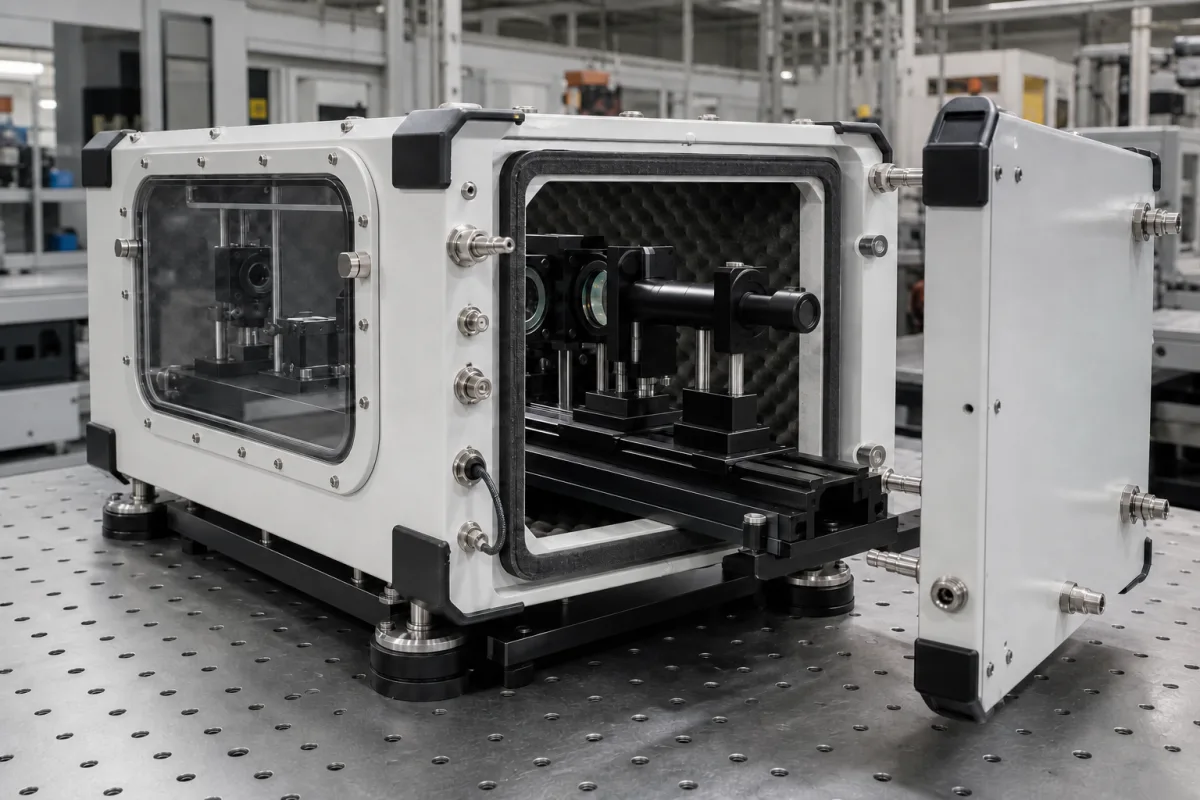
Environmental shield (sealed, purgeable enclosure for laser alignment optics): holding air temperature and pressure steady for the beam, and drying the inside to a set dew point
A sealed, windowed box over a laser alignment or beam-path setup · what the air inside does to a laser measurement, how dry it has to be kept, and how the box is purged and leak-tested
A laser alignment or measurement beam does not travel through vacuum; it travels through air whose refractive index moves with temperature, pressure and humidity, past optics that collect dust and condensation. An environmental shield is the box that goes over the bench: walls and a lid around the optics, a window to look through or pass the beam, gaskets on removable panels, and bulkhead fittings for purge gas and cables. Its job can be stated in numbers: how much the air inside may change, how dry it must be kept, and how tight the box must be to stay that way.
Enclosures and covers built around laser alignment, interferometry and beam-path optics on optical tables and machines: shield bodies, viewing or beam windows, sealing gaskets, access panels, mounting to the bench, and purge and cable ports, with the purging, drying and leak testing that keep them effective. Laser diode modules and their own housings are covered on the Laser diode module page; the measuring heads of shaft alignment systems on the Laser alignment module for shaft alignment page. Laser safety housings and interlocks are outside this page.
CNFX editorial research · Sources checked October 13, 2026 · 3 sources
Why the air around the beam matters: 1 °C, 0.4 kPa or 50 % humidity each move a laser measurement by 1 part per million
NIST's refractive-index-of-air documentation (Stone and Zimmerman) states that the significant errors in finding the index of refraction come not from the Ciddor or modified Edlén equations but from inaccurate measurement of the atmosphere, naming air temperature and pressure in particular. Each of the following produces an error of 1 × 10⁻⁶ (1 ppm) in the index, and so a length-proportional error of 1 part in 10⁶: [1]
Renishaw states that fluctuations in air temperature, pressure and relative humidity affect both the wavelength of laser light and the readings of its XL-80 interferometer, whose laser frequency is held to ±0.05 ppm over three years and whose linear measurement accuracy is ±0.5 ppm over the whole environmental range, with environmental compensation from an XC100 compensator. [2]
Editorial calculation: on NIST's figures, ±0.5 ppm corresponds to an air temperature error of only ±0.5 °C or a pressure error of ±0.2 kPa along the beam; over a 1 m beam path, 1 ppm is 1 µm. [1][2] A compensator measures the air at its sensors, so a shield that stops drafts and local heat from making the air along the beam differ from the air at the sensors protects that budget, which is the case for an enclosure even where compensation is fitted.
State the beam path length, the measurement uncertainty the setup must hold, where the temperature, pressure and humidity sensors sit, and the heat sources (lasers, motors, people) near the bench.
02
Drying the inside: purge by pressure cycling to a dew point, and prove the seal at 1.5, 2.5 or 5 psi
AGM Container Controls' NEPS1000 ADVANTAGE nitrogen purging system, sold for optical instruments and laser systems among other equipment, shows what drying an enclosure involves. It uses a single connection rather than a flow-through purge, because with an inlet and an outlet the gas follows the easiest path and can leave pockets of unconditioned gas. [3]
AGM points out that printed circuit boards, wires, rubbers and plastics inside equipment can hold hygroscopic moisture that is significant compared with the water vapour in the air, which is why its unit can monitor the dew point inside the equipment with a remote sensor and stop when the target is reached; one example it gives is a camera purged to a dew point of −40 °C during routine maintenance. [3] AGM defines dew point as the temperature to which air or gas must be cooled for condensation or frost to form, and calls it ideal for stating the quality requirement for purging an instrument or enclosure. [3]
Editorial note: for an enclosure over laser optics, this translates into three requirements on the shield itself: gaskets and window seals that hold a few psi without leaking, a purge port placed so dry gas reaches the whole volume, and as little hygroscopic material inside as the setup allows. [3]
The image above shows a shield of this kind: a white box on an optical table with a gasketed removable end panel, a bolted viewing window, foam-lined walls, and bulkhead fittings along the sides, around a rail-mounted set of optics.
AGM NEPS1000 ADVANTAGE
Published value
Purge cycle
Fill the unit with dry gas to the selected pressure, vent to zero, and repeat until the selected dew point is reached [3]
Give the internal volume, the dew point to be held, the purge gas available, the leak-test pressure the box must pass, and the number and type of bulkhead ports (gas, fibre, electrical).
03
Shield details to send
Paste it into your enquiry below or into an email to a maker, then replace every bracket.
Setup: [optics and beam path length; bench or machine; footprint]
Air stability: [measurement uncertainty; temperature and pressure limits; sensor positions]
Dryness: [dew point; purge gas; purge method]
Seal: [leak-test pressure; gaskets; window seal]
Access: [removable panels; doors]
Ports: [gas; fibre; electrical; count and thread]
Window: [material; size; coating if the beam passes through]
Explore company information and manufacturing capabilities, then discuss the scope of your project with a relevant supplier.
Share this page
Compiled and source-reviewed by the CNFX editorial team.
Each manufacturer above links to the page on that company's own website where the product is listed, with the date we checked it. How we source and review
· Page last updated 13 October 2026
Buyer questions
How much does air temperature affect a laser alignment measurement?
NIST's refractive-index documentation gives 1 ppm per 1 °C of air temperature error, and the same 1 ppm for 0.4 kPa of pressure error; over a 1 m beam path 1 ppm is 1 µm. [1]
How is a sealed optical enclosure dried?
AGM's NEPS1000 ADVANTAGE fills the enclosure with dry gas to 1.5, 2.5 or 5 psi through a single connection, vents it, and repeats until a selected dew point is reached. [3]
Does environmental compensation make an enclosure unnecessary?
Renishaw's XL-80 uses compensation to correct the laser wavelength for air temperature, pressure and humidity and is specified to ±0.5 ppm; on NIST's figures that budget equals about ±0.5 °C of air temperature, so the air along the beam has to match the sensors' air. [2][1]
Sources and what still needs a direct check
Sources checked 2026-10-13. Three sources from three publishers: NIST's Engineering Metrology Toolbox documentation on the refractive index of air, Renishaw's XL-80 laser interferometer page for its accuracy and compensation, and AGM Container Controls' NEPS1000 ADVANTAGE nitrogen purging system catalogue for purging, dew point and leak testing.