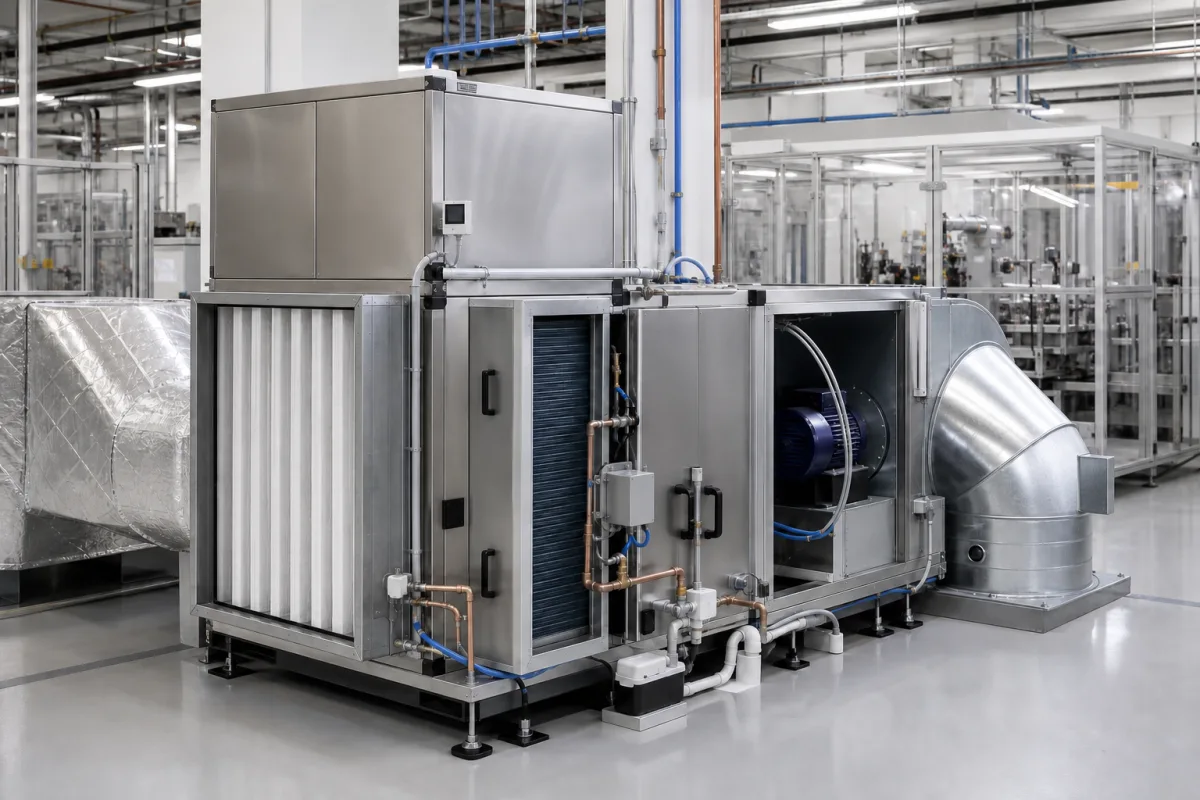
Environmental control unit (portable cooling and heating unit for tents, shelters and field facilities)
Environmental control units (ECUs) for tents, soft- and rigid-wall shelters and field facilities · 60,000 BTU/h class cooling, heat pump and electric heat at low ambient, generator sizing and inrush current, stacking and transport, and military test standards
An environmental control unit is a self-contained air conditioner, heater and ventilator on skids or wheels, ducted into a tent, soft-wall or rigid-wall shelter, trailer or temporary building, and in the field run from a generator set. Choose it by the space and climate it must hold, the power it can draw at start-up, how heat is produced when it is cold outside, and how it is moved and stored.
Portable and skid-mounted environmental control units for tents, soft-wall and rigid-wall shelters, field hospitals, command posts and temporary buildings, including heat pump and electric heat versions. Building and cleanroom air handling units are covered on the Air handling unit page; their fan modules on the Fan assembly for air handling units page; food dehydrator air circulation on its own page.
CNFX editorial research · Sources checked October 12, 2026 · 4 sources
Cooling capacity, heating at low ambient and the space served
Three 60,000 BTU/h-class units show what the figures look like. HDT's 60K Improved Environmental Control Unit (IECU), the US Army's program-of-record size, gives "60,000 BTU/H (17.6 kW)" for "soft-wall and rigid-wall shelters, trailers, and fixed facilities" using scroll compressors and microchannel coils; its SM60K version adds a heat pump with "67K BTU/H (19/6kW) additional heat capability". [1] DEW Engineering's ECU keeps "a 20 ºC to 26ºC interior temperature (in cool mode) or a minimum 10ºC interior temperature (in heat mode)" in large shelters at ambients from -19 °C to 49 °C. [2] Mainstream Engineering says one MECU "has sufficient capacity to provide thermal control to shelters as large as 1,000 square feet in ambient temperatures as high as 130°F or as low as -40°F". [3]
Editorial calculation from DEW's figures: heat pump output at 17 °F is 28,600 ÷ 55,000 = 52% of its 47 °F output; the 7,900 W of electric heat adds about 26,950 BTU/h (7,900 × 3.412), bringing the total near 55,500 BTU/h. Mainstream's 1,000 sq ft for 60,000 Btu/hr is 60 Btu/hr per square foot. [2][3]
Give the shelter type, floor area and insulation, occupants and equipment heat, the hottest and coldest ambient, and the interior temperature and humidity to hold.
02
Generator power, transport and military testing
HDT states that the IECU's "inrush current reduction permits reduced generator sizing" and that it is "Fully operational with 14 kW or higher generator sets"; the SM60K is 4 inches shorter than the program-of-record unit so two can be stacked in a tricon container, with 12 units to a 463L pallet and 8 to a tricon. [1] DEW's unit runs on 208 VAC, 3-phase, 60 Hz, weighs 241 kg, is stackable on removable wheels, and lists MIL-STD-461F EMI emissions and MIL-STD-810G environmental testing. [2]
Mainstream designs its MECU for maintenance "with common tools from standard military tool kits", with no brazing or soldering needed, and quotes an MTBF of 5,000 hours, operational availability above 95% and a 20-year storage life; it was designed to replace the FDECU, LECU and IECU. [3] Tentcool, a Chinese maker, lists ECUs of 60,000 BTU for military camps alongside tent and shelter air conditioners. [4]
State the generator size available, voltage and phase, how units travel (pallet, container, truck), and the EMI and environmental test standards the buyer requires.
03
ECU order details
Paste it into your enquiry below or into an email to a maker, then replace every bracket.
1 company lists this product among what they make. Company figures are quoted from each
company's own website; every card states where the relationship came from.
Taizhou Tentcool Electrical Appliance Co., Ltd.
Manufacturing site to be confirmed for the order
Lists ECU environmental control units, including 60,000 BTU units for military camps, with tent, shelter and cabinet air conditioners.
Explore company information and manufacturing capabilities, then discuss the scope of your project with a relevant supplier.
Share this page
Compiled and source-reviewed by the CNFX editorial team.
Each manufacturer above links to the page on that company's own website where the product is listed, with the date we checked it. How we source and review
· Page last updated 13 October 2026
Buyer questions
How big a shelter can one 60,000 BTU/h ECU serve?
Mainstream says its MECU can serve shelters as large as 1,000 square feet from -40 °F to 130 °F. [3]
Why does inrush current matter?
HDT says reduced inrush lets the IECU run on smaller generators, from 14 kW. [1]
How does an ECU heat in cold weather?
DEW's unit combines a heat pump, whose output falls at low ambient, with 7,900 W of electric resistance heat. [2]
What tests do military ECUs pass?
DEW lists MIL-STD-461F emissions and MIL-STD-810G environmental testing. [2]
Sources and what still needs a direct check
Sources checked 2026-10-12. HDT Global publishes its 60K IECU page; DEW Engineering and Mainstream Engineering publish ECU data sheets; Tentcool lists its ECU range.