EtherCAT controllers (MainDevice/master) for motion control, I/O and test systems · cycle time, synchronization jitter and distributed clocks, number of devices and axes, topology and cable redundancy, Hot Connect, servo drive profiles, Safety over EtherCAT
An EtherCAT controller — the network's MainDevice, also called the master — runs the control program and exchanges process data with drives, I/O and sensors over EtherCAT, a real-time industrial Ethernet. It may be an industrial PC, an embedded ARM computer or a PC card. Ask three things first: how many axes and devices it must handle at what cycle time; what synchronization accuracy coordinated motion needs; and how the network must survive cable breaks or modules being swapped during operation.
EtherCAT MainDevice (master) controllers — industrial and embedded PCs, motion controllers, PLCs and PC interface cards running an EtherCAT master stack — with configuration software. EtherCAT SubDevice (slave) controllers and chips, servo drives, I/O modules, couplers and cables are outside this page except where compared.
CNFX editorial research · Sources checked October 12, 2026 · 4 sources
Set cycle time, synchronization and number of axes
The EtherCAT Technology Group (ETG) describes EtherCAT as a real-time industrial Ethernet originally developed by Beckhoff Automation and disclosed in IEC 61158, designed for short cycle times (100 µs or less), low synchronization jitter (1 µs or less) and low hardware cost. The MainDevice uses a standard Ethernet MAC without an additional communication processor, so it can be built on any hardware with an Ethernet port, sending one frame of output data by DMA and copying back the returning input data. Distributed clocks synchronise every SubDevice to a reference clock in hardware, compensating propagation delay, so system jitter is significantly below 1 µs — important where multiple servo axes move in coordination — and they relieve the MainDevice of strict frame-timing requirements. Device profiles include a servo drive profile over EtherCAT (SoE) according to IEC 61491-7-204, as ETG lists it. [1]
Editorial calculation: a 100 µs cycle is 10,000 updates per second for every axis on the segment; at a 1 ms cycle the same controller updates 1,000 times per second. Ask the supplier which cycle time it guarantees for your number of axes and I/O points, since the controller's CPU load and stack, not only the network, set the limit. [1]
Not every MainDevice implements every EtherCAT feature. ETG's directive ETG.1500 (EtherCAT Master Classes, version 1.0.2, 2016) defines Class A, a standard MainDevice, and Class B, a minimum MainDevice. ETG says each implementation should aim for Class A and meet at least Class B only where resources prohibit, for example on embedded systems. Optional functions such as redundancy are described in separate Feature Packs. [2]
acontis, a maker of EtherCAT MainDevice software, publishes its feature table against ETG.1500. It marks Distributed Clock support, among other DC features, as Class A only, along with VLAN tagging. Both classes include cyclic process data exchange with multiple update rates, online scanning and reading of the ENI network configuration file, CoE SDO transfers, EoE, FoE and SoE services, and error handling via the working counter. [3] Ask a controller supplier which ETG.1500 class its MainDevice meets, and which Feature Packs it adds, before relying on distributed clocks or redundancy.
Give the supplier the number of servo axes and I/O points, required cycle time and synchronization accuracy, motion functions (interpolation, CNC, robotics), programming environment (e.g. IEC 61131-3/CODESYS), master stack, number of EtherCAT ports and redundancy, other interfaces (Ethernet, fieldbus, OPC UA), operating system, Safety over EtherCAT needs, supply voltage, operating temperature and mounting, and quantity.
02
Plan topology, redundancy, diagnostics and safety
ETG says EtherCAT supports line, tree, star and daisy-chain topologies with hundreds of nodes and no cascaded switches, up to 65,535 devices per segment, and standard industrial Ethernet cable up to 100 m between nodes in 100BASE-TX mode, with EtherCAT P adding 24 V power over the same four-wire cable. Hot Connect lets segments or nodes be connected and disconnected in operation. Cable redundancy needs only a cable from the last node back to a second port on the MainDevice, forming a ring; a cable break or node failure is detected and resolved in under 15 µs, so at most one cycle is disturbed, and MainDevice redundancy with hot standby is also possible. Each SubDevice checks frames by checksum, a working counter confirms data consistency, and frames can be read with standard tools such as Wireshark. Safety over EtherCAT was developed to IEC 61508, standardised in IEC 61784-3 and suits applications up to SIL 3. [1]
Editorial note: redundancy, Hot Connect and Safety over EtherCAT depend on the master stack and licences offered; confirm each feature is supported by the specific controller and software, not only by the protocol.
03
Compare what suppliers offer
Suppliers linked to this page list EtherCAT controllers or master products; each card links to the page reviewed.
Listings include an ARM industrial computer running an open-source EtherCAT master with CODESYS for multi-axis motion, and EtherCAT master products among PC boards for data acquisition and motion control; ask each for tested cycle times, axis counts and supported features.
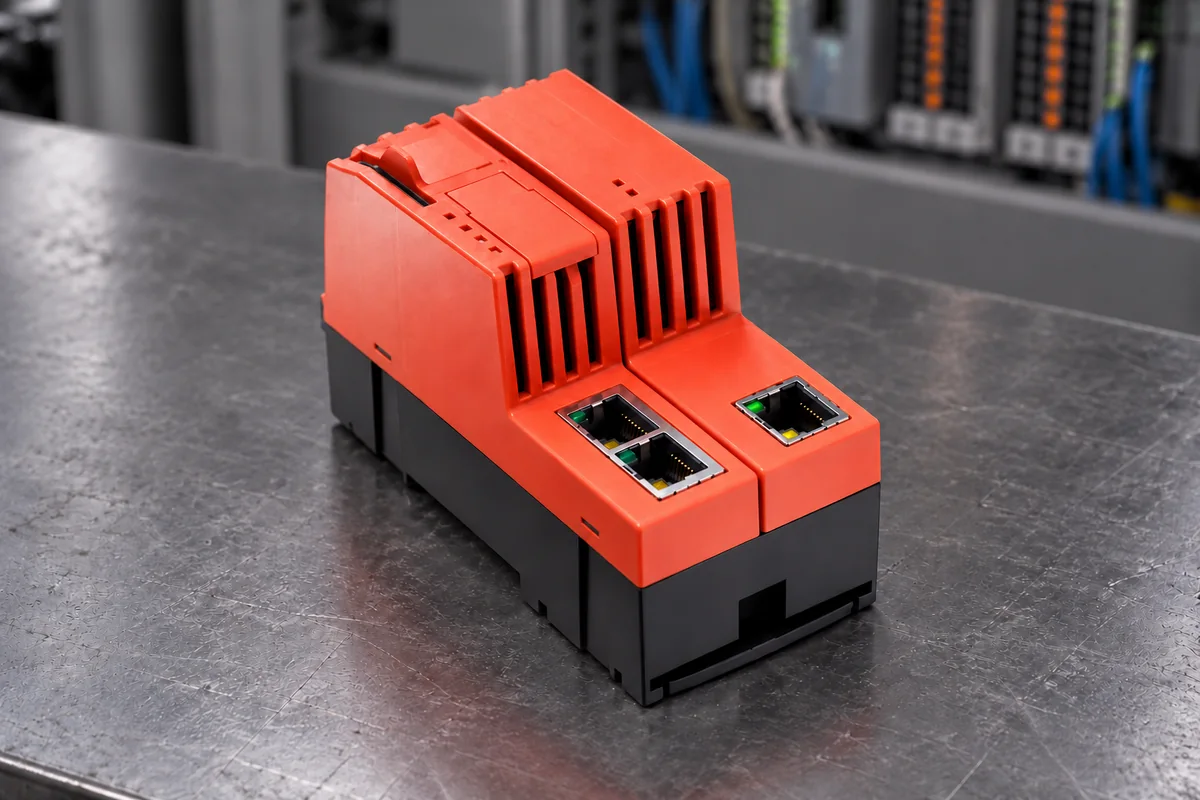
As one published example of a DIN-rail MainDevice, Beckhoff Automation's CX9240 Embedded PC has a 1.2 GHz four-core Arm Cortex-A53 CPU, 2 GB LPDDR4 RAM, two independent RJ45 10/100/1000 Mbit/s Ethernet ports, four USB 3.0 ports and a DisplayPort, boots Beckhoff RT Linux from a microSD card of at least 16 GB, and runs the TwinCAT 3 runtime for PLC and motion control. Its I/O connection detects E-bus or K-bus terminals automatically, and the optional interface can be ordered ex factory as CX9240-M112 with 2 × EtherCAT master interface or as CX9240-B110 EtherCAT slave interface. Beckhoff lists a 24 V DC (−15%/+20%) electrically isolated supply, 7 W maximum consumption (12 W while the integrated 1-second UPS charges), 2 A for the E-bus/K-bus, 84 × 100 × 91 mm, about 650 g, −25 to +60 °C operation, IP20, EMC to EN 61000-6-2/-6-4 and CE and UL markings. TwinCAT 3 licences are ordered separately. [4]
04
Trace the controller and network
This is a functional reference built from the sources cited; it is not one maker's design.
Fill the specification fields with values for your project
An EtherCAT controller quotation needs values for your project. The table explains each field, gives published values where a reviewed source states them, and says what to obtain from the supplier.
Explore company information and manufacturing capabilities, then discuss the scope of your project with a relevant supplier.
Share this page
Compiled and source-reviewed by the CNFX editorial team.
Published product pages show what a company offers, not tested performance. Confirm the legal seller, factory and scope for your order. How we source and review
· Page last updated 13 October 2026
Buyer questions
How fast is EtherCAT?
ETG says it was designed for cycle times of 100 µs or less with synchronization jitter of 1 µs or less. [1]
No. ETG says a MainDevice uses a standard Ethernet MAC without an additional communication processor. [1]
What are EtherCAT MainDevice classes?
ETG.1500 defines Class A (standard MainDevice) and Class B (minimum MainDevice), with optional Feature Packs such as redundancy. [2]
Does every EtherCAT master support distributed clocks?
No. In acontis's ETG.1500 feature table, Distributed Clock support is listed for Class A but not Class B. [3]
Does an embedded PC need an extra card to act as EtherCAT master?
It depends on the model: Beckhoff's CX9240 can be ordered with the CX9240-M112 option, 2 × EtherCAT master interface, besides its two Gigabit Ethernet ports and E-bus/K-bus terminal connection. [4]
Sources and what still needs a direct check
Sources checked 2026-10-12. The EtherCAT Technology Group is the organisation that maintains and promotes EtherCAT. ETG's ETG.1500 page defines MainDevice classes, acontis's feature table shows how one software maker maps features to them, and Beckhoff's CX9240 data page gives the hardware values of one embedded MainDevice.