Fieldbus protocol converters · Modbus RTU and Modbus TCP to PROFINET, EtherCAT or EtherNet/IP, unit identifier routing and serial addresses 1–247, one request at a time on serial lines, process-data byte limits, slaves per port, function codes
A fieldbus gateway, as covered here, is a DIN-rail protocol converter that joins two industrial networks at the field and controller level, for example Modbus RTU or Modbus TCP devices to a PROFINET, EtherCAT or EtherNet/IP controller, by mapping data from one protocol into the cyclic process data of the other. Ask three things first: which protocol and role (master or slave, controller or device) each side needs, how much data and how many devices the gateway must handle, and how it routes and paces requests to serial devices.
Protocol converters between fieldbuses and industrial Ethernet protocols (Modbus RTU/TCP, PROFINET, EtherCAT, EtherNet/IP, CAN and similar). Industrial IoT and edge gateways that send data to MQTT, OPC UA or cloud platforms (a separate product page), serial device servers sold as such, routers and PLCs are outside this page except where compared.
CNFX editorial research · Sources checked October 12, 2026 · 4 sources
Route requests to serial devices behind the gateway
The Modbus Organization's implementation guide for Modbus messaging on TCP/IP explains that the serial-line slave address is replaced in Modbus TCP by a one-byte Unit Identifier, used to reach devices through bridges, routers and gateways that use one IP address for more than one independent Modbus unit: the destination IP address identifies the gateway, and the gateway uses the Unit Identifier to forward the request to the right slave on the serial sub-network. Serial-line slave addresses run from 1 to 247, with 0 used for broadcast, and Modbus TCP messages go to registered TCP port 502. [1]
The same guide notes that on a serial line a client must send one request at a time and wait for the answer, while on Modbus TCP more than one request can be sent without waiting; the Modbus TCP to serial line gateway is in charge of reconciling these two behaviours. [1]
Editorial note: ask the supplier how the gateway queues requests to each serial port, its response timeout and retry settings, and what it reports to the controller when a serial device does not answer.
Give the supplier both protocols and the role on each side (for example Modbus RTU master downstream, PROFINET IO device upstream), the controller and its configuration file needs (GSDML, ESI or EDS), number of serial ports and devices, baud rate and framing, registers or coils to map and their update rate, total process-data size, power supply, mounting, temperature range, EMC requirements and certifications.
02
Size the data map and device count
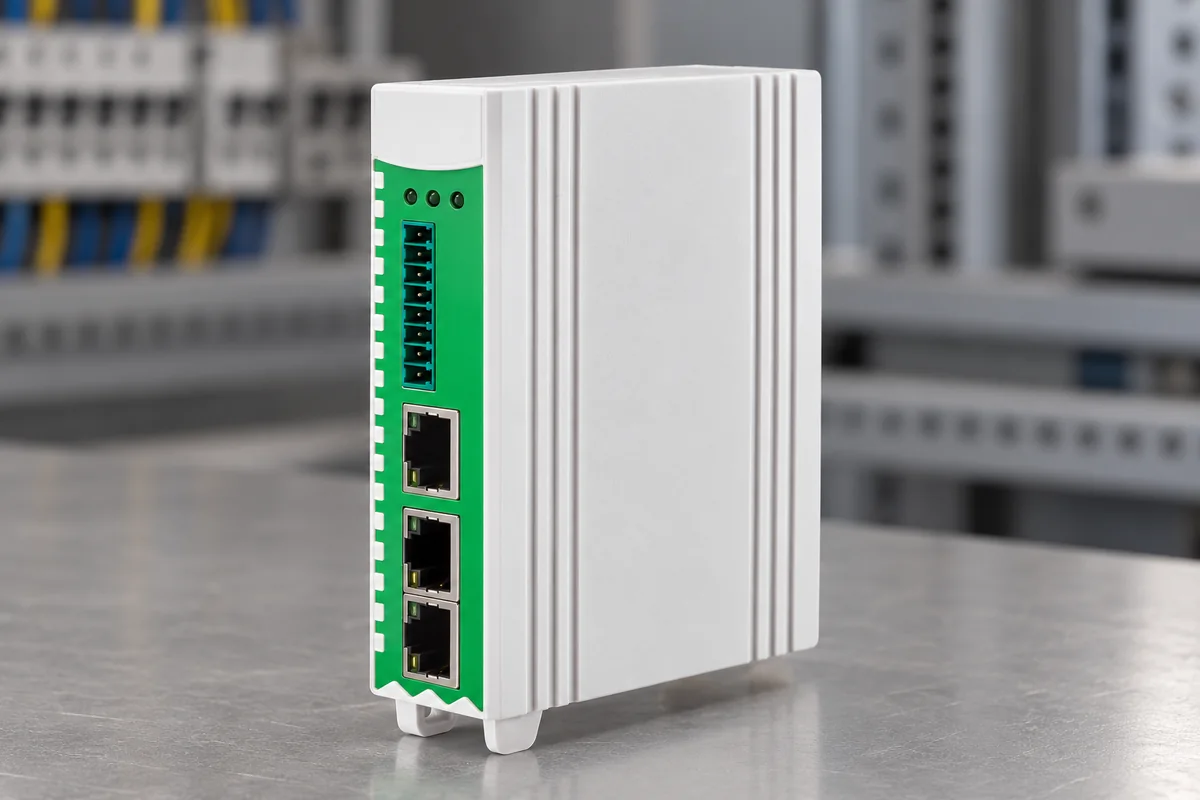
BLIIoT, a gateway maker linked to this page, lists its BL122 converter as taking Modbus RTU and Modbus TCP downstream and PROFINET upstream, with three 10/100 Mbit/s RJ45 ports supporting cascading, two RS485/RS232 ports and one RS232 port. It states baud rates of 2,400 to 230,400; RTU and TCP master or slave modes; function codes 01H–06H, 0FH and 10H; up to 31 slave devices per serial port; input plus output data of no more than 496 bytes, with a GSDML file; DC 12–36 V supply; −30 to 55 °C; IP30; DIN-rail mounting; and EMC to IEC 61000-4-2, -4 and -5 at level 3. [2]
Modbus input and holding registers are 16-bit words. [1] Editorial calculation: at 2 bytes per register, a 496-byte total budget holds at most 496 / 2 = 248 registers split between inputs and outputs. Reading 20 registers from each of 10 power meters uses 200 × 2 = 400 bytes, leaving 96 bytes for outputs. Two RS485 ports at 31 slaves each reach up to 62 devices, well within the 1–247 Modbus address range per line. Meter count and register count are assumed examples; check the gateway's mapping tool for overheads such as status bytes.
A second maker's sheet gives a larger data budget and different limits. Moxa's MGate 5103 series data sheet lists a PROFINET IO device gateway with one serial port (RS-232/422/485, 50 bps to 921.6 kbps, 2 kV isolation) and two 10/100 Ethernet ports, acting as Modbus RTU/ASCII master or slave and Modbus TCP client or server with function codes 1, 2, 3, 4, 5, 6, 15, 16 and 23, up to 128 commands, 16 client and 32 server connections, and 512 bytes each of input and output data for Modbus and PROFINET (one IO controller connection for read/write); its EtherNet/IP adapter side carries 496 bytes each way. Power is 12–48 V DC at 455 mA at 12 V, the metal IP30 housing measures 36 × 105 × 140 mm and weighs 507 g, operating range is 0–60 °C (−40 to 75 °C for the -T model), and MTBF is 859,422 hours to Telcordia SR332. [3]
Editorial calculation: Moxa's 512-byte PROFINET input image holds 256 16-bit Modbus registers (512 ÷ 2), eight more than the 248 a 496-byte budget allows; and 455 mA at 12 V is about 5.5 W of supply power to budget in the panel. [3][1]
03
Compare what suppliers offer
Suppliers linked to this page list fieldbus or protocol gateways; each card links to the page reviewed.
Listings include Modbus to PROFINET, EtherCAT and EtherNet/IP converters, PROFINET and CAN gateways with industrial bus converters, and Modbus RTU to TCP gateways. Ask each for the protocols and roles supported, the data limit, the configuration tool and the controller description file.
04
Compare a four-port gateway's data and command limits
ProSoft Technology's product page for the PLX31-PND-MBS4 describes a stand-alone DIN-rail gateway between a PROFINET controller and Modbus serial (RTU and ASCII) devices, with four serial ports (RS232, RS422 and RS485), each set as Modbus master or slave, and the PROFINET side as a Class A device. It lists PROFINET I/O data of 1,440 bytes in and 1,440 bytes out with cyclic real-time and acyclic exchange, up to 100 commands per master port, up to 10,000 16-bit registers, node addresses 1 to 247, baud rates from 110 baud to 115.2 kbps, error codes for each command and a slave status list for each serial port. Power is 10 to 36 VDC (610 mA maximum) and operating temperature −25 to 70 °C. [4]
Editorial calculation: 1,440 bytes is 720 16-bit registers each way (1,440 ÷ 2), against 512 bytes each way on the Moxa MGate 5103 and the 496-byte combined limit of the converter described above. [4][3][2] The per-command error codes and per-port slave status list are the data to ask about when a serial device stops answering. [4]
05
Trace the gateway components
This is a functional reference built from the sources cited; it is not one maker's specification.
Fill the specification fields with values for your network
A fieldbus gateway quotation needs values for your network. The table explains each field, gives published values where a reviewed source states them, and says what to obtain from the supplier.
Explore company information and manufacturing capabilities, then discuss the scope of your project with a relevant supplier.
Share this page
Compiled and source-reviewed by the CNFX editorial team.
Published product pages show what a company offers, not tested performance. Confirm the legal seller, factory and scope for your order. How we source and review
· Page last updated 13 October 2026
Buyer questions
How does a Modbus TCP gateway reach serial devices?
The Modbus TCP guide says the IP address identifies the gateway and the Unit Identifier carries the serial slave address (1–247) of the target device. [1]
Why can serial devices respond slowly through a gateway?
A serial-line client sends one request at a time, while Modbus TCP allows more than one outstanding; the gateway has to reconcile them. [1]
How much data can a Modbus to PROFINET converter carry?
It depends on the model; BLIIoT's BL122 lists input plus output of no more than 496 bytes. [2]
How much process data can a Modbus-to-PROFINET gateway carry?
It depends on the model: Moxa's MGate 5103 lists 512 bytes of input and 512 bytes of output for Modbus and PROFINET, while BLIIoT's BL122 lists 496 bytes for input and output combined. [3][2]
Can one Modbus-to-PROFINET gateway serve more than one serial line?
Yes. ProSoft's PLX31-PND-MBS4 has four serial ports, each set as Modbus master or slave, and carries 1,440 bytes of PROFINET input and 1,440 bytes of output. [4]
Sources and what still needs a direct check
Sources checked 2026-10-12. The Modbus Organization publishes the Modbus specifications (its guide is cited from an Internet Archive copy because modbus.org blocked automated access); BLIIoT is a gateway maker describing its own converter.