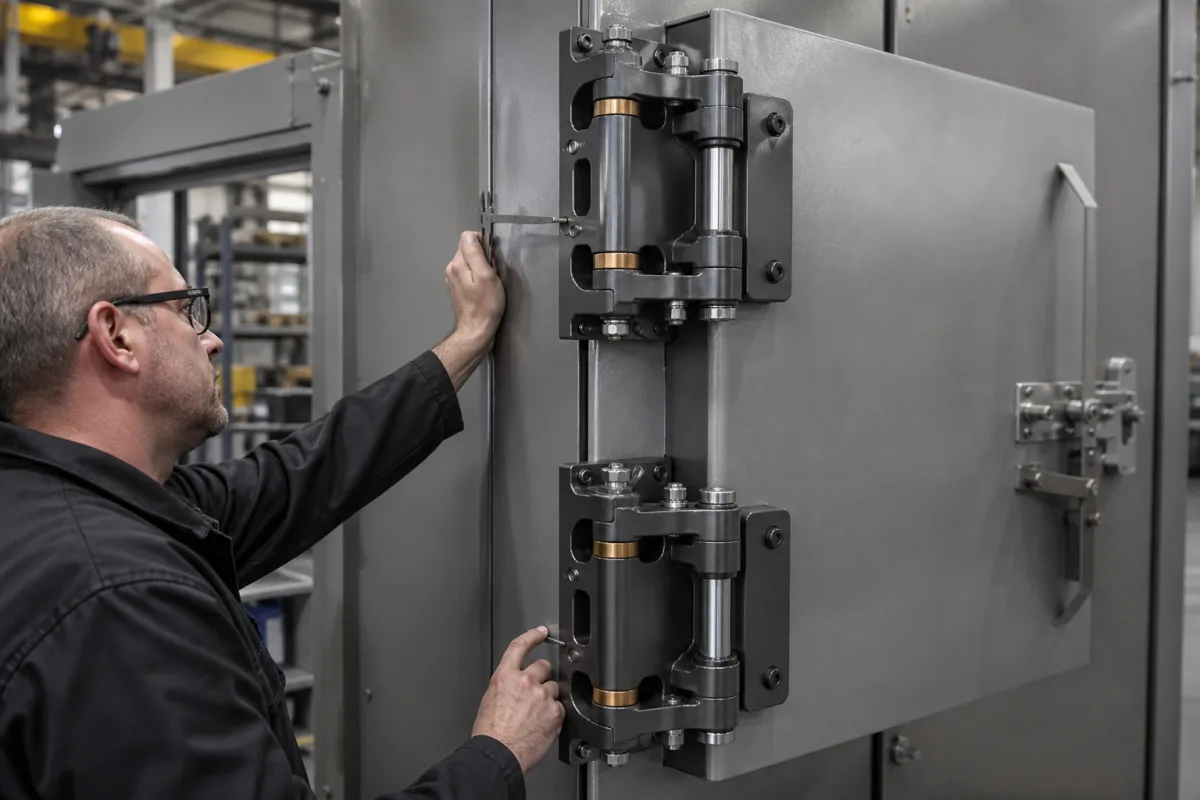
Heavy-duty pin hinge with bronze bushings for steel doors and lids: rating it against vertical load, pull-out force and hinge spacing
The hinge itself, bought as a component for a heavy steel door or lid · how door weight splits into vertical load and pull-out force between two hinges, why one hinge can end up carrying the whole door, how hinge ratings fall as doors get wider, and what bronze bushings and thrust washers add
A heavy hinge is rated by a single number, but the door it carries loads it in two directions. The weight pulls straight down, and because the door's centre of gravity hangs out beyond the hinge line, the same weight tries to pull the top hinge away from the frame and push the bottom one into it. How far apart the hinges are, how wide the door is, and whether both hinges actually share the load decide whether that one number is enough.
Heavy-duty pin hinges bought as components for steel equipment doors, enclosure doors, machine-guard panels and lids: bolt-on and weld-on leaves, steel or stainless pins, and bronze bushings and thrust washers, rated by vertical load, horizontal pull-out force and hinge spacing. Hygienic tank manway covers with their own hinges are covered on the Sanitary manway page and process-vessel manholes with hinged and davit covers on the Pressure vessel manway assembly page; complete control-enclosure doors on the Enclosure door assembly page; hinged machine-guard doors with interlocks on the Hinged access door for machine guarding page; floating hinges for vacuum-chamber doors on the Vacuum chamber door hinge system page; furniture hinges on the Furniture hinge page.
CNFX editorial research · Sources checked October 12, 2026 · 5 sources
Door weight becomes two loads on each hinge: straight down, and a pull-out moment from the overhanging centre of gravity
John Bates of the enclosure-hardware maker EMKA, writing in Machine Design, breaks the load on a pair of vertically aligned hinges into parts that a single tensile test of one hinge does not capture: [1]
In the extreme case Bates describes, a gap between the two halves of the upper hinge means the lower hinge takes all of the vertical force. With lift-off hinges the worst result of a fitting error is that one hinge carries the whole door; with captive hinges the forced misalignment cannot relieve itself and can permanently deform the hinges. Softer hinge materials such as glass-reinforced nylon can share load more evenly for that reason. [1]
Editorial calculation with EMKA's moment equation, taking the lower hinge as the pivot: a 100 kg steel door 1,000 mm wide with its centre of gravity at mid-width gives M = 981 N × 0.5 m ≈ 490 N·m; with the hinges 1,450 mm apart the upper hinge sees about 490 ÷ 1.45 ≈ 338 N of horizontal pull. The vertical load is about 490 N per hinge if shared equally, and 981 N on one hinge in the case where the other carries nothing.
Load on the hinges
How EMKA states it
What it means for the hinge
Vertical
W = (door mass + mass hung on the door) × g, shared as W = F_A + F_B [1]
Equal sharing needs hinges made and fitted exactly to nominal; otherwise the load shifts [1]
Horizontal, in the plane of the door
M = W × Y, Y being the distance from the door's centre of gravity to the hinge line; reacted as M = Z_C × C + Z_D × D [1]
Heavier and wider doors raise it; wider hinge spacing lowers it; a third hinge at the pivot point takes little of it [1]
Out of plane, from a door seal
About 40 lb per foot of compressed foam gasket; a 6 × 3 ft door needs about 720 lb to seal, a bubble gasket about 180 lb [1]
Can bend the door away from the seal; multiple hinges and multipoint latching counter it [1]
Size each hinge for the full door weight plus anything hung on it unless the fitting tolerance guarantees load sharing, and add the horizontal pull and any gasket force.
02
Wider doors and shorter hinge gaps: how a 160 kg hinge rating falls to 125 kg
SIMONSWERK publishes load value tables for its single-axis door hinges. Its reference case is a 1,000 × 2,000 mm leaf on two hinges, with the hinges 250 mm from the top and bottom; the text gives a 1,450 mm hinge gap for that reference, while the table pairs a 2,000 mm door with a 1,500 mm gap. Part of the table for the 160 kg hinge class: [2]
The 80 kg class follows the same pattern, falling to 62 kg at 1,200 mm wide on a 1,500 mm gap. SIMONSWERK writes that the hinge load “can often be several times the door weight”, that ratings fall from 100 cm door width at unchanged spacing, and that for doors wider than 1,000 mm a third hinge helps the rating only if it sits in the upper third, for which it recommends reducing the specified 350 mm spacing to 250 mm depending on knuckle length; a third hinge does not necessarily raise the stated rating. For swing-door operators it recommends four hinges in two pairs no more than 350 mm apart, and door stops at 75 % of the door width from the hinge axis. [2][3]
These are architectural door hinges, but the reduction follows the moment that EMKA describes: a wider door moves the centre of gravity further from the hinge line, and a shorter gap leaves less lever to react it. [1][2]
Ask the hinge maker for the reference door width, height and hinge gap behind a rating, and for derated values at your own door dimensions.
03
Pin, bronze sleeves and thrust washers: what the published ratings of bushed hinges cover
Two published bronze-bushed hinges show what the rating on a heavy hinge does and does not say:
MiniTec's listing does not say whether 3,500 N applies to one hinge or a pair, or in which direction; the weld-on listing states its figure as per pair of hinges on one door, so adding a third hinge does not raise it. [4][5] Editorial note: 3,500 N is about 357 kg-force; set against EMKA's case of one hinge taking the full door, a per-hinge reading and a per-pair reading lead to different door masses, so the basis needs confirming before a hinge is chosen. [1]
Hinge
Construction
Published rating
MiniTec 21.2034 heavy-duty hinge, bolt-on to aluminium profile
Zinc-plated steel, Ø15 mm steel pin, Ø15 mm bronze bushings, M8 screws; rotates through 180° and does not lock; 0.679 kg [4]
High-load weld-on hinge with bronze bearings, 5 × 5 in and 6 × 6 in
Unfinished mild-steel leaf and barrel, stainless pin, two oil-impregnated bronze sleeves and two bronze thrust washers, grease fitting [5]
800 lb or 1,200 lb per pair; ratings assume two hinges per door and are not additive [5]
State pin diameter and material, bushing and thrust-washer material, lubrication point, and whether the leaves are welded or bolted; ask whether the rating is per hinge or per pair and in which load direction.
04
What to send when ordering heavy-duty hinges
Paste it into your enquiry below or into an email to a maker, then replace every bracket.
Door or lid: [mass incl. anything mounted on it; width; height; centre of gravity]
Hinges: [number per door; gap between them; position from top and bottom]
Mounting: [bolt-on to profile / bolt-on to plate / weld-on; frame material]
Bearing: [pin material and diameter; bronze bushings; thrust washers; grease fitting]
Loads: [gasket force; door closer or operator; stop position; shock]
Environment: [outdoor; washdown; temperature; finish]
Explore company information and manufacturing capabilities, then discuss the scope of your project with a relevant supplier.
Share this page
Compiled and source-reviewed by the CNFX editorial team.
Each manufacturer above links to the page on that company's own website where the product is listed, with the date we checked it. How we source and review
· Page last updated 13 October 2026
Buyer questions
Does each hinge carry half the door weight?
Only if both are made and fitted exactly to nominal; EMKA shows a case where a gap in the upper hinge leaves the lower hinge carrying all the vertical force. [1]
Why does a wider door need a bigger hinge?
The centre of gravity sits further from the hinge line, raising the moment M = W × Y that the hinges resist as horizontal loads; wider hinge spacing reduces it. [1]
How much does door width reduce a hinge rating?
In SIMONSWERK's 160 kg table, a door 1,200 mm wide on a 1,500 mm hinge gap is rated 125 kg. [2]
Is a heavy hinge rating per hinge or per pair?
It varies: one weld-on bronze-bearing hinge is rated 800 or 1,200 lb per pair, not additive; MiniTec lists 3,500 N without stating the basis. [5][4]
Sources and what still needs a direct check
Sources checked 2026-10-12. Load paths come from an EMKA engineer's analysis in Machine Design; width and spacing derating from SIMONSWERK's load value tables for 160 kg and 80 kg hinges; bushed hinge ratings from MiniTec's catalogue page and a HardwareSource product listing.