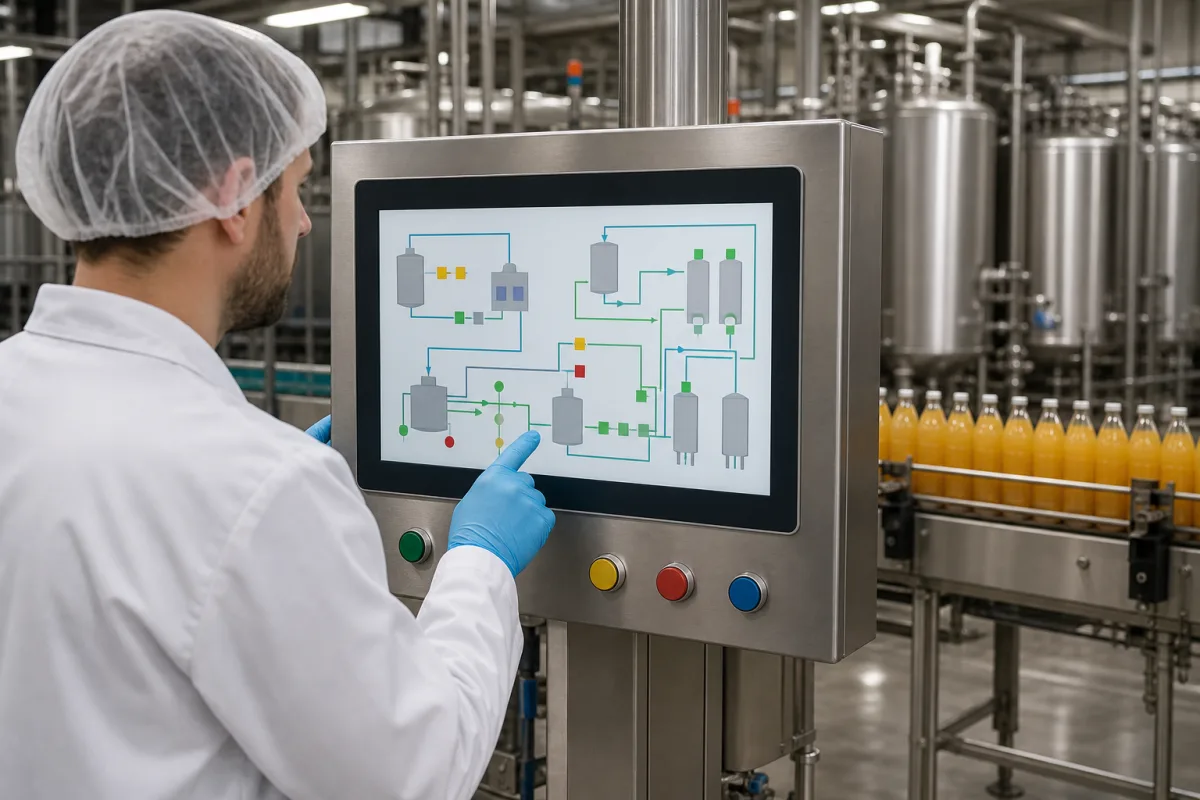
Stainless steel washdown HMI for food and beverage lines
Washdown operator terminals · IP66 and IP69K stainless enclosures, M12 sealed connectors, cleanable design for food and beverage lines
A stainless steel washdown HMI is the operator screen of a food, beverage or pharmaceutical line packaged for wet cleaning: a touch display sealed into a stainless steel housing or bezel, with sealed cable exits or M12 connectors, mounted on a pedestal, yoke or wall arm next to the machine. Ask three things first: which ingress rating your cleaning regime needs (IP66 hose-down or IP69K high-pressure hot wash), how the enclosure, connectors and mounting avoid dirt traps, and whether the unit's temperature, power and interfaces suit the line controller.
Operator touch terminals and panel PCs in stainless steel, IP66 or IP69K washdown enclosures for food, beverage, dairy and pharmaceutical lines, including pedestal and yoke mounting and sealed cable exits. Standard panel-mount touch panels and text panels for control cabinets are covered on the Human-machine interface (HMI) page. Hazardous-area operator stations, office monitors and the PLCs behind the screen are outside this page.
CNFX editorial research · Sources checked October 12, 2026 · 6 sources
Hope Industrial Systems' enclosure-rating guide maps NEMA 4 and 4X to IP65/IP66 and NEMA 12 to IP54, and advises a NEMA 4X display, IP65/IP66 sealed and built of anti-corrosive stainless steel, where a monitor sees prolonged exposure to liquids or corrosive chemicals during operation or cleaning. For high-pressure or high-temperature washing it advises a NEMA 4X display that is also rated IP69/IP69K, sealed for close-range high-pressure, high-temperature spray and hygienic cleaning. [1]
The guide notes that NEMA and IP ratings are self-certified by manufacturers unless an outside body tests them, and that Hope has its products certified by Underwriters Laboratories to UL 50E. [1] In a separate note Hope says its standard IP65/IP66, NEMA 4/4X monitors suit heavy washdowns in factories, and that it offers UL-certified IP69K models, in 19.5-inch and 23.8-inch widescreen sizes with stainless enclosures or edge-to-edge glass, for plants that sanitise with hot, pressurised water. [2]
Maple Systems' IP-rating note describes IP65 as protection against water from a 6.3 mm nozzle and IP66 against powerful jets from a 12.5 mm nozzle, from any direction. [5] Editorial note: IP69K alone does not make an enclosure easy to clean; ask for the rating of the complete assembly including cable glands, mounting yoke and any keyboard, and for the test certificate rather than a self-declaration.
Give the supplier the cleaning method (hose-down, high-pressure hot water, foam, chemicals and their concentrations), the required IP and NEMA ratings and who certifies them, screen size and touch type for gloved use, mounting (pedestal, yoke, wall arm, panel), cable entries or M12 connectors, the line controller and protocol, power supply, ambient temperature, and stainless grade.
02
Design the enclosure, connectors and mounting for cleaning
FDA's current good manufacturing practice rule for human food, 21 CFR 117.40(c), requires equipment in areas where food is manufactured, processed, packed or held that does not contact food to be constructed so that it can be kept in a clean and sanitary condition, and 117.40(a)(3) requires equipment to be installed so as to make cleaning and maintenance of the equipment and adjacent spaces easier. [6]
Maple Systems' PC8116AP shows how one maker packages a washdown terminal: a 15.6-inch 1366 × 768 projected-capacitive touch display at 400 cd/m², a 304 stainless steel chassis rated IP66/IP69K, M12 connectors for 12/24 VDC power, two Ethernet ports, USB and serial lines, 25.9 W input power, 0–50 °C operating and −20 to 80 °C storage temperature, 20–90% relative humidity at 40 °C non-condensing, VESA 100 × 100 mm mounting and a weight of about 13.2 kg. [3]
Maple Systems' stainless range lists 10.1 to 24.5-inch capacitive screens, SUS304 stainless front bezels or 316 stainless chassis, and fully enclosed versions with M12 connectors for hygienic areas. [4] Editorial note: a panel-mount bezel keeps only the front at IP69K while the rear sits inside a cabinet; a fully enclosed unit on a pedestal exposes every face and cable exit to the wash, so specify which faces must meet the rating.
03
Panel-mount HMI resellers: enclosure drawings, stainless grade and rating certificates to request
The companies linked to this product list general panel-mount HMIs or resell branded panels. Ask any supplier for the enclosure drawing, stainless grade, rating certificate for the complete assembly and the cleaning chemicals it was tested with.
Explore company information and manufacturing capabilities, then discuss the scope of your project with a relevant supplier.
Share this page
Compiled and source-reviewed by the CNFX editorial team.
Each manufacturer above links to the page on that company's own website where the product is listed, with the date we checked it. How we source and review
· Page last updated 13 October 2026
Buyer questions
Does a washdown HMI need IP69K?
Hope Industrial advises IP65/IP66 NEMA 4X stainless units for wet or corrosive cleaning and IP69/IP69K only for close-range high-pressure, high-temperature spray. [1]
What does FDA require of equipment that does not touch food?
21 CFR 117.40(c) requires it to be constructed so it can be kept clean and sanitary. [6]
What does a stainless washdown terminal specify?
Maple Systems' PC8116AP lists a 304 stainless chassis, IP66/IP69K, M12 connectors, 12/24 VDC and 0–50 °C operation. [3]
Sources and what still needs a direct check
Sources checked 2026-10-12. Hope Industrial Systems and Maple Systems are makers of industrial displays and panel PCs describing ratings and their own products; 21 CFR 117.40 is the US FDA regulation for food plant equipment.