Industry-Verified Manufacturing Data (2026)

Holding Section

Based on aggregated insights from multiple verified factory profiles within the CNFX directory, the standard Holding Section used in the Beverage Manufacturing sector typically supports operational capacities ranging from standard industrial configurations to heavy-duty production requirements.

Technical Definition & Core Assembly

A canonical Holding Section is characterized by the integration of Insulated Enclosure and Temperature Control System. In industrial production environments, manufacturers listed on CNFX commonly emphasize Stainless Steel (AISI 304/316) construction to support stable, high-cycle operation across diverse manufacturing scenarios.

A critical component within an integrated pasteurization system designed to maintain beverages at a precise, elevated temperature for a predetermined duration to ensure microbial safety.

Product Specifications

Technical details and manufacturing context for Holding Section

Definition
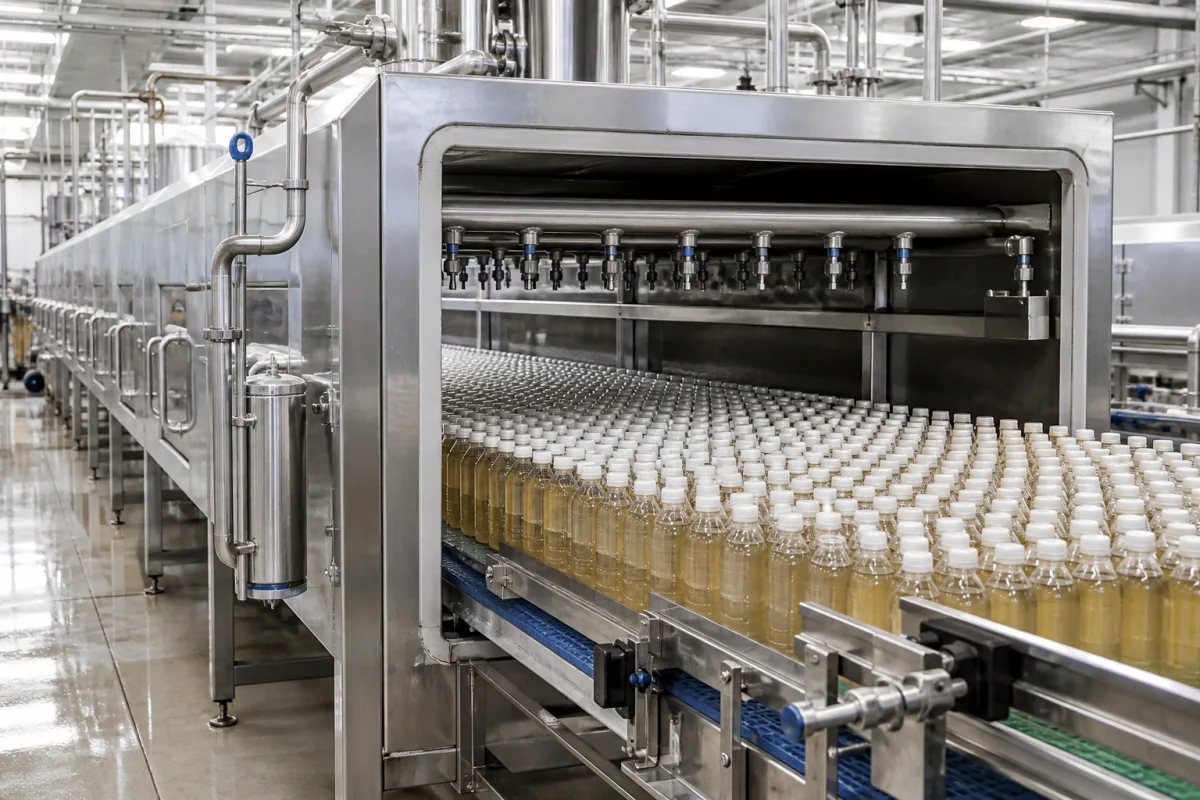
The Holding Section is a specialized zone within the Integrated Beverage Pasteurization and Cooling Tunnel System. Its primary function is to receive the beverage product after it has been heated to the target pasteurization temperature in the heating section. It then maintains this product at that exact, controlled temperature for a specific, calibrated period (the 'hold time'). This sustained exposure is essential for the thermal inactivation of pathogenic and spoilage microorganisms, thereby achieving the required pasteurization effect (e.g., a specific log reduction) without overheating the product, which could negatively impact quality attributes like flavor, color, and nutritional value.
Working Principle
The section utilizes insulated walls and, typically, a controlled environment (e.g., heated air or a water jacket) to minimize heat loss. Beverage containers (bottles, cans, etc.) are conveyed through this enclosed zone at a precisely calculated speed. The combination of the section's length and the conveyor speed determines the exact hold time. Advanced systems employ temperature sensors and feedback loops to the environmental controls to ensure temperature uniformity throughout the section.
Common Materials
Stainless Steel (AISI 304/316), Insulation Material (e.g., mineral wool, polyurethane foam)
Technical Parameters
  • The guaranteed minimum time all product spends within the specified temperature range of the Holding Section. (seconds) Customizable
Components / BOM
  • Insulated Enclosure
    Forms the main body of the section, providing thermal insulation to maintain temperature and structural support.
    Material: Stainless Steel with Insulation Core
  • Temperature Control System
    Monitors and regulates the internal environment temperature via heaters and sensors.
    Material: Stainless Steel, Electronic Components
  • Conveyor Track (within section)
    Transports the beverage containers through the Holding Section at a constant, controlled speed.
    Material: Stainless Steel, Food-Grade Plastic
Engineering Reasoning
72-85°C for 15-30 seconds
Temperature drops below 71.5°C for >5 seconds or exceeds 86°C for >10 seconds
Design Rationale: Thermal inactivation kinetics: Microbial survival probability exceeds 10^-6 when temperature-time product falls below 500°C·s, while protein denaturation occurs above 87°C causing fouling
Risk Mitigation (FMEA)
Trigger Steam control valve hysteresis exceeding 2% of full scale
Mode: Temperature oscillation amplitude >1.5°C at 0.1Hz frequency
Strategy: Cascade PID control with feedforward from flowmeter and temperature gradient compensation
Trigger Plate heat exchanger scaling resistance increase >0.00025 m²·K/W
Mode: Heat transfer coefficient degradation below 2500 W/m²·K
Strategy: Automated CIP system with 2% nitric acid at 65°C for 20 minutes every 8 hours

Industry Taxonomies & Aliases

Commonly used trade names and technical identifiers for Holding Section.

Industrial Ecosystem & Supply Chain DNA

Complementary Systems
Downstream Applications
Specialized Tooling

Application Fit & Sizing Matrix

Operational Limits
pressure: Up to 10 bar (145 psi) maximum operating pressure
flow rate: 5-500 m³/h (22-2200 gpm) depending on configuration
temperature: 70-95°C (158-203°F) typical pasteurization range
slurry concentration: Up to 15% solids by weight, particle size <2mm
Media Compatibility
✓ Beer/wort ✓ Dairy products (milk, cream) ✓ Fruit juices and concentrates
Unsuitable: Highly corrosive chemical solutions (e.g., strong acids, chlorinated compounds)
Sizing Data Required
  • Required flow rate (m³/h or gpm)
  • Target holding time (seconds/minutes)
  • Product viscosity and specific heat capacity

Reliability & Engineering Risk Analysis

Failure Mode & Root Cause
Abrasive erosion
Cause: High-velocity flow of abrasive particles (e.g., sand, scale) in the fluid stream wearing away internal surfaces, particularly at bends, restrictions, or where flow direction changes abruptly.
Cavitation
Cause: Rapid pressure drops below the vapor pressure of the fluid, forming and collapsing vapor bubbles that create localized shock waves and pitting on metal surfaces, often near pumps, valves, or sudden constrictions.
Maintenance Indicators
  • Unusual vibration or audible knocking/thumping noises indicating flow instability, cavitation, or loose internal components.
  • Visible external leaks, corrosion spots, or localized bulging/deformation of the pipe wall suggesting wall thinning or overpressure.
Engineering Tips
  • Implement regular ultrasonic thickness testing at high-wear locations to monitor wall loss and schedule replacements before failure.
  • Optimize flow velocity and minimize sudden directional changes in design to reduce erosion and cavitation risks; consider installing vortex breakers or liners in critical areas.

Compliance & Manufacturing Standards

Reference Standards
ISO 9001:2015 ANSI B4.1 DIN 7150-1
Manufacturing Precision
  • Bore: +/-0.02mm
  • Flatness: 0.1mm
Quality Inspection
  • Dye Penetrant Test
  • Spectrographic Analysis

Factories Producing Holding Section

Verified manufacturers with capability to produce this product in China

✓ 94% Supplier Capability Match Found

S Sourcing Manager from United Arab Emirates Feb 05, 2026
★★★★★
"Reliable performance in harsh Beverage Manufacturing environments. No issues with the Holding Section so far."
Technical Specifications Verified
P Procurement Specialist from Australia Feb 02, 2026
★★★★☆
"Testing the Holding Section now; the technical reliability results are within 1% of the laboratory datasheet. (Delivery took slightly longer than expected, but technical support was excellent.)"
Technical Specifications Verified
T Technical Director from Singapore Jan 30, 2026
★★★★★
"Impressive build quality. Especially the technical reliability is very stable during long-term operation."
Technical Specifications Verified
Verification Protocol

“Feedback is collected from verified sourcing managers during RFQ (Request for Quote) and factory evaluation processes on CNFX. These reports represent historical performance data and technical audit summaries from our B2B manufacturing network.”

17 sourcing managers are analyzing this specification now. Last inquiry for Holding Section from India (1h ago).

Supply Chain Compatible Machinery & Devices

Automated Beverage Filling and Capping Machine

Automated machine for filling and sealing beverage containers at high speed.

Explore Specs →
Automated Beverage Batch Blending System

Automated system for precise multi-ingredient beverage batch preparation.

Explore Specs →
Automated Beverage Container Sterilization System

Automated system for sterilizing beverage containers before filling.

Explore Specs →
Automated Beverage Labeling and Coding System

Integrated system for applying labels and printing codes on beverage containers.

Explore Specs →

Frequently Asked Questions

What is the purpose of a holding section in beverage pasteurization?

The holding section maintains beverages at a precise elevated temperature for a predetermined duration to eliminate harmful microorganisms, ensuring product safety and extending shelf life in compliance with food safety standards.

What materials are used in beverage holding section construction?

Our holding sections are constructed with food-grade stainless steel (AISI 304 or 316 for corrosion resistance) and insulated with materials like mineral wool or polyurethane foam to maintain consistent temperatures and improve energy efficiency.

What components are included in a typical holding section BOM?

A complete holding section includes an insulated enclosure, internal conveyor track for product movement, and an integrated temperature control system with sensors and regulators to maintain precise thermal conditions throughout the holding period.

Can I contact factories directly on CNFX?

CNFX is an open directory, not a transaction platform. Each factory profile provides direct contact information and production details to help you initiate direct inquiries with Chinese suppliers.

Get Quote for Holding Section

Request technical pricing, lead times, or customized specifications for Holding Section directly from verified manufacturing units.

Your business information is encrypted and only shared with verified Holding Section suppliers.

Thank you! Your message has been sent. We'll respond within 1–3 business days.

Need to Manufacture Holding Section?

Connect with verified factories specializing in this product category

Add Your Factory Contact Us
Previous Product
High-Temp Rinse Chamber
Next Product
Human-Machine Interface (HMI)