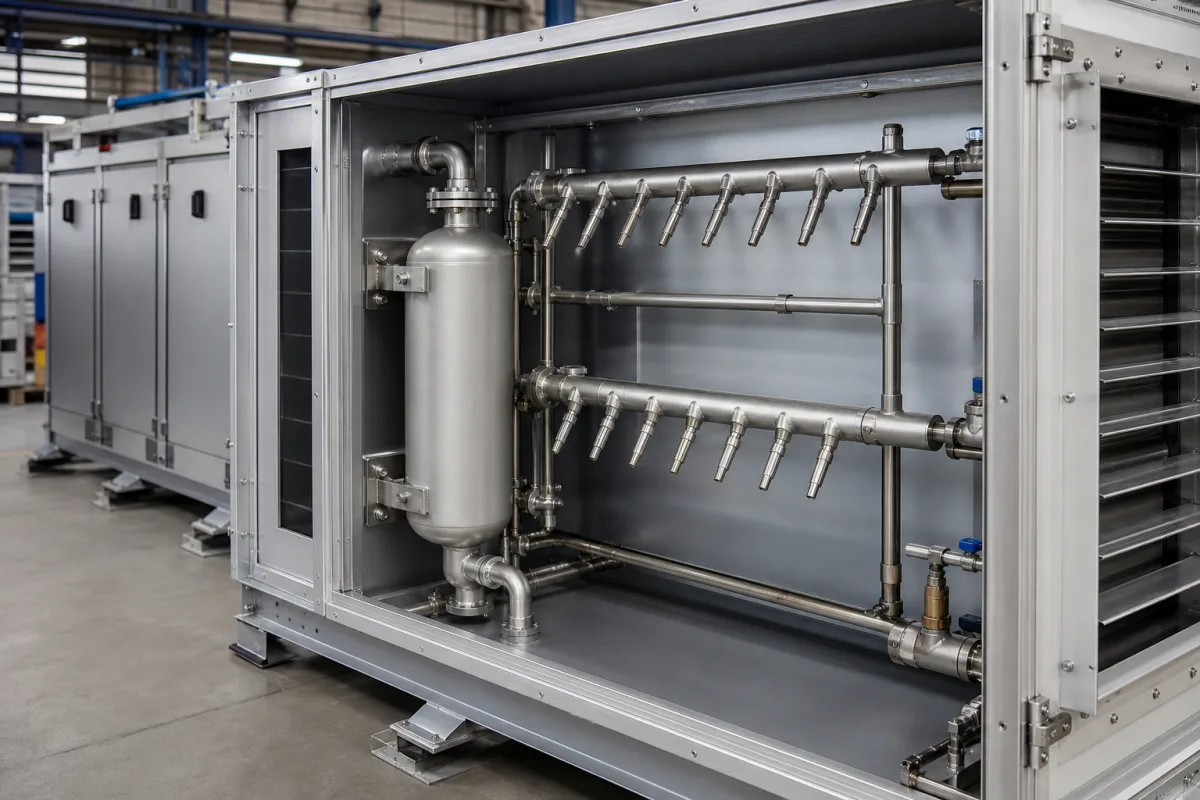
Humidification system for air handling units and industrial spaces
AHU and industrial humidifiers · Load from airflow, absorption distance, water quality by humidifier type, control accuracy
A humidification system adds water vapour to air, either as steam injected through dispersion tubes in an air handling unit or as fine water droplets that evaporate in the duct or directly in the room. Ask three things first: what moisture load in kilograms per hour it must deliver, how far downstream the vapour is fully absorbed before anything can get wet, and what water quality the humidifier type requires.
Steam (isothermal) and spray or atomising (adiabatic) humidifiers for air handling units, ducts and industrial spaces, with their dispersion, water treatment and controls. Dehumidifiers, evaporative coolers sold for cooling only, and portable household humidifiers are outside this page.
CNFX editorial research · Sources checked October 11, 2026 · 4 sources
The University of Michigan's master specification for steam humidifiers (section 23 84 13) asks suppliers to state, at project conditions, the non-wetting (absorption) distance assuming air downstream at 90% RH and 52 °F, the air pressure drop across the humidifier, and the tube orientation for dispersion panels. Humidifiers must preclude wetting of any in-duct surface within the indicated absorption distance, dispersion tubes and manifolds are Type 304 stainless (Type 316 where clean steam is used), and components are rated for at least 100 psig steam. [1]
For packaged electric units it requires electrode humidifiers that monitor conductivity and drain and flush automatically to control within ±5% RH, and resistance-element humidifiers using reverse-osmosis or deionised water of 50 µmho or less to control within ±3% RH, with an over-temperature safety switch. [1]
Editorial calculation: moisture load is dry-air mass flow times the rise in humidity ratio. An air handler moving 10,000 m³/h of air at about 1.2 kg/m³ carries 12,000 kg/h; raising its humidity ratio by 4 g/kg needs 12,000 × 0.004 = 48 kg/h of water. 52 °F is about 11.1 °C. Air flow, density and humidity rise are assumed examples; take design values from psychrometric calculation. [1]
Give the supplier the airflow and its winter design condition, target room or supply humidity, available duct or AHU section length after the humidifier, steam or water and air supplies, water analysis (conductivity, hardness, silica, chloride), required control accuracy, hygiene requirements, and power supply.
02
Match water quality to the humidifier type
Condair's water treatment guide warns that water safe to drink may still cause scaling, bacterial build-up or dusting. For boiling (isothermal) systems treatment prevents scaling and cuts maintenance; for adiabatic systems it prevents scaling and corrosion of media and nozzles, dusting from carried-over particles, and bacteria carried into the air. [2]
Its quick guide gives conductivity windows by product: 150–1,200 µS/cm on potable water for its EL electrode steam series, 1–1,500 µS/cm for its RS series, 0.5–15 µS/cm for its DL series on RO-DI water, and under 650 µS/cm for its ME/MC series, with limits for hardness, silica and chloride, and microbial limits from under 100 to under 1,000 CFU/ml. Condair offers RO systems and hygiene features such as disinfectant dosing, UV and silver ions. [2]
The linked supplier's dry-fog humidifier mixes compressed air and water in an impinging nozzle to produce droplets of 5–7.5 µm, spraying 2.4 L/h per nozzle at 0.3 MPa air pressure over about 30–60 m² per nozzle. [3] Editorial calculation: the 48 kg/h example above would need about 48 / 2.4 = 20 such nozzles if done by direct-space dry fog. [3]
03
Check electrode steam humidifier capacity, voltage and enclosure
DriSteem, a US humidifier maker, lists its XT Series electrode steam humidifiers with steam capacities from 5 to 250 lb/h (2 to 113 kg/h). The range is built from two-electrode models (XTP002 for 120–240 V; XTP003 and XTP006 for 208–600 V), three-electrode models up to XTP010 at 480–600 V, six-electrode models from XTP010 (208–240 V) to XTP048, and six-electrode dual-cylinder models XTP050 to XTP096. Steam is delivered through an Ultra-sorb Model XV dispersion panel, a Rapid-sorb dispersion tube system, a single dispersion tube or an XT steam blower, under a Vapor-logic controller with automatic drain and fill events set by water type. An outdoor enclosure for mounting on an air handler or exterior wall is NEMA 3R rated and CSA/ETL certified, made of 14- and 18-gauge G-90 galvanised steel, with a heating package for −40 °C to 50 °C. [4]
Editorial calculation: the 48 kg/h moisture load worked out above falls inside the 2–113 kg/h range of this series, so a single electrode unit or a dual-cylinder model could cover it, while the largest unit at 113 kg/h would replace about 47 of the 2.4 L/h dry-fog nozzles listed above. [4][3]
Editorial note: Condair's guide gives a 150–1,200 µS/cm conductivity window on potable water for its EL electrode series, and the University of Michigan specification requires electrode units to monitor conductivity and drain and flush automatically; ask the supplier for the conductivity window and drain water volume at your water quality. [1][2]
Compressed-air dry-fog humidifiers from the linked supplier
The listing reviewed offers compressed-air dry-fog humidifiers for direct-space industrial humidification, with optional humidity control; ask for nozzle capacity, droplet size, air consumption and water treatment for the exact model.
05
Steam generator, dispersion tubes, steam valve, water treatment and drain cycle
Capacity, control accuracy, water conductivity and section length for a humidifier order
Capacity comes from your own airflow and humidity rise, as in the 48 kg/h example above; the accuracy, pressure and stainless grades are the University of Michigan's purchasing requirements, and the conductivity windows are Condair's for its own series.
Field
What it means and published values
Ask the supplier for
Humidification capacity (kg/h)
Airflow × humidity-ratio rise.
Capacity at design.
Operating pressure (MPa)
Steam components ≥100 psig; dry-fog air 0.3 MPa. [1][3]
1 company lists this product among what they make. Company figures are quoted from each
company's own website; every card states where the relationship came from.
Dongguan Mistec Spraying
Manufacturing site to be confirmed for the order
Lists compressed-air dry-fog humidifiers for industrial humidification, anti-static and dust control.
Explore company information and manufacturing capabilities, then discuss the scope of your project with a relevant supplier.
Share this page
Compiled and source-reviewed by the CNFX editorial team.
Each manufacturer above links to the page on that company's own website where the product is listed, with the date we checked it. How we source and review
· Page last updated 13 October 2026
Buyer questions
What is humidifier absorption distance?
The distance downstream within which no in-duct surface may get wet; Michigan's specification asks for it at 90% RH and 52 °F. [1]
What water does a humidifier need?
It depends on type; Condair's guide ranges from 0.5–15 µS/cm for its RO-DI series to 150–1,200 µS/cm for electrode steam. [2]
How accurately can humidifiers control RH?
Michigan's specification requires ±5% RH for electrode units and ±3% RH for resistance units on RO or DI water. [1]
How fine is dry fog?
The linked supplier states 5–7.5 µm droplets from its compressed-air nozzles. [3]
How much steam can one electrode humidifier make?
DriSteem lists its XT Series electrode humidifiers from 5 to 250 lb/h (2 to 113 kg/h), using two-, three- or six-electrode cylinders and dual-cylinder models at the top of the range. [4]
Sources and what still needs a direct check
Sources checked 2026-10-11. The University of Michigan specification is an owner's purchasing standard; Condair and DriSteem are humidifier makers describing their own products; Mistec is the linked supplier. Figures are those documents' requirements, not general limits.