Industry-Verified Manufacturing Data (2026)

Human-Machine Interface Panel

Based on aggregated insights from multiple verified factory profiles within the CNFX directory, the standard Human-Machine Interface Panel used in the Machinery and Equipment Manufacturing sector typically supports operational capacities ranging from standard industrial configurations to heavy-duty production requirements.

Technical Definition & Core Assembly

A canonical Human-Machine Interface Panel is characterized by the integration of Touchscreen Display and Processor Board. In industrial production environments, manufacturers listed on CNFX commonly emphasize Polycarbonate or Acrylic (front bezel/screen) construction to support stable, high-cycle operation across diverse manufacturing scenarios.

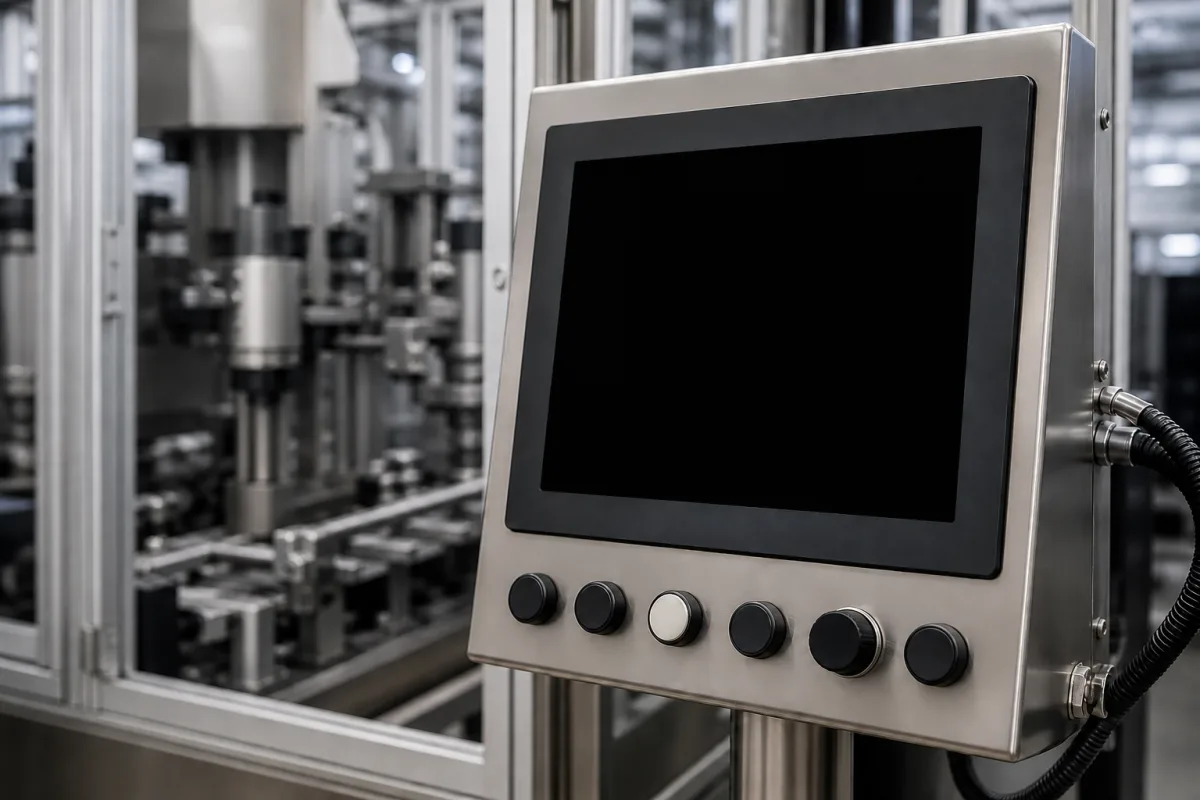
A control interface panel that enables operators to monitor and interact with industrial machinery and processes within a centralized control system.
Product Specifications

Technical details and manufacturing context for Human-Machine Interface Panel

Definition
The Human-Machine Interface (HMI) Panel is a critical component of a Centralized Control System, serving as the primary point of interaction between human operators and automated machinery or processes. It typically consists of a display screen (touchscreen or with physical buttons) and input devices that present real-time data, system status, alarms, and process variables. Operators use the HMI Panel to issue commands, adjust setpoints, acknowledge alarms, and oversee the overall operation, facilitating efficient monitoring and control from a centralized location.
Working Principle
The HMI Panel functions by receiving data from various sensors, controllers (like PLCs), and other system components via communication protocols (e.g., Ethernet/IP, Modbus, Profibus). It processes this data to render graphical representations (mimics, trends, dashboards) on its display. User inputs (touches, button presses) are captured, translated into control commands, and transmitted back to the controllers to execute actions like starting/stopping motors, adjusting valves, or changing process parameters, thereby closing the control loop between the operator and the machinery.
Common Materials
Polycarbonate or Acrylic (front bezel/screen), Aluminum or Steel (enclosure/chassis), Electronic components (PCB, display module, touch sensor)
Technical Parameters
  • Display screen diagonal size (e.g., 7", 10", 15") (inch) Standard Spec
Components / BOM
  • Touchscreen Display
    Provides visual output of process data and graphical interface; accepts touch input from the operator.
    Material: Glass with capacitive or resistive sensor layer
  • Processor Board
    Executes the HMI software, processes data for display, and handles communication with controllers.
    Material: Fiberglass PCB with embedded CPU, memory chips
  • Communication Interface Module
    Manages physical and protocol-level communication with external PLCs, sensors, and networks.
    Material: Fiberglass PCB with communication chips (Ethernet, serial)
  • Front Bezel/Enclosure
    Protects internal components, provides mounting, and defines the panel's front appearance and durability.
    Material: Polycarbonate or aluminum
Engineering Reasoning
0-60°C ambient temperature, 20-80% relative humidity non-condensing, 85-264 VAC input voltage, 47-63 Hz frequency
Ambient temperature exceeding 70°C for >30 minutes, relative humidity >95% for >1 hour, input voltage exceeding 300 VAC or dropping below 70 VAC, touchscreen capacitive sensing deviation >15% from calibrated baseline
Design Rationale: Thermal expansion mismatch between LCD glass (CTE 8.5×10⁻⁶/K) and aluminum bezel (CTE 23.1×10⁻⁶/K) causing delamination, moisture ingress exceeding IPC-A-610 Class 3 limits leading to dendritic growth on 0.4 mm pitch PCB traces, electrolytic capacitor electrolyte evaporation at Arrhenius acceleration factor of 2.0 per 10°C above 85°C
Risk Mitigation (FMEA)
Trigger Backlight LED driver current exceeding 120% of rated 350 mA for >100 ms due to PWM controller feedback loop oscillation at 150 kHz resonance
Mode: LED thermal runaway causing junction temperature >150°C, resulting in phosphor layer degradation and luminance drop below 200 cd/m²
Strategy: Implement current foldback protection with 100 ms response time, add ferrite bead filters on driver outputs to suppress 100-200 kHz oscillations, use thermal epoxy with 8 W/m·K conductivity for LED mounting
Trigger Touchscreen controller IC experiencing latch-up from ESD events exceeding 8 kV contact discharge per IEC 61000-4-2, due to insufficient guard ring spacing of 0.25 mm in 180 nm CMOS process
Mode: Controller drawing >500 mA quiescent current causing local heating to 125°C, permanent loss of touch coordinate accuracy beyond ±2 mm tolerance
Strategy: Implement TVS diodes with 5 pF capacitance and 3.3 V clamping voltage at all I/O ports, add 1.5 mm guard ring spacing in IC layout, incorporate watchdog timer resetting controller after 50 ms of abnormal current draw

Industry Taxonomies & Aliases

Commonly used trade names and technical identifiers for Human-Machine Interface Panel.

Applied To / Applications

This component is essential for the following industrial systems and equipment:

Industrial Ecosystem & Supply Chain DNA

Complementary Systems
Downstream Applications
Specialized Tooling

Application Fit & Sizing Matrix

Operational Limits
pressure: N/A (panel is not in direct contact with process media)
other spec: IP65/NEMA 4X ingress protection, 24V DC power input, 10-90% non-condensing humidity
temperature: -20°C to +70°C
Media Compatibility
✓ Clean control room environments ✓ Factory floors with moderate dust ✓ Areas with washdown requirements
Unsuitable: Explosive atmospheres (ATEX Zone 0/1) without additional certification
Sizing Data Required
  • Panel mounting cutout dimensions
  • Required communication protocols (e.g., Ethernet/IP, Profinet, Modbus)
  • Number and type of operator inputs needed (touchscreen size, physical buttons, emergency stop)

Reliability & Engineering Risk Analysis

Failure Mode & Root Cause
Touchscreen Degradation
Cause: Repeated mechanical stress from user interactions, environmental contaminants (dust, oils), and UV exposure leading to delamination, dead zones, or unresponsive areas.
Electronic Component Failure
Cause: Thermal cycling, power surges, or moisture ingress causing capacitor leakage, solder joint fatigue, or integrated circuit malfunction, often exacerbated by inadequate ventilation or improper power supply filtering.
Maintenance Indicators
  • Intermittent screen flickering, ghost touches, or complete unresponsiveness during operation.
  • Audible buzzing or humming from the panel enclosure, or visible discoloration/burning smell indicating overheating or electrical arcing.
Engineering Tips
  • Implement regular cleaning with manufacturer-approved, non-abrasive solutions and soft cloths to prevent contaminant buildup, and install protective screen films or enclosures in harsh environments.
  • Ensure proper environmental control (stable temperature/humidity), use surge protectors or uninterruptible power supplies, and perform periodic infrared thermography scans to detect early-stage overheating components.

Compliance & Manufacturing Standards

Reference Standards
ISO 9241-210:2019 (Ergonomics of human-system interaction) ANSI/ISA-101.01-2015 (Human Machine Interfaces for Process Automation Systems) DIN EN 614-1:2006 (Safety of machinery - Ergonomic design principles)
Manufacturing Precision
  • Touchscreen alignment: +/-0.5mm
  • Button actuation force: 1.5N +/-0.2N
Quality Inspection
  • IP Rating (Ingress Protection) test
  • Electromagnetic Compatibility (EMC) test

Factories Producing Human-Machine Interface Panel

Verified manufacturers with capability to produce this product in China

✓ 93% Supplier Capability Match Found

P Project Engineer from Germany Feb 22, 2026
★★★★★
"Impressive build quality. Especially the technical reliability is very stable during long-term operation."
Technical Specifications Verified
S Sourcing Manager from Brazil Feb 19, 2026
★★★★★
"As a professional in the Machinery and Equipment Manufacturing sector, I confirm this Human-Machine Interface Panel meets all ISO standards."
Technical Specifications Verified
P Procurement Specialist from Canada Feb 16, 2026
★★★★★
"Standard OEM quality for Machinery and Equipment Manufacturing applications. The Human-Machine Interface Panel arrived with full certification."
Technical Specifications Verified
Verification Protocol

“Feedback is collected from verified sourcing managers during RFQ (Request for Quote) and factory evaluation processes on CNFX. These reports represent historical performance data and technical audit summaries from our B2B manufacturing network.”

16 sourcing managers are analyzing this specification now. Last inquiry for Human-Machine Interface Panel from Turkey (1h ago).

Supply Chain Compatible Machinery & Devices

Heavy-Duty CNC Plasma Cutting Machine

Industrial machine for precision metal cutting using plasma arc technology

Explore Specs →
Automated Assembly Line System

Integrated production system for sequential component assembly operations

Explore Specs →
Automated Powder Coating System

Integrated industrial system for applying dry powder coatings to metal substrates.

Explore Specs →
Centrifugal Pump Impeller

Rotating component that transfers energy to fluid in centrifugal pumps.

Explore Specs →

Frequently Asked Questions

What materials are used in the construction of this HMI panel?

The panel features a durable polycarbonate or acrylic front bezel/screen, an aluminum or steel enclosure/chassis for protection, and high-quality electronic components including PCB, display module, and touch sensor for reliable operation in industrial environments.

What are the key components included in this HMI panel?

The main components are a responsive touchscreen display, a powerful processor board for data processing, communication interface modules for system integration, and a robust front bezel/enclosure that protects against dust, moisture, and physical impacts in manufacturing settings.

How does this HMI panel improve machinery operation in manufacturing?

This panel provides centralized control and real-time monitoring of industrial machinery and processes, allowing operators to efficiently interact with equipment, visualize process data, and make adjustments through an intuitive touchscreen interface, reducing downtime and improving productivity.

Can I contact factories directly on CNFX?

CNFX is an open directory, not a transaction platform. Each factory profile provides direct contact information and production details to help you initiate direct inquiries with Chinese suppliers.

Get Quote for Human-Machine Interface Panel

Request technical pricing, lead times, or customized specifications for Human-Machine Interface Panel directly from verified manufacturing units.

Your business information is encrypted and only shared with verified Human-Machine Interface Panel suppliers.

Thank you! Your message has been sent. We'll respond within 1–3 business days.

Need to Manufacture Human-Machine Interface Panel?

Connect with verified factories specializing in this product category

Add Your Factory Contact Us
Previous Product
Human-Machine Interface (HMI) Touchscreen
Next Product
Humidification System