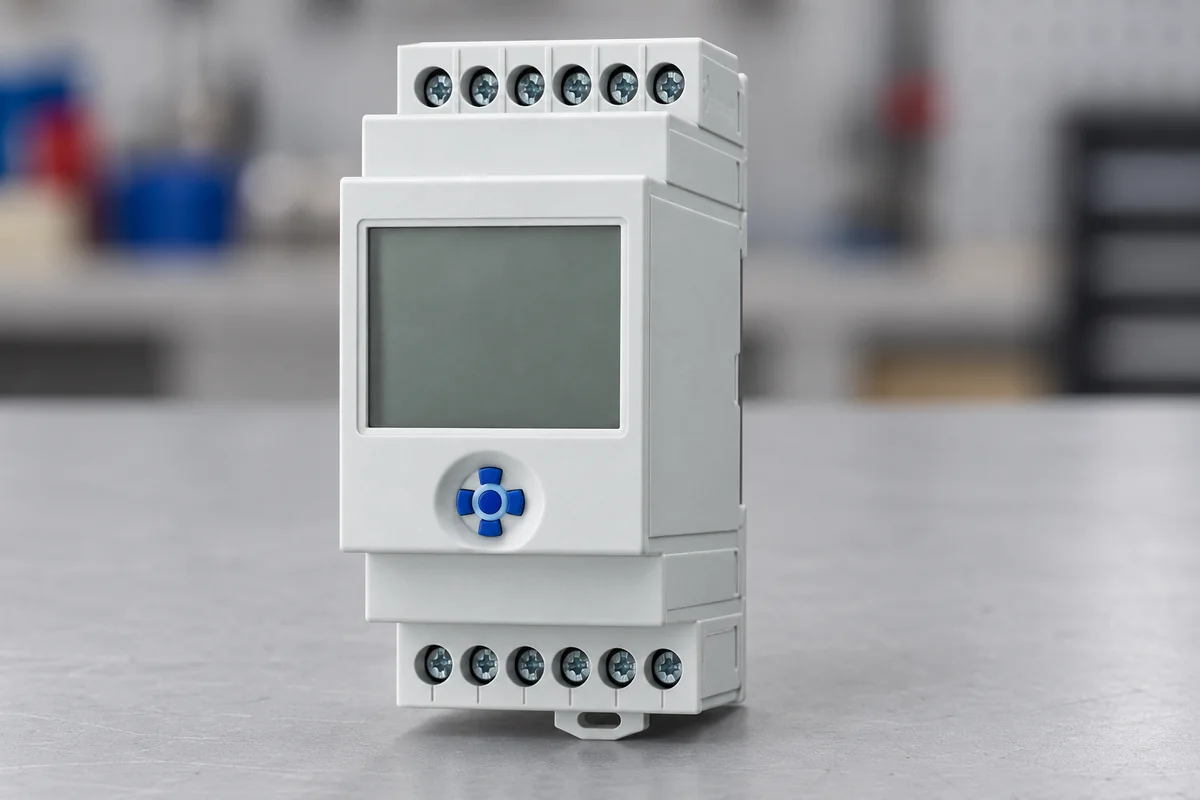
Industrial timer controller (time relay and digital time switch)
Industrial timers · Time-delay relays (on-delay, off-delay, interval, one-shot, cycle) and programmable digital time switches, timing range and accuracy, supply voltage, contact rating, programs and power reserve
Industrial timers control when equipment switches: a time-delay relay starts timing from a control signal and switches its contact after a set delay or in a set pattern, while a digital time switch follows a stored clock schedule to run lighting, pumps or ventilation. Ask three things first: which timing function and range the circuit needs, what supply voltage and load the contacts must switch, and how accurate and how well backed-up against power loss the timing must be.
Electronic and digital time-delay relays and programmable time switches for control panels and building or process equipment, DIN-rail, socket or panel mounted. PLC timer functions, mechanical clocks for household use and safety relays are outside this page except where compared.
CNFX editorial research · Sources checked October 12, 2026 · 4 sources
Shenler describes timer relay functions: on-delay (the load switches on a set time after the relay is energised), off-delay (the load switches off a set time after the relay is de-energised), interval (alternating on and off periods), one-shot (the load runs for a set time after energising, regardless of how long the input lasts) and cycle (repeating set on and off periods). It lists timer relays for 24–230 V AC/DC with timing ranges from 0.1 s to 30 min and a timing IC giving ±2% accuracy, with a choice of mounting options. [1]
Editorial calculation: ±2% is ±0.2 s on a 10 s setting and ±36 s on a 30 min setting; if a process needs tighter timing at long settings, ask for a timer with a finer range or better accuracy. [1]
OMRON's H3DT family shows how one DIN-rail timer series splits by function. All models are analog, 17.5 mm wide, DIN-rail mounted with push-in terminals and relay output, and the family lists 18 operating modes, among them ON delay (power-on or signal start), OFF delay (signal), interval, flicker ON or OFF start, one-shot output, cumulative ON delay and interval, and instantaneous operation. The multifunction, extended-multifunction and on-delay models cover 0.1 s to 1,200 h with 1 or 2 SPDT contacts at 5 A on 24–240 VAC/DC; the twin and star-delta models list 1–120 s, and the power-OFF-delay models 0.1–12 s or 1–120 s on 24–48 VAC/DC. [3]
Editorial calculation: 1,200 h is 4,320,000 s, so a 0.1 s to 1,200 h timer spans a 43,200,000 : 1 range across its range switch; ask which sub-range your setting falls in, because dial accuracy is stated against the selected range. [3]
Editorial note: draw the timing diagram the circuit needs (input, output, delay) and send it with the request, since function names vary between makers.
Give the supplier the timing function (on-delay, off-delay, interval, one-shot, cycle, schedule), time range and setting resolution, accuracy, supply voltage (AC/DC), contact type and rating with load type, number of outputs, mounting (DIN rail, socket, panel), display and programming method, power reserve, operating temperature, and certifications.
02
Match supply, load and power reserve
VIOX describes a digital timer switch as opening or closing an output according to stored daily, weekly, pulse, cycle or other programs to automate lighting, pumps, ventilation and process auxiliaries, and says selection depends on supply voltage, contact and load duty, number of outputs, shortest switching interval, program capacity, power reserve, mounting and whether an interposing contactor is needed. Its published models include DIN-rail, panel and screw-mounted switches for 12/24/48 V AC/DC or 110–240 V AC, contacts of 16 A resistive (8 A inductive) up to 25–30 A, 8 to 18 on/off programs, and battery backup described as up to or more than 60 days of reserve, or a 5-year lithium battery. [2]
Editorial note: a 16 A resistive contact rated 8 A inductive should not switch a motor or other inductive load at 16 A; size the timer's contact for the load type or use it to drive a contactor, as VIOX's selection notes suggest. [2]
03
Check contact life, DC breaking capacity and repeatability
Finder's 80 Series data sheet (IX-2025) gives full figures for 17.5 mm modular timers on 35 mm rail. The single-function 80.11 (on-delay), 80.21 (interval) and 80.41 (off-delay with control signal) have six time scales from 0.1 s to 24 h — 0.1–2 s, 1–20 s, 0.1–2 min, 1–20 min, 0.1–2 h and 1–24 h — and a 1 CO (SPDT) AgNi contact rated 16 A (30 A peak) at 250 V AC, 4,000 VA AC1, 750 VA AC15 at 230 V, 0.55 kW for a single-phase motor, and DC1 breaking of 16 A at 24 V, 0.3 A at 110 V and 0.12 A at 220 V, with a 500 mW (10 V/5 mA) minimum load. Supply is 24–240 V AC/DC (16.8–265 V operating) at under 1.8 VA or 1 W. Repeatability is ±1%, setting accuracy over the full range ±5%, recovery time 100 ms, minimum control impulse 50 ms (80.41), electrical life 50,000 cycles at rated AC1 load, ambient −20 to +60 °C and protection IP20. The multi-function 80.71 with a 1 A solid-state output lists an electrical life of 100 million cycles at −20 to +50 °C. [4]
Editorial calculation: 50,000 cycles at one switching a minute lasts about 830 hours (35 days), while 100 million solid-state cycles at the same rate last about 190 years, so frequent cycling of a small load favours a solid-state output; the 16 A contact breaks only 0.3 A at 110 V DC, so DC loads need checking separately. The ±5% setting accuracy is on the dial and the ±1% repeatability on the result, so set the timer against a stopwatch once installed. [4][1]
Suppliers linked to this page list timer relays or time switches; each card links to the page reviewed.
The suppliers reviewed list timer relays and time switches with other relays and low-voltage controls; ask each for timing functions and ranges, accuracy and repeat accuracy, contact ratings by load type, power reserve, mounting and certifications.
05
Trace the timer parts
This is a functional reference built from the sources cited; it is not one maker's design.
Fill the specification fields with values for your circuit
A timer quotation needs values for your circuit. The table explains each field, gives published values where a reviewed source states them, and says what to obtain from the supplier.
Field
What it means and published values
Ask the supplier for
Timing Function
E.g. on-delay, off-delay, interval, one-shot, cycle; 18 modes in one family. [1][3]
Function list.
Time Range
E.g. 0.1 s–30 min; 0.1 s–1,200 h; 0.1–12 s off-delay. [1][3]
Ranges; resolution.
Accuracy
E.g. ±2%; repeatability ±1%, setting accuracy ±5% full range. [1][4]
Explore company information and manufacturing capabilities, then discuss the scope of your project with a relevant supplier.
Share this page
Compiled and source-reviewed by the CNFX editorial team.
Published product pages show what a company offers, not tested performance. Confirm the legal seller, factory and scope for your order. How we source and review
· Page last updated 13 October 2026
Buyer questions
What is the difference between on-delay and off-delay timers?
Shenler describes on-delay as switching the load on a set time after energising, and off-delay as switching it off a set time after de-energising. [1]
How accurate are timer relays?
Shenler lists ±2% for its timer relays; at a 30 min setting that is ±36 s. [1]
Can a digital time switch drive a motor directly?
Check the contact rating for inductive loads; VIOX lists 16 A resistive but 8 A inductive on some models and notes when an interposing contactor is needed. [2]
What time range can one DIN-rail timer cover?
OMRON lists its H3DT multifunction timers at 0.1 s to 1,200 h in a 17.5 mm DIN-rail housing with 5 A SPDT contacts on 24–240 VAC/DC. [3]
How many switching cycles does a timer relay last?
One maker lists 50,000 cycles at rated AC1 load for its 16 A relay-output timers and 100 million cycles for a 1 A solid-state-output version. [4]
Sources and what still needs a direct check
Sources checked 2026-10-12. Shenler, VIOX and OMRON describe their own timers; national standards for time relays (for example IEC 61812-1) are not freely available.