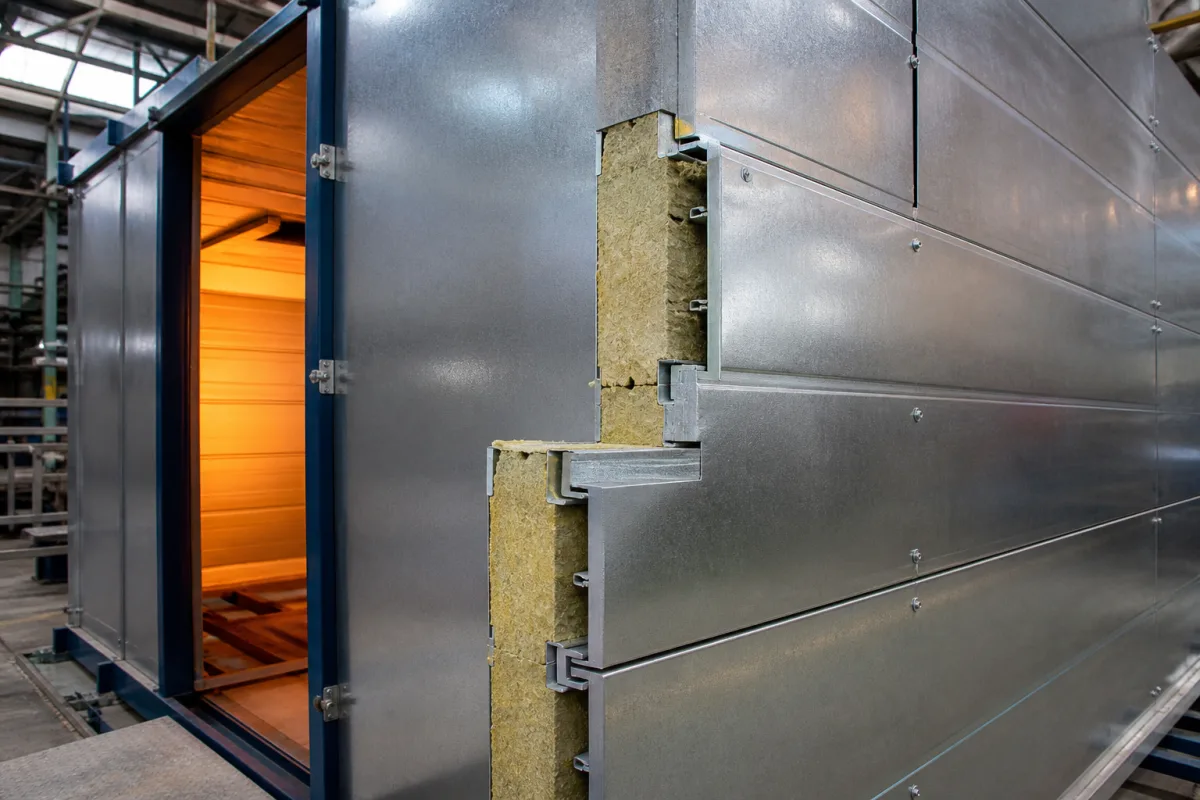
Wall panels for heated chambers and industrial ovens
The chamber in the illustration is built from galvanized steel panels with a mineral wool core, cut away to show the core and the tongue-and-groove joints, with the inside glowing hot through an open door. Cold-room panels are chosen for U-value and fire class at room temperature. A heated chamber adds three problems: the core conducts more heat as it gets hotter, the outer skin has to stay safe to touch, and the inner skin grows when the oven heats up while the outer one does not.
Covers insulated wall and roof panels that form the enclosure of heated chambers, drying and curing ovens and heat-treatment rooms: mineral wool core conductivity against temperature and maximum service temperature, wall thickness against heat loss and outer-skin temperature, differential expansion between hot and cold skins and how panels allow it, thermal bridging through frames and ties, and enclosures built around ovens. Sandwich panels for cold rooms and general enclosures, EN 14509 and reaction to fire are on Insulated sandwich panels; welded insulated housings for spiral freezers are on Insulated enclosure for spiral freezers.
CNFX editorial research · Sources checked October 13, 2026 · 3 sources
ROCKWOOL's data sheet for ProRox SL 960, a 100 kg/m³ rigid slab for intermediate temperatures, gives conductivity against mean temperature.
Conductivity at 300 °C is about twice the 50 °C value (0.081 against 0.039, Editorial calculation), so a U-value quoted at room temperature understates heat loss from a hot wall. The sheet gives a maximum service temperature of 660 °C to EN 14706 and 600 °C to ASTM C411, Euroclass A1 reaction to fire, and leachable chloride of 10 ppm or less, which matters where the core touches stainless steel.
Panel Built's enclosure around industrial ovens for Valiant Machine & Tool used a different core, Conrock 60 mineral wool, between 26-gauge galvanized steel skins: 3¾ in thick panels with an R-value of 13 and STC 32. That was a room around the ovens, not the oven wall itself.
Mean temperature
λ (W/m·K)
50 °C
0.039
100 °C
0.045
150 °C
0.052
200 °C
0.060
250 °C
0.071
300 °C
0.081
400 °C
0.107
500 °C
0.140
600 °C
0.175
Use λ at the wall's mean temperature, not at 10 or 23 °C. R-13 (imperial) is about 2.3 m²K/W and 3¾ in about 95 mm (Editorial calculation). Ask for the core grade's λ curve and maximum service temperature.
02
Wall thickness and the outer skin
The oven-panel patent US 4,198,951 (Ellison and Whike) frames the target: ovens for solvent removal and coating drying on metal strip may run at 300 to 400 °C, while some factory codes require the outside oven wall to stay below about 35 °C.
Heat flow through the core is λ × (inside − outside temperature) ÷ thickness, with λ taken at the mean core temperature. For a 300 °C chamber and a 35 °C outer face, the mean is about 167 °C, where SL 960's λ is about 0.055 W/m·K.
That heat has to leave the outer skin to the room. With an assumed surface coefficient of 10 W/m²K, 145 W/m² needs the skin about 14 to 15 K above room air, so a 20 °C room gives a skin near 35 °C; doubling the thickness halves the flow and the skin rise.
Core thickness (300 °C inside, 35 °C outer face)
Heat flow through the core
Outer skin above room air (h = 10 W/m²K assumed)
100 mm
≈145 W/m²
≈14.5 K
150 mm
≈97 W/m²
≈9.7 K
200 mm
≈73 W/m²
≈7.3 K
Editorial calculation that ignores joints, frames and penetrations, which add heat flow. The surface coefficient is an assumption. Ask the supplier for a heat-loss and outer-skin-temperature calculation at your operating temperature, including frames.
03
Differential expansion and thermal bridges
US 4,198,951 explains that the temperature gradient through an oven wall makes the inner and outer parts expand and contract by different amounts, above all during start-up and shut-down, so the structure has to accommodate it. Its modular panel has an inner and an outer angle-iron frame, each with its own skin, held apart by tie members of limited resiliency that minimise heat conduction while allowing some relative movement. Each skin projects past one side of its frame so that, with panels placed side by side, the skins overlap the neighbouring frame and can slide telescopically over it as they expand.
Insulation is packed between adjacent side frames during erection for continuity, roof panels sit on wall panels with flanges that are not fastened to them so the roof can move, and the patent describes a layered core of high-temperature insulation on the hot side with a cheaper mineral wool of lower temperature rating outside it.
The illustration's tongue-and-groove galvanized panels show the opposite approach, a continuous metal joint from inside to outside; at oven temperatures each such joint is a thermal bridge and a place where the hot skin pushes against the cold one.
Feature (US 4,198,951)
Purpose
Separate inner and outer frames joined by resilient ties
Limit conduction; allow relative movement
Skins overlapping the neighbouring frame
Telescopic sliding on expansion
Insulation between adjacent frames
Continuity across joints
Roof flanges not fastened to walls
Free movement of the roof
High-temperature layer inside, mineral wool outside
Cheaper core where temperatures are lower
The reading of the illustration's joints is editorial. Ask how the panel allows inner-skin growth, what connects the inner and outer skins, and the heat loss through joints and frames.
04
What to give a panel supplier for a heated chamber
Paste it into your enquiry below or into an email to a maker, then replace every bracket.
State the maximum and normal operating temperature, heat-up and cool-down rates, the outer-skin temperature limit, room temperature, chamber dimensions and openings, and any solvent or corrosive atmosphere. Ask for the core grade with λ at mean temperature and maximum service temperature, panel thickness, skin materials, how inner and outer skins are joined and allowed to move, a heat-loss and outer-skin calculation including joints, and fire classification.
1 company lists this product among what they make. Company figures are quoted from each
company's own website; every card states where the relationship came from.
Suzhou Porshseal UPVC Windows Co.,Ltd.
TBC
Porshseal's site lists insulated wall panels alongside insulated cabins and blast-resistant buildings; ask for the core grade's maximum service temperature and how the panels handle a heated interior.
Explore company information and manufacturing capabilities, then discuss the scope of your project with a relevant supplier.
Share this page
Compiled and source-reviewed by the CNFX editorial team.
Each manufacturer above links to the page on that company's own website where the product is listed, with the date we checked it. How we source and review
· Page last updated 13 October 2026
Buyer questions
Does mineral wool insulate as well when hot?
No: ROCKWOOL's ProRox SL 960 rises from 0.039 W/m·K at 50 °C to 0.081 at 300 °C and 0.175 at 600 °C. [1]
How cool must an oven's outer wall be?
US 4,198,951 notes that some factory codes require the outside oven wall to stay below about 35 °C for ovens running at 300–400 °C. [2]
Why do oven wall panels need to slide?
The inner skin expands more than the outer one during start-up and shut-down; the patent's panels overlap neighbouring frames and use resilient ties so the skins can move telescopically. [2]
What panel was used to enclose industrial ovens in one project?
Panel Built used 3¾ in panels with Conrock 60 mineral wool between 26-gauge galvanized skins, R-13 and STC 32, for a room around the ovens. [3]
Sources and what still needs a direct check
Sources checked 2026-10-13. An insulation maker's data sheet, an oven-panel patent and a modular-construction association's project case study.